Quebec tables reform of public sector negotiation system

Posted April 23, 2025 11:38 am.
Last Updated April 23, 2025 5:05 pm.
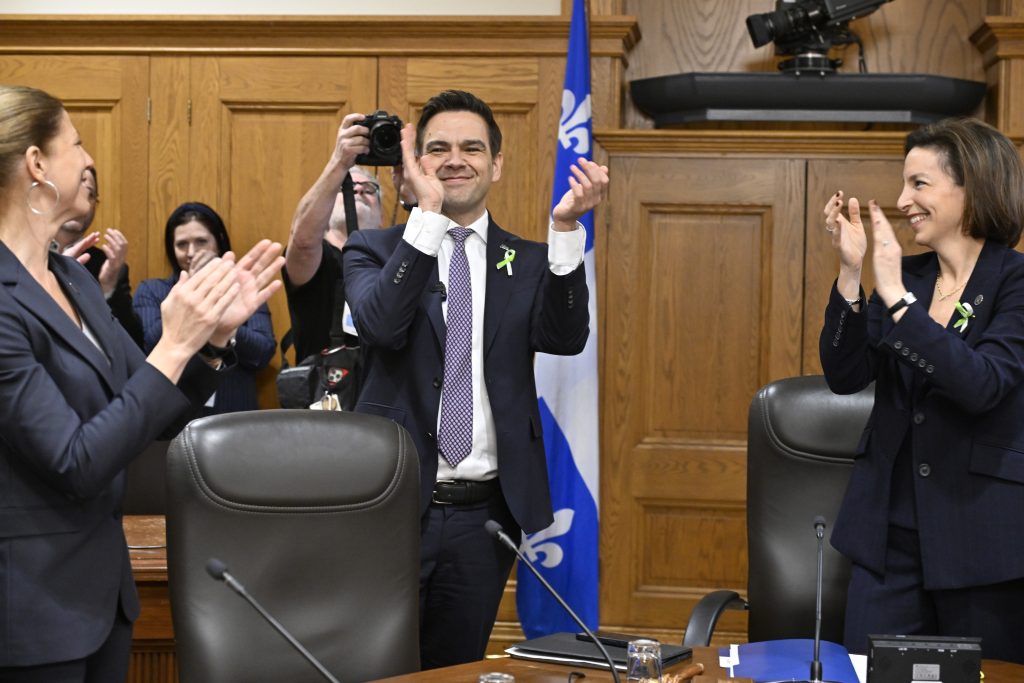
Quebec tabled its reform of the negotiation system in the public and parapublic sectors on Wednesday. And, far from alienating the unions involved, they are welcoming it.
Sonia LeBel, President of the Treasury Board and Minister Responsible for Government Administration, is streamlining the negotiation process, particularly by bringing so-called local matters back to the national level.
At a press conference, the Minister emphasized that it is not so much the number of bargaining tables that complicates the process as the complexity of the different levels of negotiation, at which certain clauses can be negotiated and others not.
In the education sector, for example, there are currently 210 local collective agreements. During the last negotiations for the 2023-2028 collective agreements, “we first had to negotiate the right to negotiate” certain matters at the national level, the Minister lamented.
By bringing local issues back to the national level, this will also allow for more consistency in the assessment of all working conditions, including wages, vacations, leave, pension plans, and schedules, she argued. Currently, “these issues are handled at different levels,” she emphasized.
No forced union mergers
The reform no longer requires union accreditation mergers in the health sector, with only one per job category, as Health Minister Christian Dubé’s plan had planned.
And the Dubé plan also added two more job categories to the four existing ones, for which unions would have had to campaign to represent them.
Bill 100 also amends the Labour Code to eliminate the maximum duration of collective agreements in this sector. Moreover, the last negotiation led to the adoption of five-year collective agreements, whereas previously, the term had been three years.
Well received
Interviewed separately, the leaders of the CSQ, CSN, and FTQ welcomed the bill, noting that the Legault government had not, this time, chosen the path of confrontation, as with Labour Minister Jean Boulet’s Bill 89, which limits the right to strike.
CSN Vice-President François Enault welcomes the transfer of local matters to the national level.
“We’ve been demanding for a long time that local matters be able to be negotiated at another level, and that these matters could give rise to pressure tactics, even going as far as a strike. So, for us, we don’t have a problem (with that); we’ve been demanding it for several years.”
La Fédération interprofessionnelle de la santé (FIQ) welcomes the reform.
“The FIQ has long called for a thorough reform of this outdated system. This bill reflects a desire to adapt the system to the contemporary realities of the health and social services network, marked by the major transformation brought about by the creation of Santé Québec. Our members experience the daily effects of a rigid framework focused on salaries, which fails to address the fundamental issues that directly affect the quality of care and the working conditions of healthcare professionals. We welcome this desire to modernize collective bargaining,” commented its president, Julie Bouchard.
CSQ President Éric Gingras is less complimentary on this point.
“There are elements where we’ll need to be convinced, notably the aspects of removing the so-called local level, especially for our colleagues in education, where it was culturally customary to proceed this way. (…) And now, we’re saying: ‘everything will be at the national level.'”
“This means we’re adding elements to be negotiated nationally, so we’re not improving the negotiations, we’re broadening them a bit,” he noted.
Nevertheless, his overall comments on the bill remain positive. “At first glance, we welcome it.”
FTQ President Magali Picard particularly applauds the fact that there will be no forced mergers of union certifications in the health sector, as envisaged in the Dubé plan.
“This is excellent news,” she exclaimed. These forced mergers “would have been a disaster, honestly.”
“We’re pleased to see that social dialogue on this issue has worked,” she said.
She noted that “the FTQ has been calling for a reform of the bargaining system for 20 years.”
For its part, the APTS says it is open, but is concerned about a certain concentration of negotiating powers.
“The desire to further centralize negotiating levers raises important questions. Such a refocusing risks not taking into account the diversity of realities on the ground, which could harm the search for solutions adapted to the needs of public network workers, but also to improving accessibility and the quality of services. What is good in the Centre-Sud of Montreal is not necessarily good in Sept-Îles. It will be essential to be able to agree on specific agreements,” commented its president, Robert Comeau.
This reform also repeals Bill 37, which dates back to 1985 and has since governed the bargaining system in the public and parapublic sectors.
–This report by La Presse Canadienne was translated by CityNews