NDP’s likely setback: music to the ears of Bloc Québécois MPs
Posted May 21, 2025 8:29 am.
Last Updated May 21, 2025 8:43 am.
The New Democratic Party’s (NDP) likely failure to obtain recognized party status in the House of Commons is music to the ears of Bloc Québécois MPs, who realize they will hold the balance of power in parliamentary committees, a vital part of the legislative process.
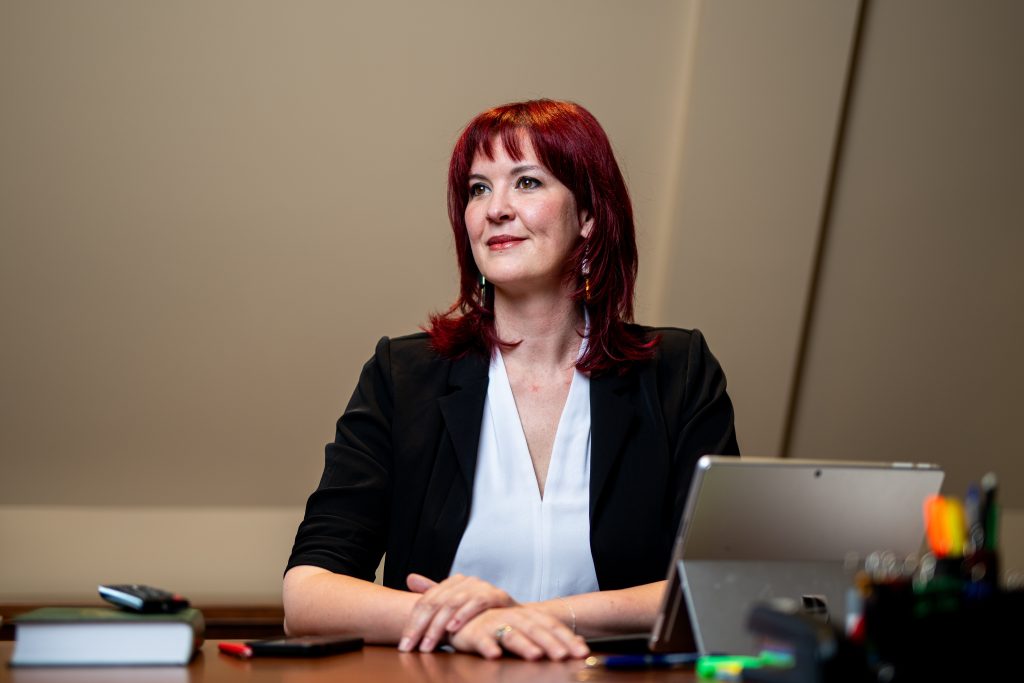
In an interview with The Canadian Press, their new House leader, Christine Normandin, is literally rubbing her hands together as she describes the situation in her West Block office. “The non-verbal speaks for itself,” she laughs.
The excitement of the woman savoring her party’s balance of power in this minority parliament contrasts with that of her baby, who was in a daze after drinking his bottle and sleeping in his stroller in a corner.
There is a big difference between the Bloc’s current situation and that which prevailed before the general election, she explains: “We are a recognized party and the NDP is not.”
A party must have at least 12 MPs to be “recognized.” The NDP, for its part, only elected seven candidates last month. And Prime Minister Mark Carney indicated last week that he is not keen on granting an exception, despite the party’s assertion that the Liberals would find themselves with only one third party on parliamentary committees.
This is because the composition of these committees is proportional to the representation of the recognized parties in the House of Commons, and only members from these parliamentary groups have the right to vote.
While the work of the House, including its sometimes spectacular Question Period, generally attracts attention, bills must necessarily go through parliamentary committees where the substantive work is done.
Thus, the Liberals will need to negotiate with the Bloc if they want to advance a piece of legislation to committee. The same is true for the Conservatives if they want to amend it.
The Bloc will also have a decisive influence on the choice of themes to be studied by the committees, and “there’s a strong chance” it will join forces with the Conservatives to determine the agenda should a scandal break, Normandin said.
“We’ll be easy to talk to”
The Bloc members swear they will work “constructively,” that they will study proposals “on their merits,” and that, “for the first year at least,” they will be “easy to talk to.”
“We might be a little less quick to say, ‘Yeah, well, we’re starting to accumulate a lot of stuff that we don’t like.’ We’re giving the runner a bit of a chance in the first year,” Normandin explained.
The Bloc is therefore extending “an olive branch,” she said a few hours before her swearing-in before her family and friends. At the same time, Normandin warns that there are still “conditions (…), non-negotiable ones.”
The Liberal government must stop adopting “a ‘trampling on Quebec’s interests, trying to overwhelm us'” mode, “leave them alone on issues of language, secularism, and so on,” and respect provincial jurisdictions, one in particular.
The Bloc does not plan to conclude a long-term agreement, as the NDP did during the last parliament. Instead, it prefers to negotiate “piecemeal.”
But although the New Democrats do not have the right to vote in committee, they also hold the balance of power in the House of Commons, and that is where the government could turn if it is unable to reach an agreement in committee.
However, Normandin points out that it has several drawbacks. “It lengthens the process. We’re reopening debates.” (…) We’re making things much more complicated for ourselves. (…) It could become extremely difficult.”
The Triple Challenge
It’s certain that, in the current situation, the parliamentary session will be “stock” for the Bloc, predicts the woman who was recently elected MNA for Saint-Jean, in Montérégie, for a third term, and who is now responsible for coordinating her party’s activities in the House.
By succeeding Alain Therrien, a political veteran, she says she has “big shoes to fill.”
And with a baby born in the last few months, it will be a double challenge? “Triple, almost,” adds Normandin.
“I’m a single mother, so a mother without a partner, but I have a good network. A parliamentary mother with a title as an officer to boot. There may be a couple of small glass ceilings there that we’ll break here and there. So much the better if it can show others later that it’s doable.” I tell myself: we’ll take the challenge one bite at a time.”
As if she didn’t have enough on her plate, the Bloc Québécois member has a small project “on the go” that she wants to advance during the session: pushing for the establishment of a daycare on the Hill that would be managed by Parliament.
“When we sit until after midnight, a daycare that closes at 5 p.m. is no longer useful to anyone,” she insists.
Normandin said she believes a daycare with atypical hours would be an alternative for MPs and their staff, would contribute to work-life balance, and would attract more people into politics.
–This report by La Presse Canadienne was translated by CityNews