Oldest rocks in the world are said to be found in Quebec
Posted June 27, 2025 10:08 am.
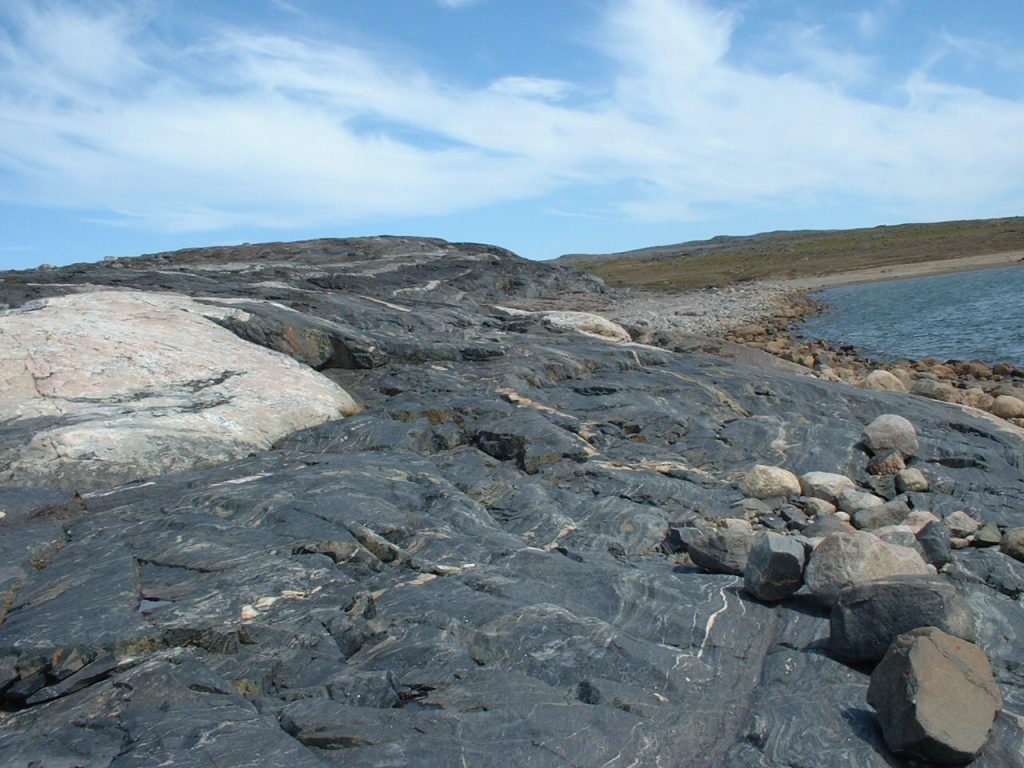
Nunavik, in northern Quebec, may contain the oldest rocks in the world, according to an Ontario researcher.
These rocks formed just a few hundred million years after the formation of the Earth itself, meaning they are about four billion years old, said Professor Jonathan O’Neil of the University of Ottawa.
“These rocks (…) would be the only ones currently known to come from (a period) that covers almost the first 600 million years of Earth’s history,” the researcher summarized.
Professor O’Neil and his colleagues have been interested for many years in the Nuvvuagittuq greenstone belt, a rock formation located on the eastern shore of Hudson Bay, about 40 kilometers southeast of Inukjuak.
Their work published in 2008 demonstrated that some of the rocks found there date from the Hadean—the first eon of Earth’s history, which begins with the formation of the planet about 4.6 billion years ago and ends about 600 million years later—and that they are therefore incredibly old.
Their proposed age at that time, 4.3 billion years, was not unanimously accepted for several reasons. The most recent study published in the prestigious journal Science uses highly sophisticated analytical methods and refines the age of some rocks to 4.16 billion years.
“The problem with the Hadean is that we have very little material to work with,” said Professor O’Neil. “We have almost no terrestrial material dating from that period. Everything was destroyed, everything was recycled.” The Earth is very efficient at recycling its own crust and remelting its own rocks.”
We don’t really understand how or why such ancient rocks are still accessible today, he admitted, but it has long been known that a large portion of the Canadian Shield provides access to some of the oldest rocks on the planet.
Until about twenty years ago, Professor O’Neil said, most of the rocks in Nunavik were considered to be between 2.7 billion and 3 billion years old. A massive mapping campaign organized by the Quebec government in the early 2000s changed everything when rocks as old as 3.8 billion years were found there.
“There are only five or six places in the world where rocks that old are found,” he recalled. “So it definitely generated a lot of interest.”
A short geology lesson is in order here. The rocks examined in the new study, whose age was pinned at 4.16 billion years, are “intruding” into the Nuvvuagittuq Belt, meaning they intersect what are called “host rocks,” explained Professor O’Neil.
“And there’s a principle in geology that tells us that a rock that intersects another rock, or a rock that intrudes into another, must necessarily be younger,” he explained. “You can’t intersect something that doesn’t exist.”
It can therefore be logically concluded that the “host rocks” are even older than the “intruding rocks” that are the subject of the most recent study.
These are the host rocks whose age was estimated at 4.3 billion years in the study published in 2008. The researchers who then claimed they were actually 3.8 billion years old may now have to reconsider, Professor O’Neil believes.
“Yes, we’re arguing about 500 million years, but it’s important,” he said. “By studying the age of intruded rocks, it imposes a lower limit on the age of the host rocks, and their minimum age becomes 4.16 billion years. So, necessarily, the host rocks must be older, and we believe they are 4.3 billion years old.”
He and his colleagues, Professor O’Neil said, believe that the new study “really provides even stronger constraints to suggest that these rocks are Hadean, and therefore older than 4 billion years.”
For people like him who are “interested in studying how the young Earth grew up in its infancy and adolescence,” rocks and minerals are like books that tell “the story of the Earth,” the researcher explained.
If we want to understand how the Earth formed, if we want to know if there was plate tectonics when the planet was very young, if we want to analyze the composition of the early oceans (and perhaps detect the first signs of life on Earth), we need to study the oldest rocks we can find, he said.
“It’s much more than saying my rock is older than your rock,” Professor O’Neil concluded with a laugh. “It’s a unique window into the early history of our planet.”
–This report by La Presse Canadienne was translated by CityNews