Can a pay-what-you-can model help against food insecurity? This non-profit thinks so
Posted July 3, 2025 5:39 pm.
Last Updated July 3, 2025 6:35 pm.
In times of inflation and increased grocery prices, being able to buy enough food may be difficult. To help break these barriers, the non-profit Corbeille de Pain launched solidarity markets that will run from July 1 until Oct. 30 on the West Island of Montreal.
The West Island solidarity market offers mostly organic and in-season produce. All prepared meals, bread, maple syrup, honey, jam, and dried goods are sourced from local farmers. These markets also provide social pricing or a “pay what you can” model — meaning that everyone, regardless of their financial situation, can shop there.
Kate Feldman, food security manager at Corbeille de Pain, said that one of the keys to fighting food insecurity is community building.
“The medicine to all of these issues can really be community and communities coming together to attend markets like this one or to volunteer at different organizations at food banks,” Feldman said.
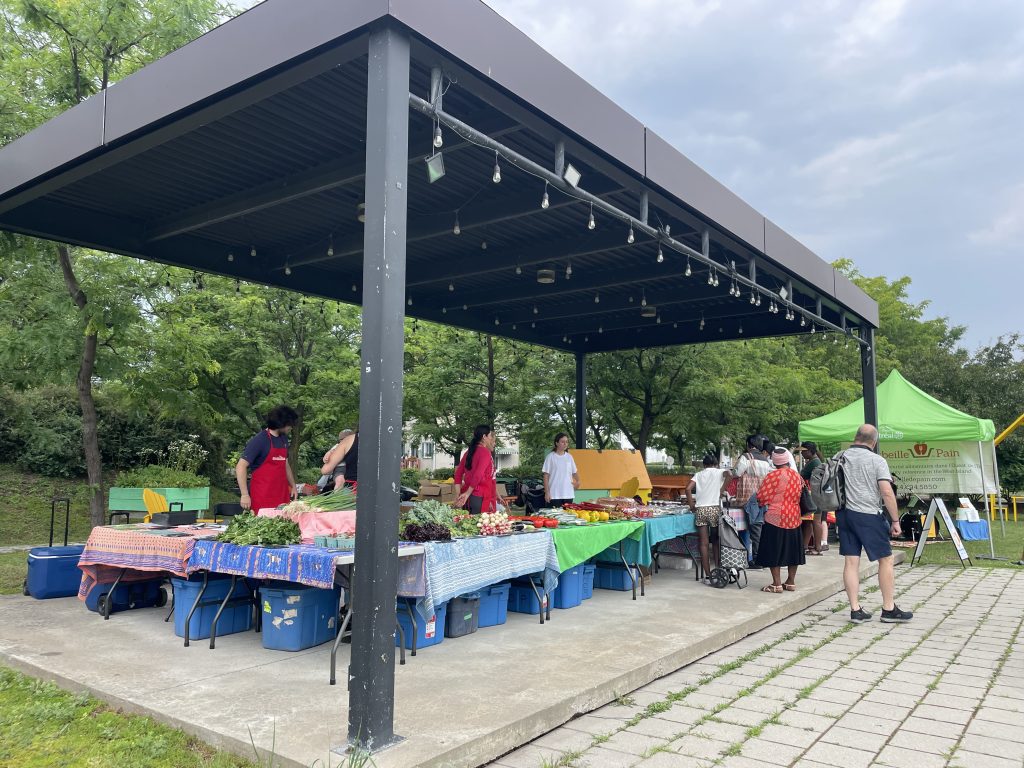
Thursday’s market was outside the Gerry Robertson Community Centre in Pierrefonds. Spread across the West Island, markets are offered throughout the week in Dollard-Des Ormeaux and Pointe-Claire, including four pop-up markets within Dorval. Over 20,000 residents are reportedly living below the poverty line.
“I’d love to see a world in which there’s no food insecurity, but for now we still have it, and kind of the goal is to provide tools to help people deal with these other issues.”
The food coupon program, Carte Proximité, runs across 11 boroughs in Montréal and Laval. It spans 59 markets, and the West Island Solidarity Market is one of them. This initiative also supports kiosks, helping over 1,500 food-insecure families.
Since its founding five years ago, the project has focused on giving shoppers a more noble experience that reinforces people to have control over what they choose for their household — while supporting local producing regions around the city. The market also offers subsidized eggs where customers are charged only $5 for a dozen eggs.
“We want to be able to offer that but in order to offer the pay what you can model, we kinda need the whole community to pitch in,” Feldman said.


To ensure the “pay what you want” model is effective, they hope what people offer to pay balances out with what others round up with. She explained that if a shopper were to buy $30 worth of vegetables at their markets, they’d be able to pay $20, if that’s the amount they could give, and hopefully, someone else will pay it forward by rounding up their bill by $10.
‘Our mission as well is to support local agriculture’
Anik Vigneault, communications coordinator at Corbeille de Pain, said they try to stay in a 30 to 50 kilometre range of their markets to the nearest producer — which she says helps support local agriculture.
“In the West Island it’s often known as being, you know, a rich part of Montreal, but there are a lot of pockets of poverty in the West Island,” she said.

Feldman added they’d like the farmer’s market model to be more accessible to reach more people and support more local farmers as it strengthens the local economy.
“Oftentimes farmer’s markets are available everywhere, but often, there’s a financial barrier for a lot of people, or sometimes there’s kind of a social pressure when you go to a market like that,” she said.
“Lots of farmers, but the number of farmers is going down, and the age of farmers is going up, so we really want to support as much as we can local farmers and young farmers.”

Eva Rutkowski, a Corbeille de Pain customer, feels that the market is useful to her and others within the community.
“It helps because you have everything here, all the vegetables I need to cook, and they’re very good. The meals come out better,” she told CityNews.
Feldman explained that she believes there’s a stereotypical view of the West Island in Montreal—people in other parts of Montreal thinking that all the West Island residents are doing well and don’t need help. However, that’s not the case.
“There are quite a few people in large pockets of the West Island that do really need support,” she said. “And so I think if there would be another takeaway from one of our markets, it is that there are people on the West Island that need the support.”
Feldman expanded on the non-profit’s opportunities for residents from cooking courses, to community gardens, which she says is essential in the fight against food insecurity.
“I think especially within the current economic context that we live in, food insecurity is kind of a byproduct of a lot of different issues that we’re seeing,” she said.
“We’re seeing rising cost of living, we’re seeing a housing crisis, and food insecurity is kind of a symptom of all of these other issues.”