Montreal mother found not criminally responsible by judge in child abandonment case
Posted September 15, 2025 7:49 am.
Last Updated September 15, 2025 6:34 pm.
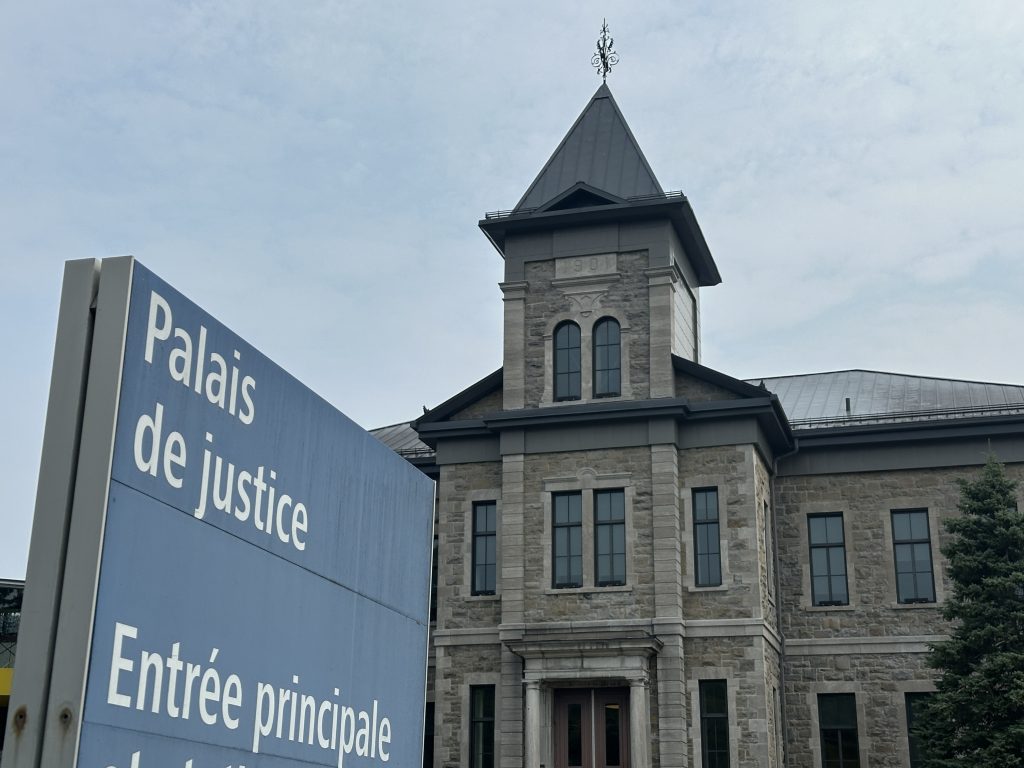
A Montreal mother accused of abandoning her three-year-old daughter in a field near a major Ontario highway began Monday at the Salaberry-de-Valleyfield courthouse – found not criminally responsible for her actions.
Judge Bertrand St-Arnaud made the ruling, following the joint recommendation of both the Crown and defence.
Crown prosecutor Lili Prévost-Gravel told the court the accused’s mental health had been deteriorating for several months at the time of the incident, to the point where she believed her daughter’s body and mind were possessed. At the time, the woman was not taking medication or under psychiatric care.
Video evidence presented in court, made public Monday, shows the mother being interrogated by police. After 20 hours of interviewing her over three days, on June 16, two days before the girl was found, she came to the realization of what she did.
“I left her on the side of the road and I went back immediately and she was gone,” the woman said in the video. “Oh my god, I have to go find her. I just realized it was all my fault.”
The woman’s identity is protected by a publication ban, which also shields the name of her daughter.
The child was found conscious but dehydrated by Ontario Provincial Police on June 18, three days after her mother reported her missing in Coteau-du-Lac, Que. Medical reports show she suffered dehydration, insect bites, and skin lesions but survived.
“She had to be hospitalized for four days and be re-hydrated and have some treatment under sedation,” Prévost-Gravel said. “And after that, she had her release from the hospital, but after that she had some follow-up with her doctor. For now, psychologically, it’s hard for the family. The father of the young lady told us that she cannot be left alone anymore and she feared for her to be left alone, basically.”
The accused underwent a 48-page psychiatric evaluation at Montreal’s Philippe-Pinel Institute, which was submitted to the court last week. Its contents were made public on Monday after being unsealed.
The psychiatrist, Dr. Marie-Michèle Boulanger, concluded the woman suffered a psychotic episode brought on by mental fragility in the peripartum period and other stressors. Boulanger wrote that Article 16 of the Criminal Code, not criminally responsible due to mental disorder, applies in the case.
While the woman has shown improvement with antipsychotic medication, the psychiatrist said her progress remains fragile and further treatment is required.
She recommended continued psychiatric and pharmacological follow-up in a secure environment, with close monitoring due to the risk of relapse.
The Crown wants to follow the suggestion of the psychiatrist.
“She commits some crime but she cannot know if what is right or wrong and it’s because of this mental illness,” said Prévost-Gravel. “And in that file she was schizoaffective. She was in a maniac phase and she had a psychosis.”

Criminal defence lawyer Walid Hijazi said the ruling reflects the legal distinction between acquittal and non-responsibility. “It’s not an acquittal per se, but someone who is unable to measure right from wrong doesn’t realize that what she did was wrong,” he said.
Charles Schiller, a criminal defence lawyer with Legal Aid Montreal who is not involved in the case, said the Crown’s decision to accept the psychiatric findings was key.
“The Crown agreed with the conclusions of the report between defence and Crown came together to conclude, based on the expert’s recommendation, that this person should be declared not criminally responsible,” Schiller said.
He added that the accused’s disorganized remarks to police, combined with the expert’s assessment of her state of mind, were important factors for the Crown in deciding not to contest the report.
“It’s always a very positive thing when the Crown and the defence come together to agree on a report, because this also helps the public and society reach a conclusion faster,” Schiller said.
The psychiatrist also noted the accused has been cooperative and engaged in treatment but warned that stressors such as media attention and reintegration into society could trigger another episode.
The judge will now decide whether the woman is released without conditions, released with conditions, or remains detained under the jurisdiction of the Quebec Review Board.
“Tomorrow it will be the arguments of the parties and then the judge will decide and try to render a decision tomorrow,” said the Crown prosecutor. “That would mean whether or not the accused is detained at Pinel with certain conditions or liberated with certain conditions.”
–With files from La Presse Canadienne