SPVM unveil drone operation to improve road safety
Posted September 17, 2025 3:47 pm.
Last Updated September 17, 2025 4:57 pm.
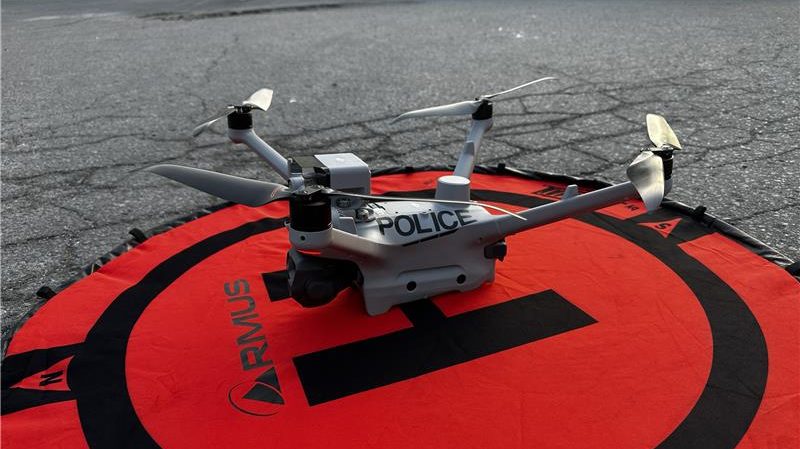
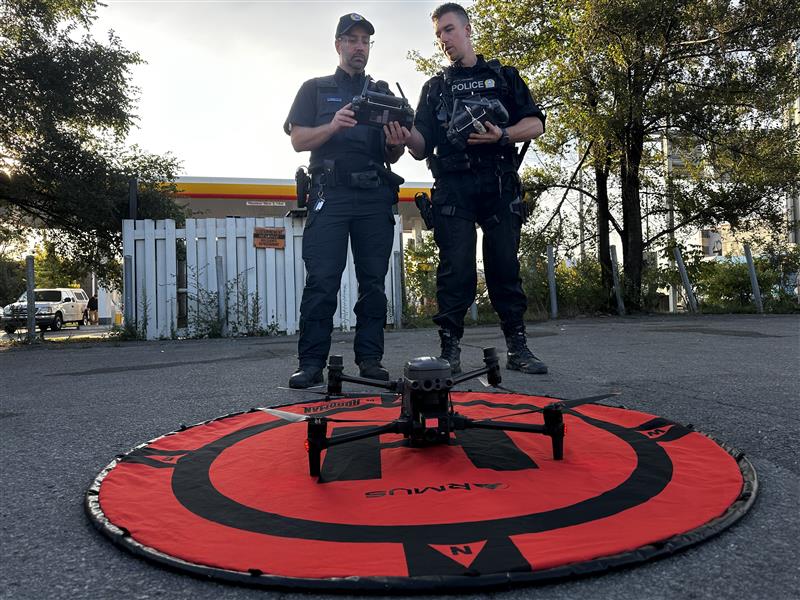
At a road safety operation demonstration on Wednesday morning, the Montreal police (SPVM) unveiled their latest rollout of drones for media, which feature a variety of high-tech amenities from 4K quality imagery to enhanced maps.
Set up at the Crémazie and Saint-Michel intersection, two drone operators observed traffic behaviours on the road with various police officers positioning themselves in key areas.
“We have several collisions, but also an intersection that’s difficult to intervene at because we don’t have a safe place to position patrol vehicles. It’s an area where several users coexist, including cars, pedestrians, and cyclists,” said Michael Brochu, the SPVM’s road security advisor.
According to statistics provided by the SPVM — Saint-Michel and Crémazie East saw 31 collisions with material damage in 2023, while 2024 saw 44, and as of September 1st of this year, the number reached 16.
“It’s an intersection that’s prone to accidents. There are many accidents annually, so with our statistics and figures, we’re able to test intersections where we want to prioritize drone use,” said CMDR. Yannick Rivest-Benoit, with the SPVM.
With a battery life of over 25 minutes, these drones aim to improve road safety and overall access to difficult areas. Alongside Brochu and Rivest-Benoit, other officers explained that the SPVM uses drones for planned operations, searching for missing people, or supervising demonstrations. They clarify that the use of drones in road safety is a first.
“Basically, what you have to understand is that we use the drone a bit like an extension of the police officer’s visual aid. This is really how you have to understand the usefulness of drones in road safety,” said Rivest-Benoit.
“We target areas that are more problematic, one in terms of accidents and two in terms of landscaping. For us, for the police, it’s difficult to set up operations there. So we use the drone to detect violations. Then, we position interceptors at a safe distance to intercept these violators,” said Rivest-Benoit.
Each drone costs $25,000 and is manufactured with AI features capable of reaching 65 km/h in rain, snow, or wind.
“While providing an example of an incident where a driver passes a school zone while a pedestrian is using the crosswalk, Rivest-Benoit said, they could capture the violation with the drone.

“We then inform the interceptor, who can then proceed with the interception and then issue a ticket,” said Rivest-Benoit.
Officers said they always communicate with airport officials before an operation and remind Montrealers and drone enthusiasts that the Transport Canada law prohibits anyone from using a drone near a police operation. Officers also discussed the potential risk birds pose to these operations.
“There may be one, but it’s minor birds aren’t very interested in drones in general. The reason is because the drone is fixed and it flies very, very statically,” explained SPVM drone instructor Philippe Coulombe.

“[However], there is still a danger, and then, what do we do as drone operators? We have a visual observer with us. The visual observer will warn us of any danger in the airspace.”
Though still in its early phases, more drone demos are on the horizon for the SPVM.
“They are extremely high-performance devices, allowing us to extend our view over very good distances. They are devices capable of recognizing our vehicles, identifying the vehicles present, and providing us with the names of the streets present,” Brochu explained.
“The will is there. We’re still analyzing or testing to see if the added value is relevant. But yes, we should see it more and more. In fact, we have to see this as a new way to improve our road safety record,” said Rivest-Benoit.