New nuclear medicine wing opens at Montreal’s Sacré-Cœur Hospital
Posted September 18, 2025 3:15 pm.
Last Updated September 18, 2025 5:24 pm.
A major expansion at Sacré-Cœur hospital in Montreal is set to transform how medical imaging is delivered in the region.
The hospital officially inaugurated its new nuclear medicine wing — a 1,600-square-metre facility equipped with five state-of-the-art imaging systems.
The modernized space is expected to significantly improve access to critical diagnostic tests, while enhancing the overall experience for patients.

Tripling capacity and reducing transfers
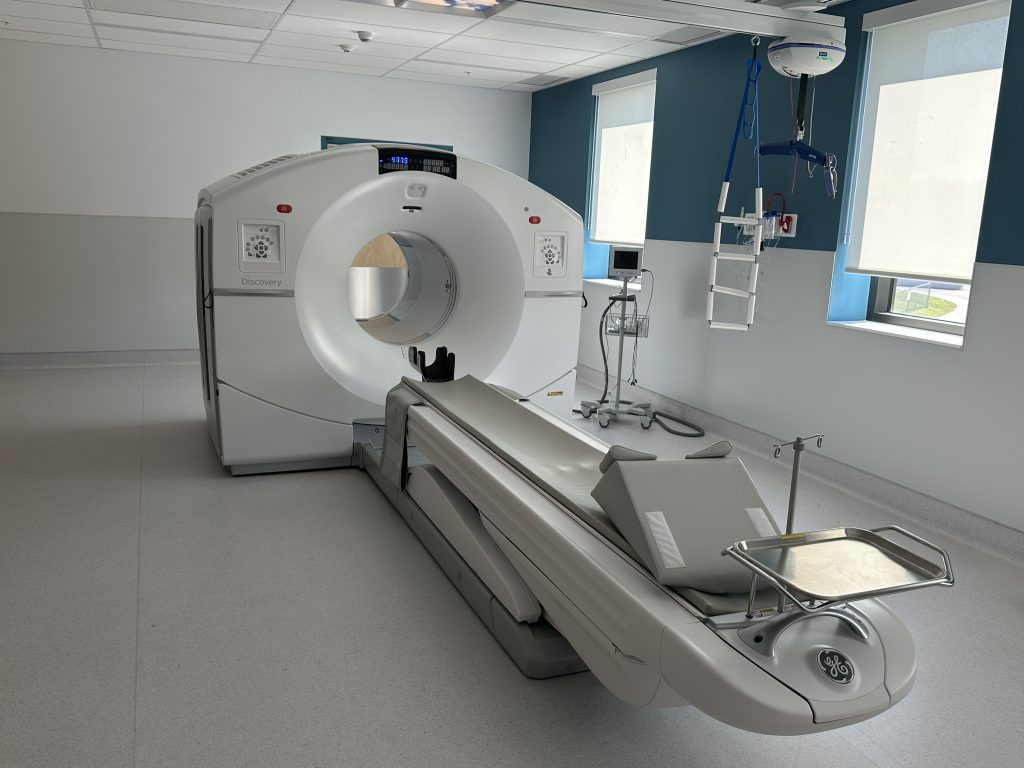
One of the biggest impacts of the upgrade is the hospital’s ability to dramatically increase its PET scan capacity — from 1,431 scans in 2024 to an estimated 5,000 by 2026.
“Before the arrival of this camera, we had to go to the CHUM, so our patients needed to go downtown to have this study,” said Dr. Mathieu Charest, chief of nuclear medicine at Sacré-Cœur. “Now, the PET machine is available all day long, five days a week.”

The change means patients no longer need to be transferred to other hospitals for advanced scans, particularly helpful for those already admitted.
“If you’re hospitalized, you need to go to a different hospital, transport needs to be organized,” said Charest. “Here, they just have to roll the patient down.”
A new level of care, close to home
Nuclear medicine is a specialized branch of imaging that uses low-dose radiation to assess how organs and tissues function. It plays a key role in diagnosing and monitoring diseases like cancer, heart conditions and neurological disorders.
“We focus on how the disease is active or not,” said Charest. “Is the cancer very aggressive or not? Is it spread to other areas or is it just localized?”

According to staff, keeping this level of care on-site makes a difficult time more manageable for patients.
“If you have cancer, you’re already anxious. There’s a lot of testing, a lot of questions in your head,” said Charest. “If it’s in your hospital, by the team you already know, it’s much easier for everybody.”
Breakdown of the new equipment
The facility includes three main types of imaging systems:
- Two SPECT-CT cameras for general nuclear medicine, used to scan systems such as respiratory, renal, and endocrine.
- Two CZT cardiac cameras, including one of Quebec’s first GE StarGuide systems, which allows for high-resolution, non-invasive cardiac imaging.
- One PET-CT scanner for oncology, infectious disease and neurology — one of the most advanced in Quebec, featuring digital technology and five detector rings.
“The camera is more clear and better for the result,” said Tommy Beaudry, a nuclear medicine technologist. “Because the picture is faster, we can do at least maybe double the number of patients we could before.”
A team effort years in the making
Construction began in March 2023, and while patients began using the facility in June, the hospital officially marked its opening on Sept. 18.
“It’s several years of conception and work,” said Gabriel Seyer, head of medical imaging services. “We officially opened with our first patients on June 4, and we’ve been gradually deploying the service since.”

Seyer said the upgrade was necessary to keep pace with evolving medical standards and to ensure quality of care.
“It was necessary to be at fine point of technology to promote patient access and follow medical evolution,” he said. “It also allows us to increase access for patients, especially our waiting lists.”
The PET scan service alone is expected to double in capacity next year.
Next step: nuclear therapy
With the equipment now installed, staff say they’re focused on bringing the department fully to life — and looking ahead to new possibilities in nuclear therapy.
“We have new tracers coming, especially for prostate cancer, where we can deliver radiation precisely to the lesion and the metastasis,” said Charest. “So we have a lot of projects, and now we have the tools to make it work.”
Technologists at the centre
Technologists like Cynthia Prévost work hands-on with patients, equipment and radioisotopes — preparing doses, running cameras, and ensuring everything meets quality control.
“We are responsible for that,” she said. “If there’s a problem, we work in a team with biomedical engineers and IT. We need everyone to do it well.”
It’s a job, she says, that is both technical and deeply human.
“There’s no one who comes for the pleasure. That’s something we know,” she said. “But when they come to see us, we make sure it’s the best possible service — the best quality and the best support.”

‘We’re very lucky to have this today’
After years of planning and building, seeing the finished department in action is deeply meaningful to staff.
“I want to thank everybody who worked on this — from the Foundation who helped us raise money for the PET scan, to the administration that helped make this come true,” said Charest. “We waited a long time to have it. The construction part was on time, on budget. And we’re very lucky to have this today.”
For Seyer, the payoff is personal.
“It’s my daily motivation,” he said. “It allows us to feed all our energies together for the patient and the teams. I’m very excited to work in this new environment that allows for better access and better care.”