‘If we don’t get our education today, we can’t be doctors tomorrow’: Med students rally in Montreal

Posted September 23, 2025 12:58 pm.
Last Updated September 24, 2025 11:11 am.
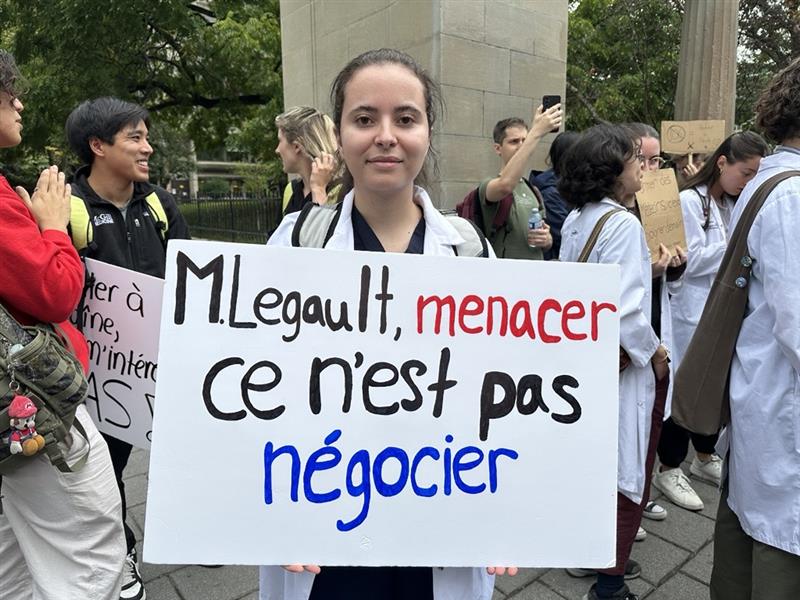
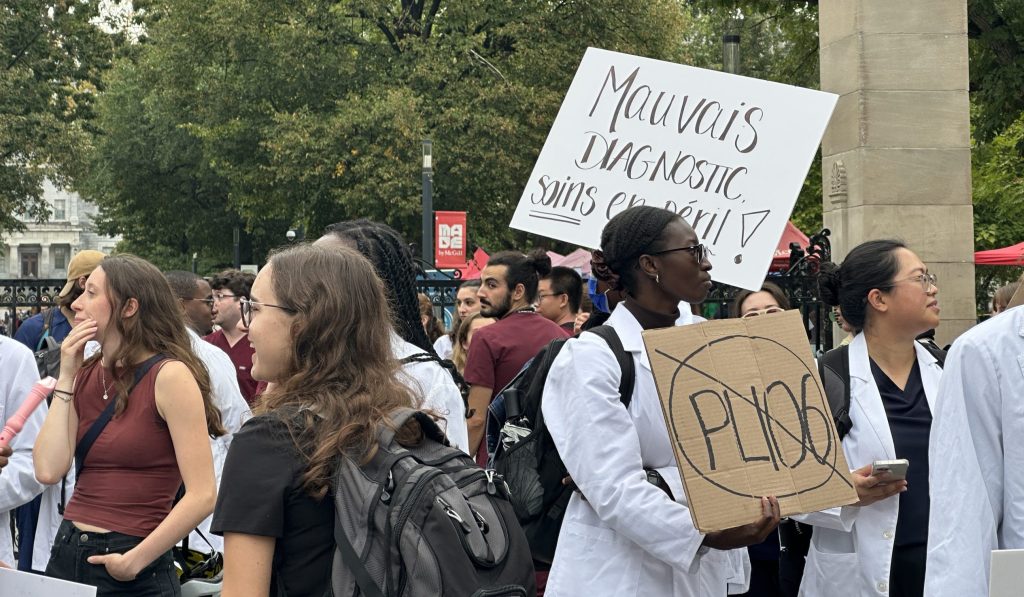
After a week without teaching from medical specialists, Quebec’s medical students from the province’s four faculties rallied Tuesday afternoon in Montreal outside McGill University.
The disruptions could put them at a disadvantage compared with students in other Canadian provinces during the residency matching process.
A crucial step for graduating doctors is choosing a specialty, followed by the Canadian Resident Matching Service (CaRMS) process, which takes place once a year.
Students first submit their applications, a step currently underway, followed by interviews in January and February. After that, there is a ranking process, and students receive their initial match results in March.
Those who do not get their first choice have a second round, offering another chance to secure a spot in their preferred specialty.
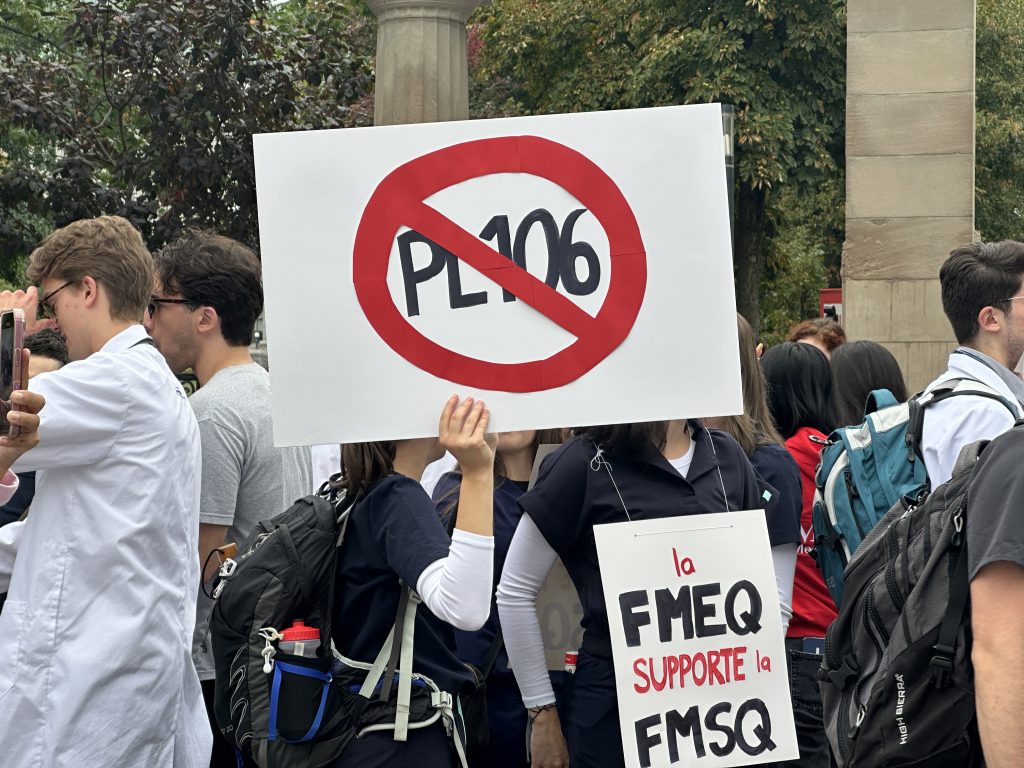
Final-year students are currently the most affected by the pressure tactics of the Fédération des médecins spécialistes du Québec (FMSQ), which has suspended teaching duties.
On Tuesday, 91 per cent of family doctors voted to follow suit and suspend teaching as of Oct. 1.
“We’re not surprised that the family doctors followed suit, they tried to be nice with the government. They wanted to give government time, but at the moment it is not negotiating in good faith,” said Ryan Kara, president of the McGill Medical Student Society. “What this means is that on July 2026, you will not be able to see a resident doctor when you go to the hospital. Waiting times are going to increase. The time you spend with a doctor is going to decrease. This is scary.”
Students say the uncertainty is weighing on them.
“It’s been stressful. Students are very anxious about their graduation, with a lot of uncertainties about what’s going to happen if we keep missing more days of school,” said Nicolas Dostie, president of Université de Montréal’s medical students’ association. “If we don’t get our education today we won’t be able to be doctors tomorrow.”
They also worry about CaRMS eligibility, which requires graduation and completion of all clinical rotations.
Students rely on those rotations to decide on a specialty and secure recommendation letters from supervising physicians. Six-week rotations have already been invalidated, potentially delaying the entry of about 1,000 new doctors into the workforce next year.
Dr. Sherif Emil, a pediatric surgeon and professor in McGill’s Faculty of Medicine and Health Sciences, said the disruption is especially difficult for students in their senior years.
“They may not have time to compensate for missed days or missed education. How is that going to affect their graduation, their ability to move onto residency? So it’s just such a distressful time,” he said.
Emil said physicians are being forced to choose between their duty to educate and their concerns about Bill 106, which would tie part of physician pay to performance indicators.
“We’re having to decide between what we think is better for the future of this province, not just for patients but for the people who take care of them,” he said. “But we’re not flight attendants and we’re not postal workers. We’re people who are entrusted to take care of people’s lives. That has to be first and foremost.”
Negotiations between the federations and the government remain stalled.
In a statement to CityNews, Quebec’s Health Minister Christian Dubé said that “suspending the teaching of thousands of future doctors is serious, both for the next generation and for patients. We are doing our part to find a path forward, but the medical federations must also do theirs and return to the table in a constructive way. We reiterate our full availability to discuss for the benefit of all. Patients cannot wait any longer.”
Medical students say they share many of the concerns of the FMSQ and Fédération des médecins omnipraticiens du Québec (FMOQ) but fear their education, and the province’s next generation of doctors are being put at risk.