Quebec animal rights organization calls out government inaction on fatal livestock fires

Posted September 28, 2025 5:15 pm.
Last Updated September 29, 2025 1:54 pm.
The Quebec Animal Rights Community says their calls for government intervention are falling on deaf ears, as livestock animals are left to suffer and die in fatal fires all across the province.
According to their census, more than half a million animals have burned alive since 2015, in what they say has become a tragic and silent epidemic.
Curious about some of the frequent press articles he had seen in circulation regarding barn fires, professional veterinarian and specialist in anesthesiology with a deep passion for animals, Dr. Jean-Jacques Kona-Boun said he began doing a survey looking into the number of animals that perished in barn fires as there was no ongoing survey at that time.
Between 2015 and 2023, nearly 10 years later, Dr. Kona-Boun and DAQ volunteers have recorded 231 fatal barn fires in livestock buildings throughout the province of Quebec. With the fires on record, they’ve been able to determine that, on average, Quebec sees two fires in livestock buildings every month, resulting in the death of at least one animal.
Nicolas Morello, a lawyer and the director of legal affairs for the Quebec Animal Law Community said, “from the beginning of the time that DAQ started documenting the fatal livestock fires, there is an average of 60,000 animal beings that are burned alive every year.”

And according to Morello and Dr. Kona-Boun, that number is a conservative underestimate.
“There’s no government agency that keeps track of the number of victims that die in fatal livestock fires,” exclaimed Morello. “The only way that number can be tracked is through media reports.”
Drawing not only on media research, but access to information requests, case law, technical documentary and field testimonials, they’ve been able to determine that at least half a million animals have died in barn fires in Quebec, with the number continuing to increase.
They’ve also uncovered the species most often killed in the fires:
-400,000 chickens
-60,500 ducks
-50,000 pigs
-12,000 cows
-An undetermined number of sheep and horses, who have reportedly died in fires as well
Official Summary Report
The data is listed as part of a comprehensive report produced recently by Morello, Dr. Kona-Boun and law students.
“We created a 106 page report that concentrates on three specific regions in Quebec where more than 50 per cent of the barn fires take place,” Morello explained.
Over the years, Morello says on top of conducting a study of the number of fires, the locations and the number of animal beings that died in fatal fires, they’ve also studied the cause of the fires.
Morello described: “What we learned is that the majority of the buildings do not have fire suppression systems like sprinklers. They almost never have smoke or heat detectors. There are large problems with how hay and straw is kept in a livestock barn. There are also issues with electrical and mechanical failures, and many of the barns where these fatal fires take place are old and are not subject to municipal or provincial regulation.”
They’ve also discovered that fires occur more frequently during winter, with a peak between March and April, largely due to the increased use of heating, breakdowns and mechanical or electrical failures.
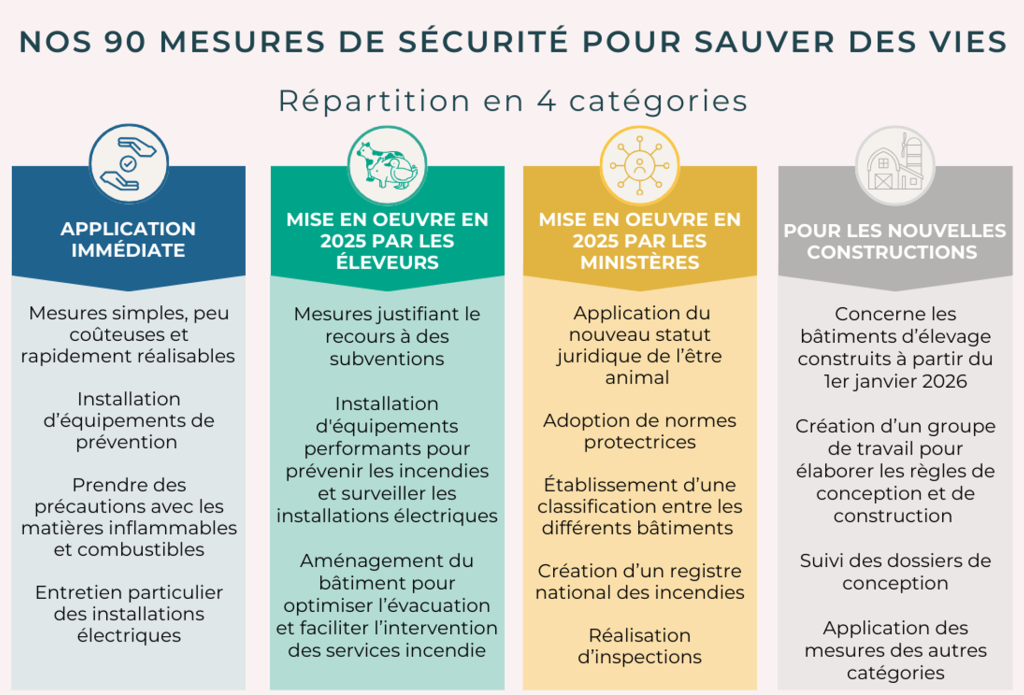
As a result, they’ve listed 90 concrete recommendations, divided in four sections of immediacy, that both farmers and the government can undertake to ensure the safety of farm animals.
“We list the number of measures that can be taken immediately with little or no cost, and then measures where there may be a necessity of having a government subsidy to implement the measures to protect the animal beings, and then we also have a final part of our recommendations that deal with new buildings that will house livestock and how to prevent this,” explained Morello.
Physical & Psychological toll
Often confined in cages, pens or automatic confinement systems, animals often find themselves trapped, with no way out when fires break out.
“Being killed in a fire, it is associated with excruciating pain, unimaginable pain, and it is one of the worst, the most painful deaths possible,” said Dr. Jean-Jacques Kona-Boun.
The experienced veterinarian also went on to describe that as sentient beings, animals not only feel pain, but also feel fear and have emotions similar to humans.
But while being killed in a fire is associated with trauma and pain, he shares another reality faced by animals before the flames ultimately reach them.
“It is important to realize that there is also pain caused by the smoke,” Dr. Kona-Boun began to explain. “It causes asphyxiation suffocation, hypoxia, and also irritation, pain on the mucosa, mucosal membrane, the respiratory mucosa, the ocular mucosa, it is an irritant, it is painful, and it’s not like falling asleep peacefully by inhaling an odorless and painless gas for anesthesia or euthanasia.”
Dr. Kona-Boun relates that the experience is similar to dying in a gas chamber.
“Even if the animals are unconscious when the flames come, and as I said, even consciousness and death doesn’t occur quickly, what follows is horrific because it’s equivalent to being incinerated, conscious in a crematorium,” he added.
But for those lucky enough to survive the flames if they make it out in time, Dr. Kona-Boun says it doesn’t mean their ordeal is over.
“Because of the pathologies caused by burns and by the smoke — and these pathologies are various — they can be localized, they can be systemic, they can spread in many systems and organs, they can cause a failure of organs and ultimately they can cause death,” said Dr. Kona-Boun.
Dr. Kona-Boun attests that many animals can continue to feel the effects of severe burns, lesions or even the inhalation of smoke or toxic fumes long after the fire has been extinguished.
Quebec Legal Status of Animal Beings
The Animal Welfare Act adopted in 2015, after it passed unanimously at the National Assembly, and the Civil Code of Quebec both recognize animal beings as sentient creatures.
“They are no longer classified as moveable property like a chair or a car that might burn in a fire,” said Morello.
But the Quebec Animal Law Community says despite the legal status, this has had little effect in the agricultural sector, as the Fire Safety Act and the Building Code don’t establish specific safety standards or technical requirements to protect animal beings. A technicality he says has deprived farm animals of the same protection alotted to domestic animals or pets.
“There is a legal commitment that the government must uphold to protect these animal beings,” he added.
“We conducted a study of the number of fires, the locations, the number of animal beings that died in these fatal fires, and what we learned is that the majority of the buildings do not have fire suppression systems like sprinklers, they almost never have smoke or heat detectors,” said Morello.
Lack of government response
At the forefront of their awareness campaign is what Morello and Dr. Kona-Boun are calling out government inaction.
Dr. Kona-Boun said he’s sent over 200 emails to both the Quebec Ministry of Agriculture, Fisheries and Food (MAPAQ) and the Ministry of Public Security (MSP) since 2015, calling on them to intervene and require farmers to add safety measures.
“We communicated with the ministries responsible who have the shared responsibility of the fire safety and the safety and welfare of animals. So respectively, the Ministry of Public Safety and the Ministry of Agriculture and these two ministries have been characterized by their silence during all these years.”
In a statement to CityNews, the Ministry of Agriculture retaliated against the claims made by the Quebec Animal Law Community and said:
“MAPAQ is concerned about the issue of farm fires in livestock buildings. We are working with relevant stakeholders on fire prevention and awareness to promote consideration of animal safety and well-being.
Since fall 2024, MAPAQ has been coordinating a new working group under the Quebec Strategy for Animal Health and Welfare (SQSBEA) focused on non-health emergency measures. Preparing farmers for farm fires is one of the topics this working group is addressing.”
But Morello retorts the statement, saying: “It should be noted that despite these actions, more than 20,000 animals have already lost their lives in fires since January of this year.”
Utterly dissatisfied with the government’s fire prevention and awareness efforts, which they say have been ineffective, DAQ has also launched a petition calling for the government to put in place immediate safety measures.
“The petition was launched about two weeks ago, and now there are more than a thousand people who have signed the petition,” said Morello.