Quebec bids farewell to Guy Rocher, pillar of Quiet Revolution
Posted October 2, 2025 3:51 pm.
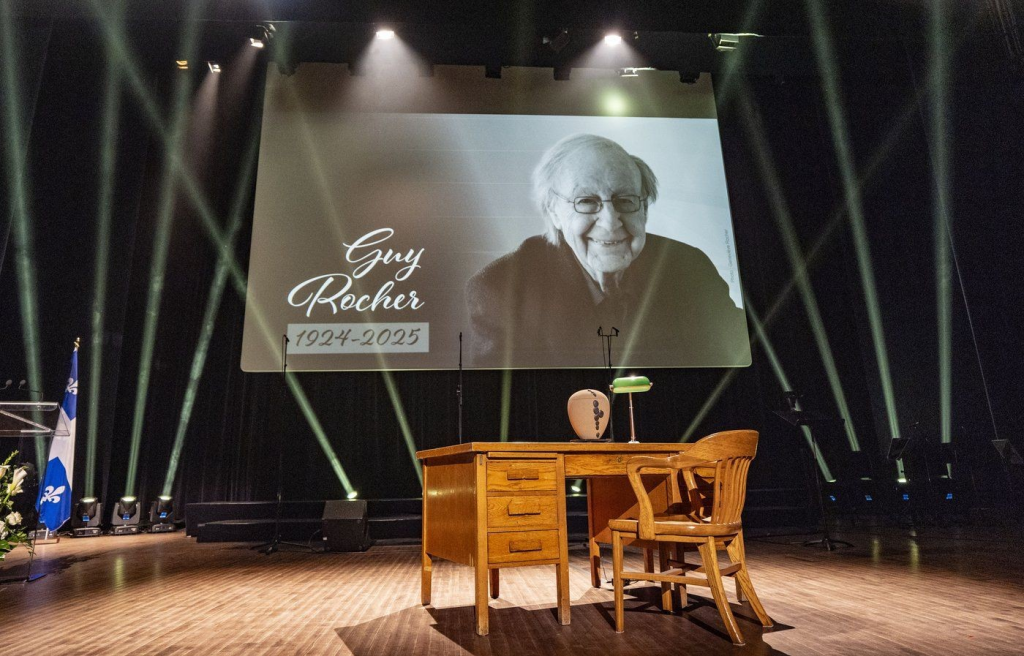
The public and dignitaries flocked in large numbers Thursday afternoon to pay their final respects to the eminent sociologist Guy Rocher during a ceremony held at the Université du Québec à Montréal (UQAM).
The thinker, born in Berthierville on April 20, 1924, died at the age of 101 on September 3.
The Quebec government, with the consent of his loved ones, chose to hold a state funeral for the man who initiated several major changes in Quebec’s contemporary history.
Upon his arrival at the ceremony, held in the Pierre-Mercure Hall at the Montreal university, Premier François Legault recalled the sociologist’s “immense contribution” to Quebec.
Rocher was notably a member of the famous Parent Commission, which laid the foundations of the modern education system.
He played an important role in defending access to education for all and advocating for the secular nature of educational institutions. He was also one of the architects of Bill 101, which made French the official language of Quebec, adopted by the government of René Lévesque in 1977.
Legault cited the importance of this architect’s writings, particularly those on the place of secularism in Quebec. “Even I and my government still use Guy Rocher’s writings to draw inspiration from the place of secularism in our shared values,” he said during a press briefing.
For PQ leader Paul St-Pierre Plamondon, Rocher embodied “the emancipation of Quebec.”
“His work is colossal, very positive for Quebec, but it is also an unfinished work, by his own admission,” he said shortly before the national ceremony.
The public had already gathered in the morning at the chapel of rest, where his urn was on display, in the Agora of the Judith-Jasmin Pavilion at UQÀM, the university of which he is one of the founders.
Several of the distinctions he received throughout his career were visible nearby, amidst flowers.
The choice of this location was highly symbolic, since it is the former Saint-Jacques Church, which became secular “like he himself became in the 1960s,” explained UQÀM Rector Stéphane Pallage.
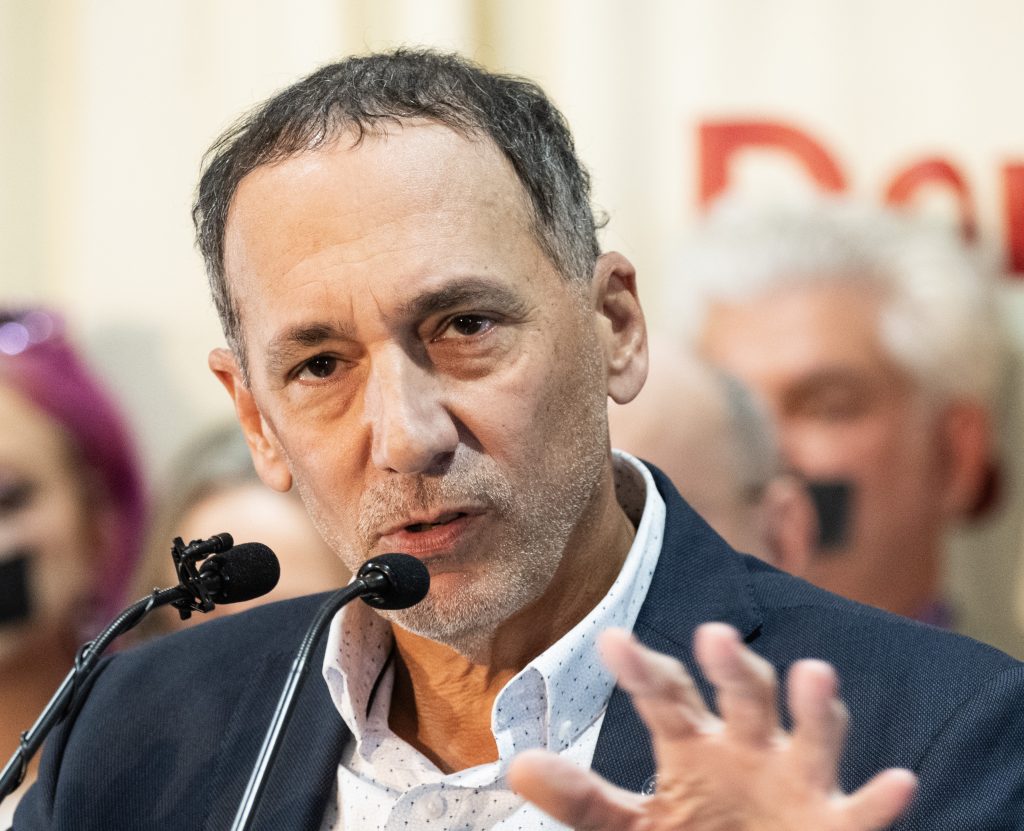
For social worker and union activist Gérald Larose, it was a “duty” to come and pay his respects one last time to Rocher, whom he considers “the father of modern Quebec.”
“He was a revolutionary, but also calm because he always had progressive ideas. And at 100 years old, he still had them,” he said.
Among the crowd lining up, several dignitaries also came to offer their condolences to the loved ones of one of the greatest intellectuals and architects of the Quiet Revolution.
“We remember what a great builder of modern Quebec this man was,” stressed Minister of Higher Education Martine Biron during a press briefing. “He taught us that it was important to learn, and that made us, the people of Quebec, stronger, and I think this work must be continued,” she added.
Pride in teaching
If there’s one thing to remember from Rocher’s work, it’s the importance of academic freedom, according to Pallage.
“We must always put freedom first, freedom of thought, freedom to create, freedom to teach, academic freedom in fact, it’s an essential value in a democratic society,” he said, noting that this freedom is “under attack in many places today.”
Pauline Marois, the former Premier of Quebec, recalled once asking him what he was most proud of in all his accomplishments.
“He told me it was my 50 years of teaching because I was a facilitator, I helped people become responsible citizens. And that was his greatest contribution to Quebec,” said the man who is now Chancellor of UQÀM.
The Quebec flag was also flown at half-mast on the central tower of the Parliament Building during the funeral.
–This report by La Presse Canadienne was translated by CityNews