McGill researchers develop breakthrough hydrogel to heal damage vocal cords
Posted October 10, 2025 12:47 pm.
A team of researchers at McGill University has created a hydrogel that shows promising results in healing vocal cord injuries, offering new hope to patients suffering from voice loss or chronic damage.
In preclinical studies, the gels outperformed current treatments by lasting longer and potentially reducing the need for repeat procedures.
Scarring of the vocal cords can lead to permanent vocal impairment. Current injectable treatments degrade quickly, requiring patients to undergo repeated procedures that can further damage delicate tissue.
Researchers say the gel is made from natural tissue proteins processed into a powder and converted into a gel. To make it last longer, the team used a process called click chemistry.
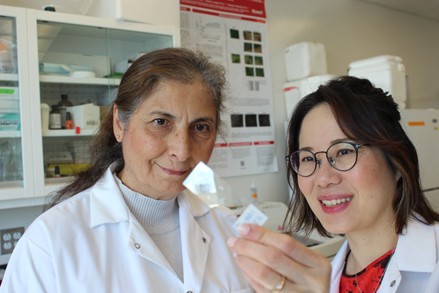
“This process is what makes our approach unique,” said co-senior author Maryam Tabrizian, professor in McGill’s Department of Biomedical Engineering and Canada Research Chair (Tier 1) in Nanomedicine and Regenerative Medicine. “It acts like a molecular glue, locking the material together so it doesn’t fall apart too quickly once injected.”
According to the U.S. National Institutes of Health, approximately one in 13 adults suffers from a voice disorder each year.
Vocal cord injuries are especially common among older adults who have acid reflux or who smoke, and people who use their voices professionally, such as singers, teachers and radio hosts.
“People take their voices for granted but losing it can deeply affect mental health and quality of life, especially for those whose livelihoods depend on it,” said Li-Jessen, associate professor in McGill’s School of Communication Sciences and Disorders and Canada Research Chair (Tier 2) in Personalized Medicine of Upper Airway Health and Diseases.
The researchers are hoping to continue their research by testing the gel in computer simulations that mimic how it behaves in the body. Once those results are validated, they hope to move toward human trials.
If successful, researchers say the work could pave the way for a minimally invasive, longer-lasting treatment for voice loss.