Quebec doctors call Premier Legault’s threat of special legislation a ‘slap in the face’
Posted October 23, 2025 9:50 am.
Last Updated October 23, 2025 10:03 pm.
The Fédération des médecins spécialistes du Québec (FMSQ) is calling Premier François Legault’s threat to impose special legislation to force through changes to compensation and put a stop to pressure tactics is a “real slap in the face.”
Legault says if a breakthrough is not achieved in negotiations with doctors by Friday, the special legislation would break the impasse. The special law would change doctors’ compensation linking 15 per cent of their income to performance and also make it illegal for them stop teaching students.
“The government never intended to listen or truly negotiate, neither with the FMSQ nor with any other of the stakeholders involved. The latest tabling is indisputable proof of this. Today, the government’s approach could not be clearer: coercion, sanctions, special legislation, and so much the worse for democracy,” said FMSQ president Dr. Vincent Oliva in a statement.
Legault’s announcement followed the government’s fourth and “final offer” to the FMSQ and the Fédération des médecins omnipraticiens du Québec (FMOQ). The FMSQ rejected the offer, calling it a “declaration of war” and a setback in the mediation process.
“The premier’s announcement, a real slap in the face for experts, came just hours after his government’s new submission aimed at ‘relaunching’ negotiations, but which was described as final with 24 hours’ notice. The content of this latest submission was also in line with the health minister’s attitude, as he backed down, or even withdrew, several offers already made,” the FMSQ wrote Thursday.
“In response to this proposal, and in an effort to be constructive, the federation proposed non-binding arbitration aimed specifically at resolving the current impasse with the help of a neutral third party.”
The framework agreement with the FMSQ and the FMOQ, Quebec’s federation of family doctors, expired two years ago.
“When we’re short 2,000 doctors in Quebec, to say that we’ll be penalized for not reaching targets when we’re this short is absurd,” said Dr. Michael Kalin, a Montreal family doctor.
“Let’s actually fix the system. Sit down with the leadership of the family doctors and the specialists, get an arbitrator, make it binding. Why is the government so afraid of arbitration? Yet they refuse to do it. Is it perhaps that their position is unreasonable, that it’ll be defeated?”
“This is utterly counterproductive and unfair,” added Montreal lawyer Julius Grey. “But I don’t think it can be stopped because, well, Medicare is not part of the Charter of Rights and they can make rules about the remuneration of doctors.”
Health Minister Christian Dubé called on the two federations to “take advantage of this last opportunity” to propose “significant progress.” He said in a press briefing Thursday that he found it “normal” that “change management” leads to “resistance” among doctors. However, he argued that there was an “urgent need for action.”
“How can you make a professional act more efficient?” asked Paul Brunet , the chair of the Council for the Protection of Patients. “Are you going to tell the doctor don’t spend one hour with this patient who needs more help than others, just spend the 15 minutes with him. It doesn’t make sense.”
Keeping doctors in Quebec
The Quebec premier is promising to take steps to prevent doctors from leaving Quebec to work elsewhere.
“To curb the exodus, will there be measures in the law?” a reporter asked Legault. “Yes,” the premier replied
“Some provinces have done this, like Ontario and British Columbia. What we’re saying, and we’re being really reasonable, is that we’re taking 15 per cent of the compensation and we’re saying we have to achieve objectives. Among the objectives, among others, is patient care by locality, by region, and nationally.”
Dr. Lyne Couture, the president of the Association of General Practitioners of Laurentians–Lanaudière, says what the government is doing is “clearly anti-democratic.”
“There is a shortage of 2,000 family physicians,” Couture told CityNews. “So bear in mind that fact. We cannot take everybody, unfortunately it’s not that we do not want. So bear in mind that with that kind of shortage, we cannot do what the government wants us to do.”
Legault says he hopes there will be “significant progress in the negotiations” and Thursday. “We still hope to reach an agreement.”
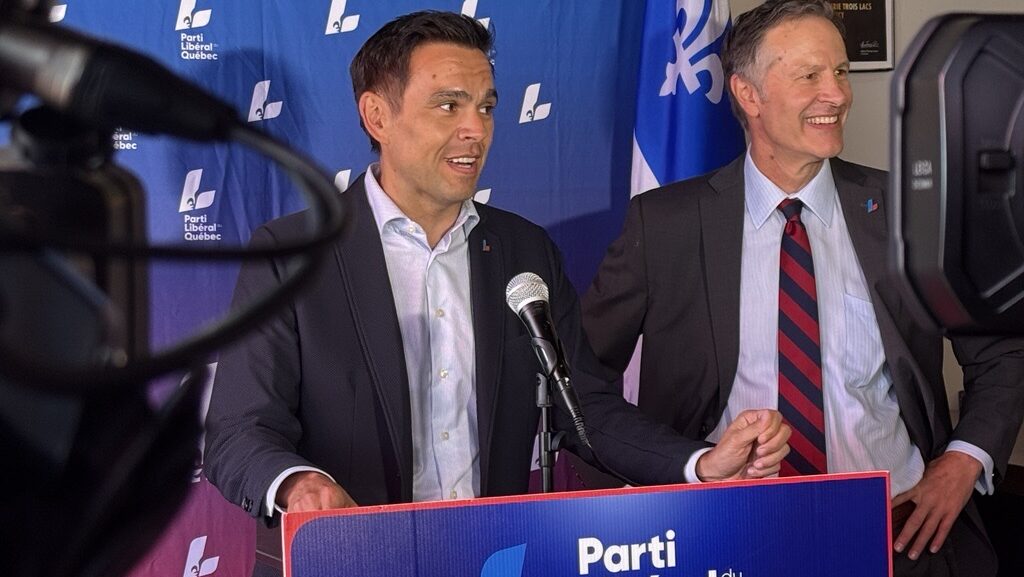
Liberal health critic Marc Tanguay says special legislation would demotivate doctors, who risk quitting, which would have repercussions for patients, he said.
Tanguay also argued special legislation would only worsen the situation in the fragile health care system.
“Every woman and man in Quebec is free to say: ‘Well, you know what? I’m retiring. You know what? I’m going to Ontario.’ (…) In the coming days, things won’t get better in the network, they’ll get worse,” he insisted.
“We’re always better off with a poorly negotiated agreement than a special law imposed; that’s a pretty basic rule in labour negotiations,” added his counterpart at Québec solidaire, Vincent Marissal.
Teaching of medical students to resume
The medical federations, which are demanding that they be given the resources to perform more procedures, have been exerting pressure, including stopping the teaching of medical students.
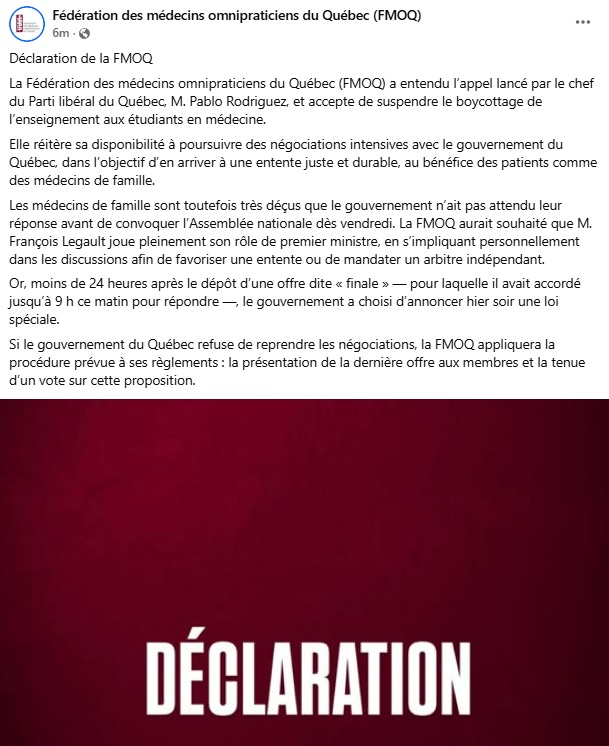
On Thursday morning, the FMOQ said it was suspending that pressure tactic in order to pursue “intensive negotiations” with the government.
“We’ve heeded the call made by the leader of the Quebec Liberal Party (PLQ), Pablo Rodriguez, and agree to suspend the boycott of teaching medical students,” the FMOQ wrote in a statement Thursday morning.
They reiterated their “willingness to continue intensive negotiations with the Quebec government, with the goal of reaching a fair and lasting agreement for the benefit of both patients and family physicians. Family physicians are, however, very disappointed that the government did not wait for their response before convening the National Assembly on Friday. The FMOQ would have preferred François Legault to fully play his role as Premier, by personally involving himself in the discussions to promote an agreement or mandate an independent arbitrator.”
They added that if the Quebec government refuses to resume negotiations, “the FMOQ will apply the procedure set out in its bylaws: presenting the final offer to members and holding a vote on this proposal.”
“They want to apply a special law because of the boycott on teaching,” said Couture. “So if we remove the boycott on teaching, there’s no reason to apply a special law anymore. That’s what our thinking is.”
-With files from La Presse Canadienne and Gareth Madoc-Jones