Quebec special legislation explained: Q&A with Montreal family doctor
Posted October 27, 2025 1:38 pm.
Last Updated December 3, 2025 2:36 pm.
Tensions are running high after Quebec passed a special law changing how doctors are paid in the province. The legislation also restricts collective action among physicians.
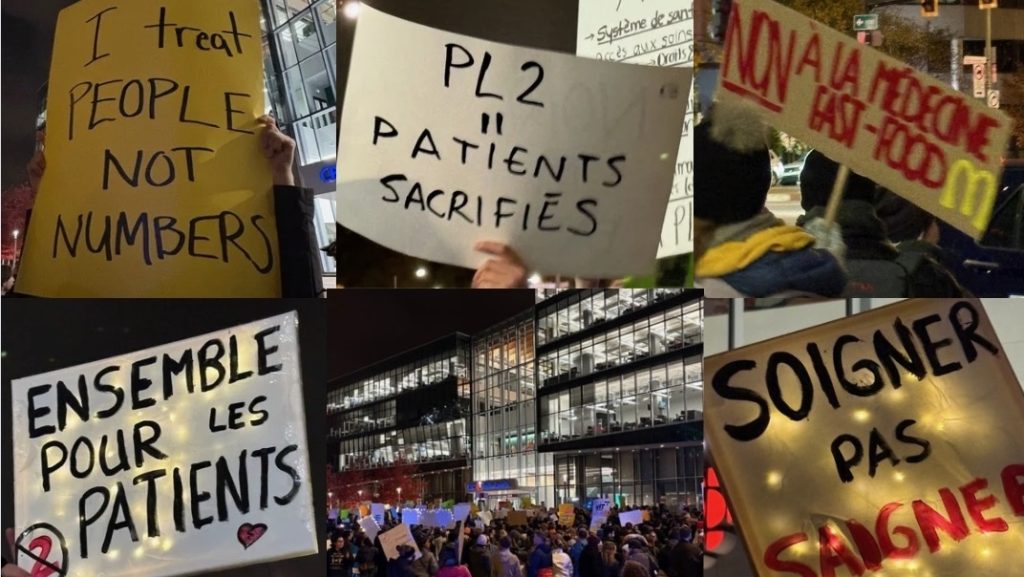
On Sunday, hundreds of doctors protested outside Radio-Canada as Health Minister Christian Dubé defended the legislation at popular TV program “Tout le monde en parle.”
Among them was Montreal family doctor Michael Kalin, who is also the coordinator of the Département Territorial de Médecine Familiale de Montréal (DTMF). He joined CityNews to break down what the new special legislation means for doctors.
Just to start off, could you just briefly explain what is the DTMF?
The DTMF is a regional board of family doctors. We are elected and appointed, and we’re tasked with overseeing the implementation of government policies with respect to primary care manpower. So we have to find the doctors to take care of the patients, to staff the institutions, to help out with home care. And as you can imagine, this task became incredibly, incredibly difficult as of Friday as this new law was put into effect.
So just talking a bit about what happened yesterday, what kind of message were you hoping to send with your fellow doctors and colleagues at this protest?
Well, we had to assemble. On Friday last week, the government passed exceptionally Bill 2, which was based on Bill 106. And they did this through a gag order bypassing normal legislative activity and process. And in this, they passed a bill, which on its surface sounds wonderful, which is to improve patient access to primary care. But in effect, that’s the exact opposite. And this legislation was also coupled with some very punitive actions against doctors, really blocking our ability to mobilize, to protest, to move, to change our practice profile. And so the ability to have a spontaneous demonstration outside where the minister was defending this horrible, horrible bill was very invigorating. It felt wonderful to be among colleagues and friends who really together collectively were standing out for our rights as citizens, our professional rights as physicians, but also for our patients. Because at the end of the day, make no mistake, Bill 2 is terrible, terrible for patients. And we care deeply about our patients. And this is why we went to Radio-Canada last night to protest, to have our voices heard.
Can you explain what concerns you the most about these new restrictions?
A lot of people have asked me about what is Bill 2. And it’s very convoluted. So I’m going to try to make it as simple as possible. There are 1.5 million Quebecers without a family doctor. The government wants to, on paper, say that everybody has a family doctor. So what they’ve done is, even though we are 2,000 doctors short, they’ve said all these 1.5 million Quebecers will now be assigned to existing doctors. Oh, and by the way, for you doctors, we’re going to pay you less. We expect you to work longer. And if you don’t see patients quickly, we’re going to find you. So what does this mean for a patient? Well, it means that all of a sudden it became much harder to see your own doctor. It also means you have less time with your doctor. This is not good for anybody. We all recognize this. It’s a political stunt to make it look like they’ve made good on a promise, which was that every Quebecer will have a family doctor. But you can’t solve a problem by dumping it on the existing system. The existing system doesn’t work. It needs to be fixed. And I think that patients recognize this. They see how hard their doctors are working. We’re not lazy. We’re committed. And to spend less time with patients, to take on a greater patient profile will not make this any better. In fact, it will make it significantly worse. And that really troubles us. And this is why we were out last night, to really stand up for our patients.
And what kind of dialogue or solution would you like to see moving forward between the government and the medical community?
One word: arbitration. It’s just that simple. The two sides have been talking about this for years. Obviously, more intensively in the last few months, it was a brief attempt at a mediator, which failed. Go to arbitration. Have an impartial third person to sit down with who will have an opportunity to listen to both sides, to look at the numbers, the finances, the needs, what’s worked, what hasn’t, and come up with a solution that’s binding. They did this in Ontario recently. And everybody’s happy. And why can’t we do that in Quebec? Why is the government so frightened to sit down with an arbitrator and get a solution that works for everybody?
Do you think come October 2026, there should be a new government?
I think that this government has clearly failed in its mandate. When we look at what we need, which is a viable healthcare system that treats everybody promptly, well, with quality care, with respect on all of these fronts, at all of these points, the government has failed miserably. Now, let’s be honest, governments before them have also failed. We can look back 10 years ago to Minister (Gaétan) Barrette and his failed attempts at reform and how disastrous that was. We look at COVID and how people really, really suffered and died as a result of a lot of the measures that were put in place. This is going to be much, much worse. It is terrible.
“This policy, this law, you would think came out of Cuba, North Korea or the Soviet Union.”
–Montreal family doctor Michael Kalen
It is unreal. People are in absolute disbelief how it is basically trampled on our fundamental constitutional rights, our ability to protest, to move. Doctors will be fined between $500 and $2,000 a day for protesting, for going on strike. Doctors are expected to work 252 days a year, every weekday. We’re not allowed vacation. If we want to take a day off, we will be fined 40 per cent of our usual salary for that day. You heard me right. Doctors are not entitled to vacation. We don’t get pensions. We don’t get sick days. We’re expected to work longer hours. Yet, at the end of the day, it’s all about patient care. The government can punish doctors as much as they want. It will not improve patient outcomes because we need more physicians. We need more resources. We need more nurses, social workers, nurse practitioners, because this is a team effort. It starts at the top, at the minister of health to recognize the real needs, and dumping the problems on the shoulders of family doctors is not going to solve anything. We need real solutions.