Religious symbols ban: Quebec passes law to prevent students, staff from covering their faces
Posted October 30, 2025 3:33 pm.
Last Updated October 30, 2025 6:25 pm.
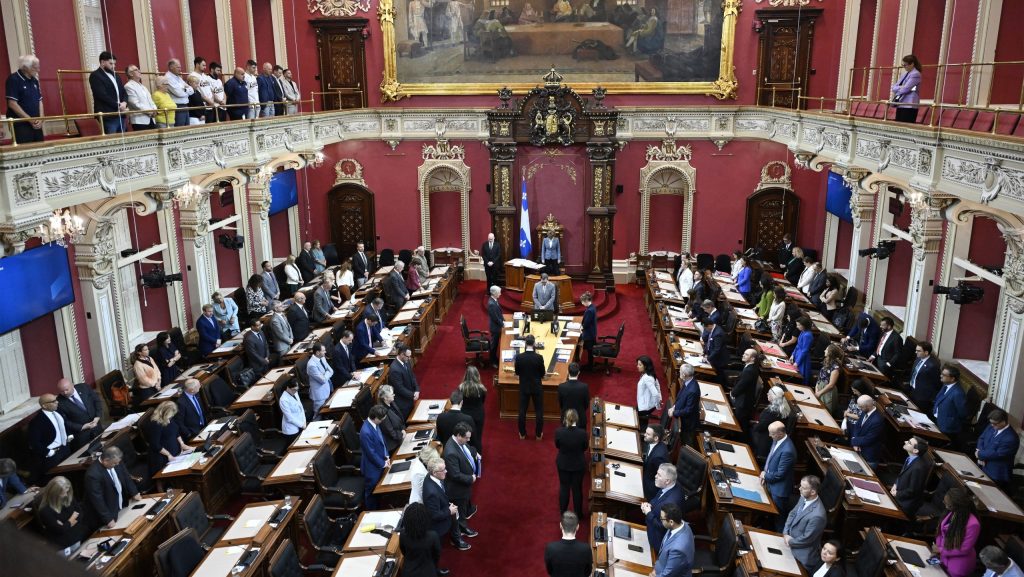
The Legault government passed Bill 94 on Thursday, aimed at strengthening secularism in the Quebec school system.
From now on, students will have to attend school with their faces uncovered, as will virtually all school staff.
In addition, menus adapted to religious restrictions will be prohibited, as will absences or leave granted to staff for religious celebrations that are not included in the school calendar.
This law follows the controversy of fall 2024 over the Bedford public school in Montreal, but the CAQ government has already indicated that another bill on secularism will be tabled in the coming months, this time to impose secularism in subsidized daycare services.
Bill 94 was adopted Thursday morning by a large majority, 70 to 27. The CAQ government members voted in favour, as did the Parti Québécois members, while the official opposition Liberals and Québec solidaire voted against.
The law was sanctioned shortly afterwards by the lieutenant governor.
The legislation is very broad in scope. For example, the ban on wearing religious symbols extends to people working under agreements with educational institutions.
This affects the daycare worker, the educational advisor, the psychologist, the library volunteer, the janitor, the cafeteria staff, the hockey coach in the context of a particular project, etc.
Furthermore, no school premises may be made available for religious practices, even outside of class hours.
In addition, a language requirement has been added. The use of French at school becomes mandatory when staff communicate with students or when colleagues speak to each other.
But the government has relaxed the rule. If the child’s integration depends on the initial use of another language, that other language will be permitted.
Quebec is also tightening school conduct rules to prohibit expressions of hatred and discrimination.
The student must respect gender equality, but must also adopt a behaviour free from any form of intimidation or violence, motivated in particular by racism, sexual orientation, sexual or gender identity, homophobia, a disability or a physical characteristic.
Amendments have been made to the original text. For example, there will no longer be any accommodation to the obligation of school attendance for religious reasons, but also for other reasons.
Also, teacher evaluations have been made more flexible. They will now be done every two years.
The proposal for a committee on educational services was also withdrawn.
In a statement, the Quebec Association of Autonomous Parents’ Committees welcomed the adoption of the law and “the pragmatism of the parliamentarians.”
It was the case of the Bedford School, in Montreal’s Côte-des-Neiges, that prompted the government to tighten the screws on secularism.
In this institution, a group of North African teachers created a toxic atmosphere.
Girls were banned from playing soccer, children on the autism spectrum were denied specialized services, and science and sex education were poorly taught or not taught at all. Eleven teachers at Bedford School have since been suspended.
Following the events in Bedford, the then Minister of Education, Bernard Drainville, dispatched investigators to 17 schools where violations of the secularism law had been reported. The report mentions that in one school, students were wearing religious symbols that covered their entire faces.
–This report by La Presse Canadienne was translated by CityNews