New safety recommendations for snow mounds in Drummondville schools draws skepticism
Posted December 16, 2025 12:33 pm.
Last Updated December 16, 2025 5:25 pm.
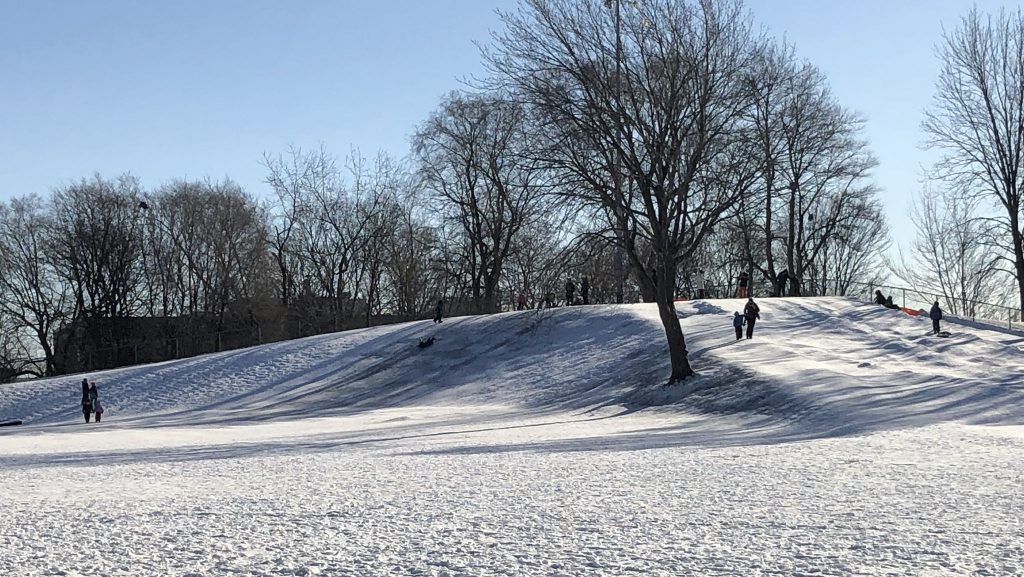
Some Quebec schools have are following new safety recommendations for snow mounds. Centre de services scolaire des Chênes (CSSC) in Drummondville has asked its schools to follow new regulations for snow mounds where children play.
Among the rules are: snow mounds should be between 1.8 and three metres, have an inclination of no more than 25 degrees, have recovery and waiting area. Children would need to wear helmets if these rules are not followed.
“The way it works is that the snow removal crew brings in the snow pile and the administration visually checks to see if there are any pieces of ice that could be dangerous for children sliding or playing,” CSSC director of communications Normand Page said in an interview.
In an interview with Tout un matin on Radio-Canada, Tuesday morning, Premier François Legault expressed his skepticism on the guidelines. “It doesn’t make sense.”
“I understand that it has to be safe, but starting to put helmets in the schoolyard, I find that a bit excessive,” he added. “I think we should leave it up to the school principals to decide.”
Education Minister Sonia LeBel echoed Legault. In a social media post, she wrote, “I’m simply inviting the administrations to exercise their judgment, as with all outdoor activities!” asking schools to ensure that students can play and enjoy the winter in an appropriate environment.
For Katherine Korakakis, president of English Parents’ Committee Association, snow mounds that block school entrances are a bigger safety concern.
“[W]hen you’re looking at elementary school kids, you have to like physically bring them over the mound,” Korakakis said. “Like it’s harrowing.”
She added that if there are rules about snow mounds, it should be applied across all schools. “You can’t have schools where some rules apply and some [where they] don’t.”
Page said that since 2022, there have been some incidents involving children playing on snow piles.
“I have had some complaints about broken glasses, broken teeth, and concussions,” Page explained. “But there have never been any complaints about snow piles or unsafe equipment.”
Page explained that the new “recommendations and advice” sent to schools came from CSSC’s insurer Union mutuelle d’assurance scolaire du Québec (URASQ) and not from the Quebec government.
“As policyholders, when we receive communications from our insurer containing recommendations or advice, we forward them to our network,” Page added.
He explained that following the insurer’s guidelines would be important if there were to be any incidents.
“What any insurer will do is ensure that if there are any claims or legal proceedings, for example, if there has been an accident, then it will be necessary to prove that the service center is at fault,” Page said.
That message was echoed by Dominique Robert, president and CEO of la Fédération des centres de services, who added that it’s ultimately up to the individual school administrations to use their best discretion to ensure students’ safety on snow banks.
“Should we have rules governing snow mounds? The answer is yes,” he said. “Every school district and every school has its own rules to limit risk. The challenge is to ensure that we limit the risk so that children can have fun, because that is the ultimate goal: for children to be able to play and have fun, but with limited risk.”
In an email to CityNews, URASQ said that its recommendations were meant to mitigate risks.
“The main issue remains the exercise of due diligence to ensure the safe conduct of the activity, in the best interests of the children,” said Caroline Vermette, director general of URASQ.
Vermette said that the measures were consistent with existing practices. “The URASQ recommendations do not impose a new burden on school staff,” she added.
The recommendations from the insurer includes:
- The height of the track must be between 1.8 and three meters.
- The track must have a slope of approximately 25 per cent.
- A recovery and waiting area must be marked out.
- A daily inspection must be carried out (safety, snow conditions, imperfections, presence of water and ice, etc.).
- A verification log must be implemented.
- A monitoring plan must be developed.
- A schedule for using the hill (rotation by age and skill level) must be created.
- A communication plan must be developed and sent to parents.
- If the snow hill does not meet standards, helmets must be worn.