Plains of Abraham remarks: Carney refuses to apologize, stands by his words
Posted January 26, 2026 10:32 am.
Last Updated January 26, 2026 1:01 pm.
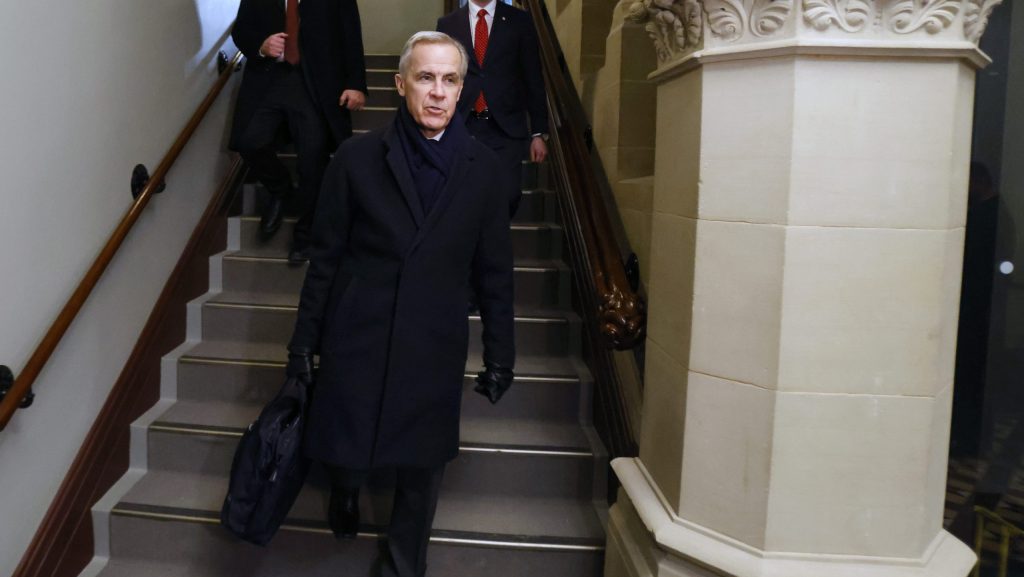
Prime Minister Mark Carney refuses to apologize for the way he presented the English conquest in a speech delivered last week on the Plains of Abraham, which has earned him severe criticism, particularly from the Quebec government.
On the contrary, Carney stands by his words. “I said that it was because of the resilience of the French-speaking people that Canada was created, a Canada that recognizes two founding peoples and, after a certain period of time, three founding peoples, including Indigenous peoples,” he said Monday during a press briefing in Ottawa.
The controversy erupted on Thursday when Carney said in a speech on Canadian unity that the Plains of Abraham, where he was speaking, symbolized the beginning of a “partnership” between two peoples. According to Quebec, the prime minister is being dishonest and is blatantly attempting to rewrite history.
The annoyance stems from the fact that the Plains do not represent any kind of intercultural dialogue. It was a battlefield where the English defeated French troops, who then lost control of New France. The change of regime was achieved by force, and there was a significant attempt to assimilate French speakers linguistically.
Returning to his comments, Carney insisted that he had acknowledged the “very difficult” passages in history. He cited the Durham Report—which recommended the assimilation of French Canadians by establishing the dominance of the English-speaking majority in Upper Canada—and the deportation of the Acadians—mainly due to their refusal to swear unconditional allegiance to the British Crown.
The ‘genius’ of Canada
“It’s a very difficult story,” said the prime minister. “But over time, we have protected and, after another period, strengthened the French language, Quebec culture, institutions such as the Civil Code, and other institutions. And that is the genius of Canada.”
This weekend, several influential Quebec Liberals came to their leader’s defense. Minister Joël Lightbound spoke of “different perspectives” on history, his colleague Marc Miller spoke of “good faith” remarks, and François-Philippe Champagne spoke of one “vision” of history among others.
Bloc Québécois leader Yves-François Blanchet saw things very differently. He officially demanded an apology for what he considered a “deplorable mistake.”
“What the Prime Minister of Canada said about the Plains of Abraham is unacceptable. (…) He should apologize. And a large part of the population would say, ‘Okay, let’s move on, but try to learn what Quebec is, just as you are supposed to learn to speak the language of Quebec.’”
‘The leader of the No camp’
At the same time, Parti Québécois (PQ) leader Paul St-Pierre Plamondon said that Carney’s comments on the so-called “partnership” had effectively launched the referendum campaign for Quebec independence.
St-Pierre Plamondon, whose party enjoys a large lead in the polls in Quebec a few months before the elections, referred to his opponent as the “leader of the No camp.” On Monday, the Prime Minister avoided accepting this title twice when questioned on the subject.
The PQ leader accused Carney of being “colonialist,” of “falsifying facts and history,” and of “making us believe that it is to our advantage to be subordinate and dominated.”
On Monday, during a press briefing to review the start of the parliamentary session in Ottawa, Government House Leader Steven MacKinnon refused to explain how his leader would assume the role of leader of the “No” camp, instead turning the spotlight on economic challenges.
“All politicians would be wise to take into account what is happening in the world, to prepare our country, to protect our prosperity, to open new markets around the world, to diversify our relationships with other countries,” he said. “That is the job of government.”
–This report by La Presse Canadienne was translated by CityNews