‘This is a crisis’: Around 100 research projects halted at Douglas Institute after labs damaged by flooding
Posted February 5, 2026 1:57 pm.
Last Updated February 5, 2026 4:55 pm.
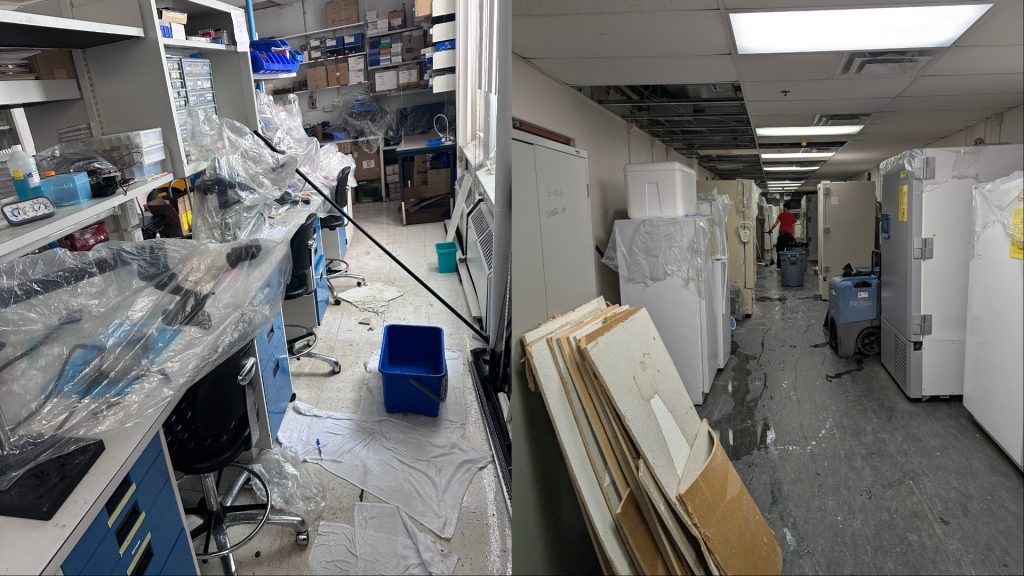
Around 100 research projects have been halted at the Douglas Mental Health University Institute after four laboratories were damaged by flooding last week, a consequence attributed in part to the age of the building.
At a press conference Thursday in Quebec City, Québec solidaire (QS) denounced the Legault government’s inaction on the Douglas Institute renovation project. In 2020, the government announced that the institution would be modernized, but the project has since remained at the planning stage.
Alejandra Zaga Mendez, QS finance spokesperson and MNA for Verdun, the borough where the Douglas Institute is located, implored the Coalition Avenir Québec (CAQ) government to speed things up so that the project moves “as quickly as possible” to the planning stage, then to the execution of the work.
“We are here to ask for only one thing: to quickly accelerate the modernization project for the Douglas Institute. We can no longer wait. This is a crisis that is being experienced on the ground,” denounced Zaga Mendez.
Guillaume Cliche-Rivard, QS’s health critic, insisted that he wants a start date for the work. “What we want is a clear timeline, a clear answer, a financial commitment, a start date for reconstruction, because enough is enough,” he declared. “We can no longer live in these conditions. The patients, the workers, the workers are at their wits’ end. When is the date?”
Just a glimpse of the problems
The Québec Solidaire MNAs were surrounded by professionals from the Douglas Institute who argued that the flooding on Jan. 26 was just a “glimpse” of the extent of the problems. Staff members reported issues with vermin and insulation, noting that elderly patients had to be moved during the winter because they lacked heating, while conversely, rooms overheated in the summer.
A video of the Jan. 26 flooding circulated widely in the media, showing water cascading over laboratory equipment as a sodden ceiling panel collapsed. Local authorities stated that the incident was serious and had damaged the second floor and ground floor of the Lehmann Pavilion. They confirmed that significant water damage occurred in four separate locations along a second-floor corridor of the Lehmann Pavilion.
At a press conference on Thursday, Sylvain Williams, a scientist at the Douglas Institute for nearly 30 years and a professor in McGill University’s Faculty of Medicine and Psychiatry, emphasized that the damaged equipment is very expensive. “Scientific instruments, millions of dollars of public investment, are now in the garbage… a catastrophe,” he said.
He explained that the Douglas Research Centre hosts many university students “who learn how to do research.”
“Now, about a hundred projects have been halted and more than a hundred research assistants, research associates, and students are in limbo. It’s truly a disaster,” he reiterated. The building will likely be closed for months, he added.
The Douglas Research Centre is an international leader in mental health, particularly in its Alzheimer’s research. “Research isn’t just about stopping experiments; it’s also about stopping to find solutions for new treatments and to better understand these diseases,” Williams emphasized.
Water Drops and Patients
Johanne Gouskos, a special education teacher at the Douglas Institute for 26 years, said she had witnessed the “deplorable” deterioration of the facilities for years. “Patients have to walk around empty garbage cans on the floor to collect the water dripping from the ceilings,” she described. “Depending on the weather, the dripping can become noisy and impossible to ignore. The therapist and the person they are treating try to pretend nothing is wrong, but it’s simply impossible.”
Gouskos described the therapeutic environment as unsafe. “This environment is particularly difficult for our patients. A psychotic person may believe that the drops are sending them messages, or another, who has generalized anxiety, may feel aware that the ceilings are collapsing at the Douglas, [and that they can] hardly tolerate the anxiety of being in our facilities.”
“It is shameful that the government has allowed such an institution to deteriorate to this point without any concern for the direct impacts on the mental health of those receiving care, as well as those providing it,” she added.
Zaga Mendez expressed her disappointment with the reaction of Health Minister Sonia Bélanger, who was questioned on the matter. “It’s inaction. The minister hasn’t told us anything new. In fact, she’s telling us it’s an asset maintenance issue, a water damage issue. It’s ignoring reality,” she said.
Minister Bélanger noted that the pipes froze due to the cold, causing the flooding. “I will continue to work with my colleagues within our budgets to ensure that we can at least perhaps improve our asset maintenance,” she stated.
–The Canadian Press’s health coverage is supported by a partnership with the Canadian Medical Association. The Canadian Press is solely responsible for this journalistic content.
–This report by La Presse Canadienne was translated by CityNews