‘They’ve saved easily 70 lives’: Survivors describe fatal Air Canada crash at LaGuardia
Posted March 24, 2026 4:53 pm.
Last Updated March 24, 2026 5:51 pm.
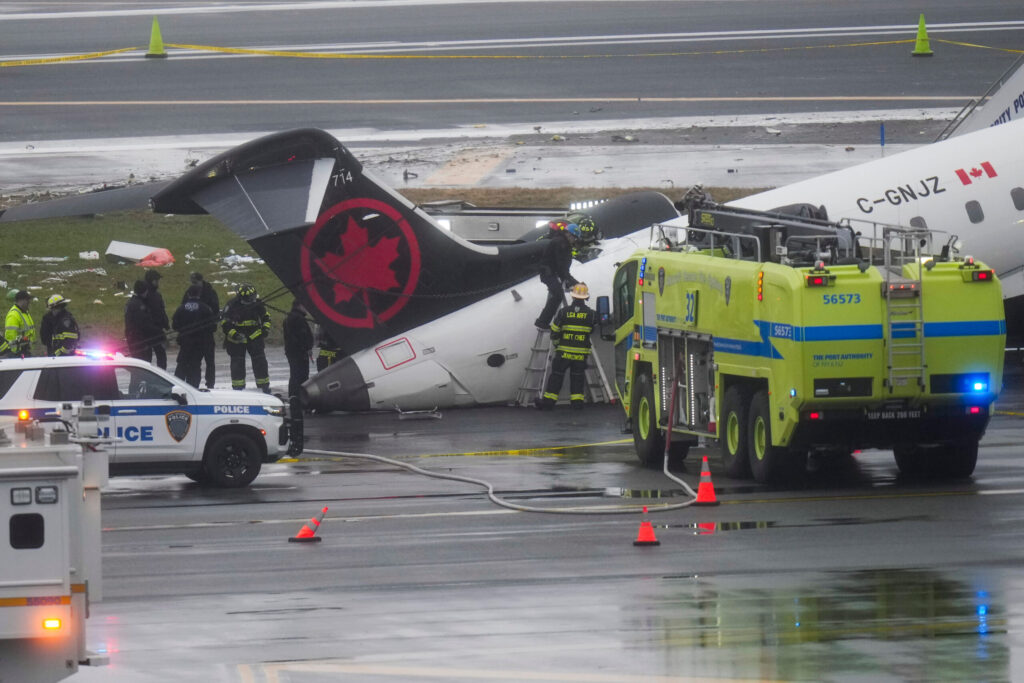
Passengers are recounting moments of “chaos” and “shock” after Sunday’s deadly Air Canada crash at New York’s LaGuardia Airport where an aircraft carrying over 70 people collided into a truck, killing two pilots.
“It was surreal,” said Blake Richards, a Montrealer who was on board the flight.
He said the aircraft’s landing was “seemingly normal” until the pilot braked suddenly. Then, what he thought was just a rough landing turned catastrophic in a matter of seconds.
Richards said he sat on the plane’s 14th row as he watched as the aircraft come apart.
“I saw the cockpit just get ripped from the plane. At that moment everyone was just kind of in shock,” he said.
The crash happened around 11:30 p.m. on Sunday, when Air Canada flight AC8646 collided with a fire truck crossing an active runway.
The truck had been dispatched to assist a nearby United Airlines flight reporting “strange odours” onboard.
Passenger Jack Cabot said he had trouble putting the moment of impact into words.
“It went from a stressful landing to complete chaos and anarchy in just seconds,” said Cabot, a New Yorker. “All of a sudden people are screaming, things are flying, there’s blood.”
Cabot said the only thing on his mind was survival in the moments during the crash.
“I was just hoping I lived, I was hoping I could see my family again”
Cabot said how the plane continued to “spiral out” on the tarmac after colliding into the truck. Then, after the dust settled and once the aircraft stopped moving, the New Yorker said that passengers’ phones began to call emergency services in unison, detecting that they had been in a collision.
“That kind of like unfroze everybody for a second. Everyone turned it off,” he said, “and then someone said, ‘let’s get the door.'”
Richards said travellers waited on the tarmac before being processed inside the airport, only leaving hours later in the early morning.
“It took a long time to process us,” he said. “We left at around five in the morning.”
Even as they returned home, many said the shock lingered.
“I’ve just been in a kind of liminal space,” Richards added.
‘They’ve saved easily 70 lives’
Among those killed was Quebec pilot Antoine Forest.
In a social media tribute, his brother said Forest had always dreamed of becoming a pilot and “left too soon,” but could “leave with his head held high.”
Passengers also pointed to the actions of the flight crew in the final moments before impact.
Cabot said he chose to speak to CityNews following encouragement from his family, who saw it as an “opportunity to talk about the pilots and their bravery.”
“They chose to hit the brakes as hard as they could, knowing that it might be the end of their lives,” Cabot said. “And to that, they’ve saved easily 70 lives.”
Aviation experts say early indications point to a possible breakdown in communication.
John Gradek, faculty lecturer in aviation management at McGill University, said there is typically no direct line of communication between aircraft and ground vehicles.
Instead, both rely on ground control.
“If there was a weak spot in that process, it was with the ground controller,” he said. “In most of these situations, there is something that happened, that an individual misspoke or miscommunicated and just did not realize.”
According to Gradek, investigators will now likely work to reconstruct the final minutes before the crash in precise detail.
“They’re going to turn the clock back about four or five minutes before the incident and go second by second,” he said.
After an initial phase focusing on establishing the facts, Gradek said investigators will turn to a deeper examination into why the collision happened. This will include interviews with those involved and factors like fatigue and stress, he said.
“They’ll want to know things about sleep patterns about the controller,” Gradek said.
Trying to move forward
For survivors, the focus is now on recovery.
“I stayed with a friend last night. Got into a better headspace. Took the first flight I could,” Richards said, after arriving to Montreal Tuesday afternoon.
Cabot said returning to normal life is his next step.
The 22-year-old student said he arrived back home on Monday and has been spending time with family and friends as he recuperates. He’ll be returning to classes at Ithaca College soon.
“I just kind of want to move on with my life,” Cabot said.