Quebec will assign every Quebecer to a CLSC to improve access to healthcare

Posted March 27, 2026 10:46 am.
Last Updated March 27, 2026 5:25 pm.
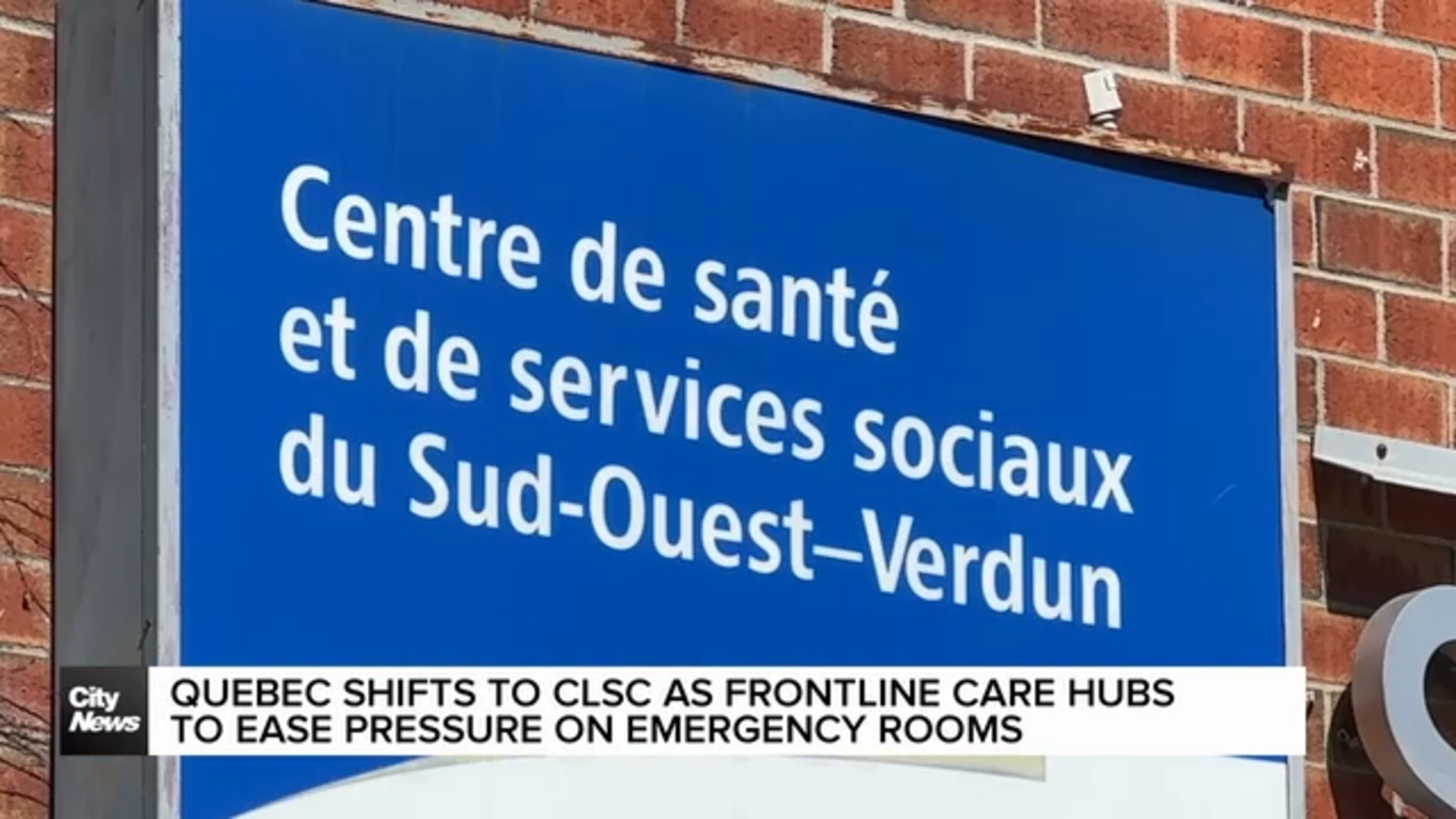
Every Quebecer will now be affiliated with a local community service centre (CLSC) in their area to receive care close to home. This was announced Friday morning by the Minister of Health when she unveiled the government’s policy on primary care and services.
“To realize our vision of a frontline close to the community, we will ensure that CLSCs can once again become a physical gateway for access to frontline services for all those who need them,” said Health Minister Sonia Bélanger at a press conference, adding that “CLSCs are a source of pride for Quebecers, a founding idea of our public system.”
As for what will concretely change in access to care in the CSLCs, Bélanger had difficulty formulating a clear answer, since it is Santé Québec that will be in charge of operating everything and the Ministry of Health is mainly announcing a vision.
A patient who used to go to the emergency room for their health problems will likely not be able to go to the CLSC hoping for faster treatment. At best, they will be assessed and referred to another health service.
“Let’s get a nurse in there and take the load off that doctor and let the doctor see the sickest patients,” said Nathan Friedland, nurse. “Why are you going to see a physician for an ear infection or a urinary tract infection or a laceration that a nurse or nurse practitioner can deal with?.”
For psychosocial issues, it will be different. Bélanger said that CLSCs will be there to support people. “Family Medicine Groups (GMFs) will be there to provide care, appointments, and walk-in services. CLSCs are something else entirely. Generally speaking, a CLSC is a local community service centre. Let’s not forget that. It’s not an emergency clinic. A CLSC is really there to organize primary health services, mental health, home support, youth services, maternal and child health, etc.,” explained Bélanger
While in Saint-Hyacinthe to announce aid to a business, Premier François Legault emphasized that for the past 20 years, all health reports have indicated that addressing the system’s problems must begin at the primary care level. “CLSCs should be the entry point to primary care, and that doesn’t preclude having family medicine groups (GMFs),” commented Legault.
It’s worth remembering that from the moment they opened in the 1970s, doctors shunned CLSCs. Even today, few doctors work in CLSCs, as they prefer family medicine groups (FMGs). “When we talk about rural areas, it’s possible that some doctors, because they don’t have an FMG, will set up practice in a CLSC, and we’ll applaud that. In urban areas, it can be different,” acknowledged Mélanger.
In a press scrum, the president of the Quebec Federation of General Practitioners (FMOQ), Dr. Marc-André Amyot, emphasized that some doctors work in CLSCs (local community health centres). When asked if there would be more doctors in CLSCs with the new government policy, he replied that he didn’t think it would change “the orientation of where doctors practice.”
“In the best-functioning health systems in the world, they talk about local governance. We seem to want to move in that direction, bringing together all community actors, medical professionals, pharmacists, nurse practitioners, all clinics together, to determine the right care based on location,” added Dr. Amyot.
While we wait for concrete actions
The Quebec Provincial Association of Users’ Committees (RPCU) reacted Friday in a press release. It believes the government’s intention is good, but criticizes the timeline it has set for itself. “Users of the network cannot afford to wait a full decade before seeing concrete results.”
The Quebec Interprofessional Health Federation (FIQ) welcomes the intention to give CLSCs a central role in welcoming, guiding, and coordinating services. However, it questions how the government’s objectives will be achieved.
“CLSCs should not simply become a new access point,” emphasizes President Julie Bouchard in a press release. “If we only refer patients to Family Medicine Groups or redirect them towards self-care, we lose the essence of this new vision.”
The Patients’ Alliance for Health stated that the role of CLSCs has been devalued over the years. “Although the ministerial announcement comes at the end of the mandate, the Alliance is asking Minister Bélanger for immediate action that will quickly lead to the consolidation of primary care, starting with dedicated financial investments,” reads a press release.
As for the Quebec Order of Nurses (OIIQ), it was quite complimentary in its comments. “If we had been asked to write a policy on primary care and services, we would be hard-pressed to do better! Of course, we still have many questions regarding the operationalization of this bold vision, but at this stage, it is important first to recognize the richness of the orientations outlined,” wrote Luc Mathieu, president of the OIIQ.
Eight new IPS clinics
Furthermore, within five years, the government aims to add approximately 100 “integrated entry points” for a total of 205 across all regions of Quebec. Currently, 88 of these are accessible in nine regions.
Minister Bélanger also announced the deployment of eight new nurse practitioner (NP) clinics in the Bas-Saint-Laurent, Laurentides, Gaspésie, Montérégie-Ouest, Lanaudière, and Bellechasse-Sud regions, as well as in Estrie and Montreal. By 2030, there will therefore be 26 NP clinics in Quebec.
At the same time, Bélanger indicated that the Your Health platform would soon be deployed on a larger scale in Quebec. For now, two Your Health pilot projects have been launched in the Bas-Saint-Laurent region and the municipality of Saint-Donat.
“We are well aware that some citizens prefer to use digital or telephone access points. That is why I am announcing that we will be deploying Your Health, which is already launched in two regions and will soon become the only user-friendly and efficient digital access point for all of Quebec. Your Health is a platform that brings together all online services, including the Health Record, Clic Santé and Health Appointments, as well as a technological tool for self-care,” Bélanger explained.
The deployment of the Your Health platform was an election promise of the Coalition Avenir Québec (CAQ) in 2022, which at the time spoke of a “real revolution” that would allow Quebecers “to obtain a medical appointment in person or via telehealth in a single simple and easy step.”
“The number of ambulatory patients that are waiting at emergency wards, if this diminishes, then it means that the system works,” said Paul Brunet, chair for Montreal Council for the Protection of Patients.
—The Canadian Press’s health coverage is supported by a partnership with the Canadian Medical Association. The Canadian Press is solely responsible for this journalistic content.
–This report by La Presse Canadienne was translated by CityNews