Quebec Premier Christine Fréchette leans on experience in pre-election cabinet
Posted April 21, 2026 6:48 am.
Last Updated April 21, 2026 6:08 pm.
New Premier Christine Fréchette has opted for continuity rather than a break with the François Legault era, as several key figures are retaining their positions — albeit with some modifications — in her cabinet.
Excluded by Legault, François Bonnardel returns to the cabinet as Minister of Immigration. He also assumes the role of Government House Leader.
Simon Jolin-Barrette remains Minister of Justice but loses the Canadian Relations portfolio. He is instead given responsibility for Constitutional Affairs. This will allow him to continue his work on the Quebec constitution.
Jean Boulet takes over Canadian Relations and retains the Ministry of Labour.
France-Élaine Duranceau remains Minister responsible for Government Administration and President of the Treasury Board. She also becomes Minister of Cybersecurity and Digital Affairs.
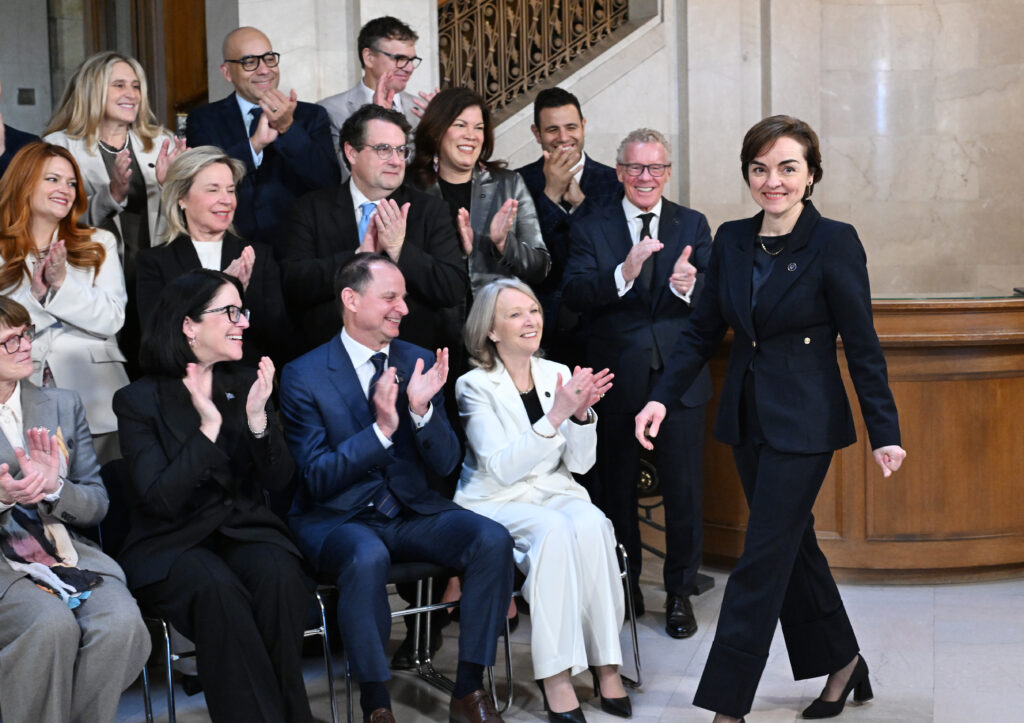
Gilles Bélanger, who previously held this position, is excluded from the cabinet. He had, however, been one of the first to support Fréchette in the Coalition Avenir Québec (CAQ) leadership race. Geneviève Guilbault was also ousted from cabinet.
Jean-François Roberge, who is handing over Immigration to Bonnardel, nevertheless retains the portfolios of French Language and Secularism.
Drainville, super-minister
The defeated CAQ leadership candidate, Bernard Drainville, ultimately obtains the position of super-minister of Economy, Innovation, and Energy.
Ian Lafrenière retains Public Security (renamed Internal Security) and Relations with First Nations and Inuit. He also becomes Deputy Premier.
Eric Girard remains at Finance but takes on Infrastructure; Sonia Bélanger at Health; Sonia LeBel at Education; Martine Biron at Higher Education; Christopher Skeete at International Relations; and Mathieu Lacombe at Culture.
Lionel Carmant returns to the cabinet and resumes responsibility for Social Services and the Fight Against Homelessness.
Several ministers also change portfolios. Pascale Déry moves to the Environment; Kateri Champagne Jourdain to Natural Resources; Jean-François Simard to Employment; and Benoit Charette to Transport.
Samuel Poulin, who supported Drainville in the leadership race, gains prominence by taking on Municipal Affairs.
Donald Martel retains Agriculture; Amélie Dionne, Tourism; Chantal Rouleau, Social Solidarity; and Girard (MNA for Lac-Saint-Jean), Regional Economic Development.
New faces
Among the new faces is the MNA for Chapleau, Mathieu Lévesque, who becomes Minister Delegate for Regions and responsible for Youth.
Daniel Bernard (Rouyn-Noranda–Témiscamingue) will be Minister Delegate for the Economy and Small and Medium-Sized Enterprises, and Catherine Blouin (Bonaventure) will be responsible for Families.
Members of the National Assembly Karine Boivin-Roy (Anjou–Louis-Riel) and Kariane Bourassa (Charlevoix–Côte-de-Beaupré) will become Ministers of Housing and Sport, respectively.

Poll bump and political tests ahead
Early signs suggest Christine Fréchette may be getting a short-term lift.
New polling from Léger shows support for the CAQ rising to 17 per cent, representing a four-point jump from the week before, when she won the leadership.
Pollster Sébastien Dallaire told CityNews that increase reflects a familiar honeymoon trend after a leadership change.
She is associated with change by a portion of voters,” he added. “That’s no small feat.”
The bump marks a rebound for the party, which had dropped to around nine per cent support a month ago under then-premier François Legault.
But Dallaire said the numbers remain fragile, noting that at 17 per cent, the CAQ is still far from secure and could struggle to stay competitive were an election to be called today.
“Maybe the CAQ would manage to maintain a handful of seats, but at 17 per cent? It’s still very dicey,” he said.
For political analyst Daniel Béland, the new cabinet is part of that effort to reset the party’s image.
Fréchette is walking a fine line, he said, by keeping experienced ministers in place while making targeted changes to signal she’s in control.
Part of that messaging lies in promoting formerly-excluded minister François Bonnardel as House Leader and appointing Internal Security Minister Ian Lafrenière as deputy premier, a role that did not exist within Legault’s last cabinet.
The same thinking extends to revoking Justice Minister Simon Jolin Barrette the role of parliamentary leader, someone who Béland said is “very much associated with François Legault.”
“When you have five months before an election and you want to turn things around, you need people who are experienced around the cabinet,” he said. “But you also have to show that you’re now in charge, and some people are no longer part of cabinet.”
–This report by La Presse Canadienne was translated by CityNews