‘Gabie Renaud’ bill tabled in Quebec to protect women from domestic violence
Posted May 13, 2026 12:10 pm.
Last Updated May 13, 2026 6:08 pm.
The Fréchette government tabled the “Gabie Renaud” bill on Wednesday to better protect women from domestic violence. It is hoped it will be adopted before the end of the parliamentary session.
The legislation aims to allow anyone who fears for their safety or that of their child to obtain “information concerning the history of domestic violence of a current or former intimate partner.”
The person at risk will have to fill out a form — online or at a police station — which will be analyzed by the Sûreté du Québec (SQ). Police officers will then search for information, and the relevant details will be communicated to the individual through an organization yet to be determined.
“When the information is provided to the person who made the request, they will be offered appropriate support and referred to the necessary resources,” the government stated.
“The goal is quite simple: to allow a person to make an informed decision about their relationship without imposing a choice on them,” explained the Minister of Internal Security, Ian Lafrenière, at a press conference Wednesday at the National Assembly.
Anyone 14 years of age or older can make this information request. However, the request can only be made to an individual 18 years of age or older.
All relevant information
Police officers will collect any information they deem relevant, not just convictions related to domestic violence. “It has to be relevant to an intimate relationship,” the minister clarified.
The bill uses the concept of “intimate partner,” which it defines as “a person who has or has had an intimate relationship, such as a marital, romantic, or sexual relationship, with a person at risk, regardless of whether they live together or whether their relationship is serious or stable.”
The government deliberately chose a “very broad” definition to “minimize the obstacles to filing applications.”
However, there will be safeguards to prevent applications based on false statements. The bill provides for fines ranging from $500 to $15,000 in this regard.
Fines ranging from $1,000 to $30,000 are also planned if the information disclosed to the person at risk is made public, for example, on social media.
‘It’s very troubling’
The government hopes to pass this bill before the end of the parliamentary session on June 12. The task will be difficult, as the legislative agenda is already quite full.
“There’s a consensus in Quebec. I’m sure we’ll succeed with the help of the opposition,” said the minister. The opposition parties support the CAQ government’s legislative initiative.
READ: Some 600 people sign open letter calling for new Quebec law to prevent femicides
The cost of implementing the bill is estimated at $27.6 million over five years, including $5.2 million for the first year. The government expects to receive 10,000 requests for information per year.
There have been 10 suspected femicides in Quebec since the beginning of the year.
“We’re on track to surpass the number of femicides compared to last year. It’s very troubling. It’s also a little scary because we feel like we’re doing a lot and it seems like it never stops,” said Martine Biron, the minister responsible for the status of women.
‘Not dead for nothing’
The idea for this law has been gaining traction since the death of Gabie Renaud last September, allegedly killed by her partner who had a long history of domestic violence.
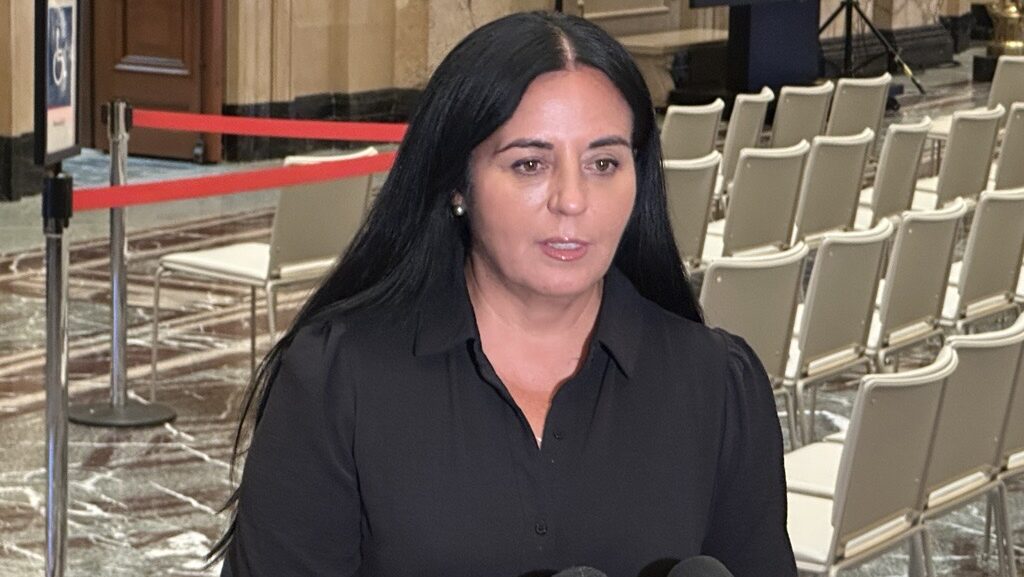
Gabie Renaud’s sister Rachel Renaud spoke Wednesday about the impact of the new law.
“It’s very significant because it makes it that my sister is not dead for nothing,” Rachel said. “We will remember her forever. And she’s helping other women with her name on it. And being victim of a femicide, she will make people understand really what it is, what could happen, and you don’t want to go there. Use the Gabie Renaud law to make sure that you’re safe.”
Rachel says losing her sister has brought tremendous sadness into the lives of many.
“I will never be able to hug her again. I will never be able to tell her I love her again. I will never be able to remind her that she wasn’t alone. These children will grow up without hearing her voice, without feeling her arms around them, without being able to fully experience a mother’s love. And unfortunately, children who lose their mothers in such a violent context will often carry her wounds for the rest of their lives.”
Québec solidaire campaigned for the adoption of such a law, inspired by Clare’s Law. Christine Fréchette then made it a campaign promise during her leadership campaign.
Clare’s Law was adopted in England following the murder of Clare Wood by her ex-partner in 2009. He had a history of violence against women.
Several Canadian provinces have already adopted this type of law, such as Saskatchewan and Manitoba.
–This report by La Presse Canadienne was translated by CityNews