Some 600 people sign open letter calling for new Quebec law to prevent femicides

Posted April 21, 2026 7:25 am.
Last Updated May 7, 2026 7:40 am.
Hundreds of signatories from all walks of life have joined Québec solidaire co-spokesperson Ruba Ghazal in calling for the adoption of a law and other “strong” measures to prevent femicides.
Since the beginning of 2026, nine suspected femicides have occurred in Quebec in the context of domestic violence, the same number as for the whole of 2025.
In an open letter published Tuesday morning in “La Presse”, the signatories directly appealed to the new premier, Christine Fréchette, to act “now” to prevent further tragedies.
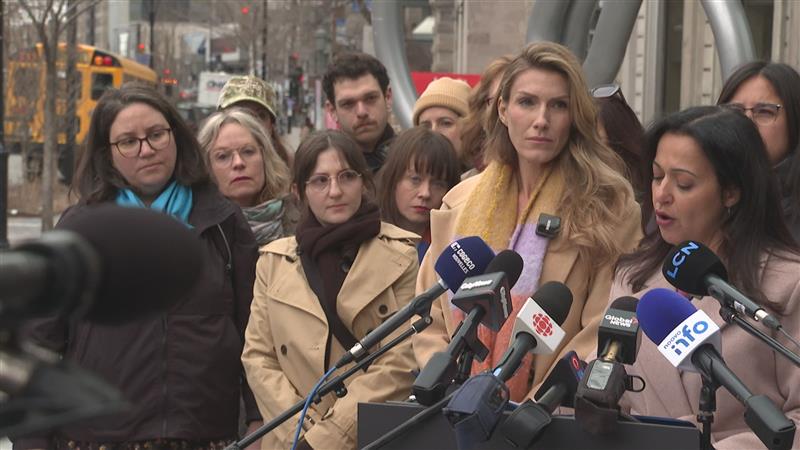
“Nine femicides in 2026. It’s unbearable,” said Ghazal. “Quebecers find this unbearable. It’s April and we’ve already reached last year’s sad record. I refuse to accept it as a fatality. These are lives that can be saved. The solutions exist: the only thing missing is the political will and the resources to implement them. Everyone hailed the arrival of the second woman premier in Quebec’s history as a strong symbol. But symbols do not save lives. Equality is first and foremost the right to live in security. I ask Fréchette to listen to the collective sense of urgency and to take concrete action to save lives,” said Ghazal.
The approximately 600 signatories, including Véronique Cloutier, Ingrid Falaise and Guylaine Tremblay, called for the adoption of a “Gabie Renaud law”, which would notably allow women to know if their partner has a history of violence.
“Today, since the beginning of the year, there are already nine (victims of femicide). The next one is still alive. Then soon, she won’t be anymore.”
It was with these words that Ingrid Falaise, actress, author and lecturer, who recounted her harrowing experience of domestic violence in the book Le Monstre, concluded her speech on Tuesday in front of the offices of Premier Christine Fréchette.
With the National Assembly prorogued until May 5, the signatories have asked the Premier to reopen the National Assembly in order to quickly adopt new measures.
“Since 2020, 85 women have been murdered in a domestic context and 13 infanticides have taken place,” said added Falaise. “This year, nine of them have already struggled, in vain, not to die. These femicides are not news items, they are lives that we have not been able to protect. The solutions are known, the recommendations exist — 190 were tabled in 2020 — but what is missing is the will to act now. Meanwhile, women still live every day in fear of being next. Madam Premier, today you have the opportunity to live up to the urgency. The solutions are there. I would like to believe that you will do things differently.”
“We refuse to wait for the next femicide, and we hope you do too,” the open letter reads.
The signatories also asked Fréchette to support shelters for women victims of domestic violence by providing them with stable and sufficient funding.
“Quebec women need a well-thought-out law that will allow them to be informed about their partner’s history of violence and accompanied by specialized resources in domestic violence to weave a safety net around them, if necessary Fréchette, for the law to achieve its objectives, it must be accompanied by the necessary budgets,” said Louise Riendeau, co-responsible for political files at the Regroupement des maisons pour femmes victimes de violence conjugale.
The approximately 600 signatories, including Véronique Cloutier, Guylaine Tremblay and Martine Delvaux, called for the adoption of a “Gabie Renaud law”, which would notably allow women to know if their partner has a history of violence.
Such legislation, based on the Clare Act in the United Kingdom, would allow women to obtain information from police services about a spouse’s history of violence.
Louise Riendeau, spokesperson for the Quebec Network of Shelters for Women Victims of Domestic Violence, explained that some provinces have already adopted this type of law, taking into account the balance between the right to privacy and the protection of women’s lives. “Police services or expert committees can access data on the offender, conduct a risk assessment, and disclose only the necessary information to the individual. In some provinces, for example, they will tell the person that there is a medium or high risk level, or if there is a low risk level or insufficient information, they will say: ‘Here’s what we have, but if you have any concerns, don’t hesitate to seek help.'”
With the National Assembly prorogued until May 5, the signatories called on the Premier to reopen Parliament to quickly adopt new measures. “Everyone welcomed Christine Fréchette’s arrival as the second female premier in Quebec history, and rightly so,” argued Ghazal. “It’s a powerful symbol, a very important one for us here in Quebec. But we have to go beyond symbols, because symbols don’t save lives.”
“All across Quebec, women are living with this fear every day, in their own homes. They choose their words carefully, they walk on tiptoe, they try to avoid anger. They hope that tomorrow will be different. And we all know that some will not see tomorrow,” argued the Mercier MNA.
The signatories also asked Fréchette to support shelters for women victims of domestic violence by providing them with stable and sufficient funding.
Supporting shelters
According to Louise Riendeau, existing shelters need approximately $50 million to consolidate the network and support their staffing needs, and “a few tens of millions” to open new facilities. “Regions like Montreal, the Outaouais, the North Shore, and the South Shore are in dire need of new shelters.” The need is critical: shelters are turning away, on average, one out of every two women due to lack of space.
“That moment when a woman decides to take action is often a matter of life or death. And it’s a situation where she is most vulnerable to femicide. No woman should have to be told, ‘Sorry, we want to help you, but unfortunately, there’s no room for you in our shelter,’” lamented Ghazal. She added that Fréchette has ample resources, since Finance Minister Eric Girard allocated $250 million in discretionary funds to the premier in his latest budget.
Falaise argued that “not a day goes by without me receiving a message from a woman trapped in coercive control, post-separation violence, domestic violence. And every time, every single time she’s afraid of being next. Every single time, I’m afraid she’ll be next. She’s afraid of not being believed. She’s afraid of no longer being protected. She’s afraid of leaving and dying.”
“Guys, be allies”
Ghazal also expressed concern about the rise of male chauvinism among boys and the lack of resources for violent men. “When a man feels like spanking, there need to be resources available to support him so he doesn’t. It can’t just be his partner who carries that burden, because we know that women often want to save their partners, but it’s not their responsibility to bear that responsibility.”
Falaise, for her part, had this message for men: “Guys, be allies, refuse to remain silent, because silence protects violence.”
Since the beginning of 2026, nine suspected femicides have occurred in Quebec in the context of domestic violence, the same number as for the whole of 2025.
–This report by La Presse Canadienne was translated by CityNews