Montreal increases funding for homelessness prevention ahead of July 1 moving day

Posted May 29, 2026 3:37 pm.
Last Updated May 30, 2026 7:19 pm.
The City of Montreal announced that it will increase its funding for homelessness prevention programs to $3.4 million ahead of the July 1 moving day for thousands of Montrealers.
The fund will be used to provide relocation assistance, support temporary housing or storage rentals to those at risk of losing their housing. The programs are run by the Office municipal d’habitation de Montréal (OMHM).
“Rehousing assistance will enable the OMHM and frontline community organizations to increase their presence on the ground and better plan their operations to help Montrealers at risk of ending up on the street,” said Mayor Soraya Martinez Ferrada, while announcing the funding increase.
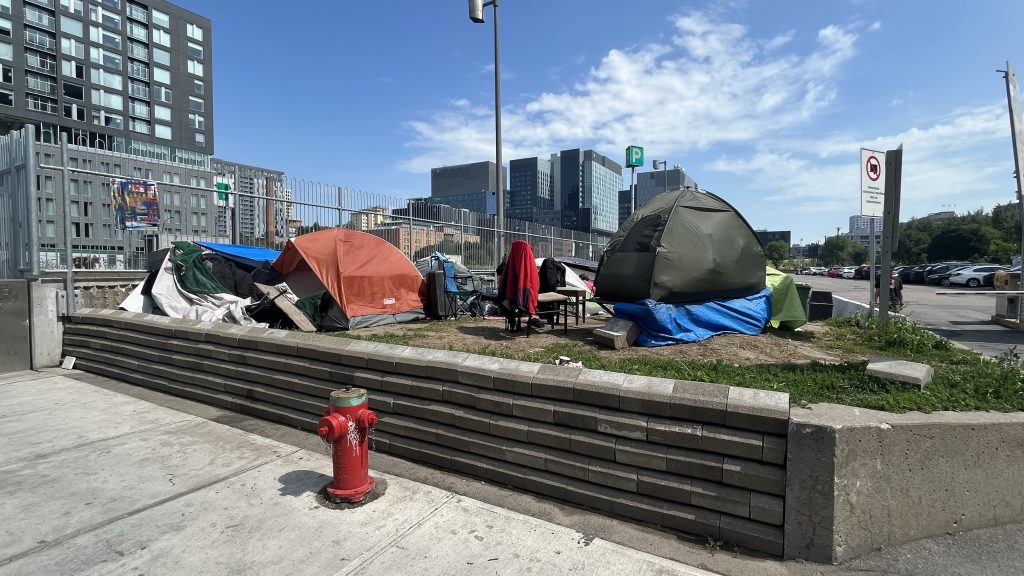
The announcement comes days the City created a crisis unit within its tactical intervention group for homelessness after a considerable growth of the Notre-Dame encampment in recent weeks in the city’s east end.
Montrealers at risk of losing their housing will be able to take advantage of additional measures between mid-June and mid-July, the period covered by the OMHM’s “Operation July 1.” Last year, 2,382 requests were submitted to the agency during the same period. The director of the OMHM’s Housing Management Department, Rouzier Métellus, expects a similar number of requests this year.
The $3.4 million allocation brings the operation’s budget to $5.5 million over three years. The funds will be used flexibly during this period to expand the available team and housing options as needed, explained Métellus.
Catherine Lussier, coordinator at the housing advocacy group Le Front d’action populaire en réaménagement urbain (FRAPRU) said the programs were essential.
“The investment is a good sign of wanting to continue supporting as much tenants as possible, but obviously this is also just the tip of the iceberg,” Lussier said.
As the July 1 moving day approaches, many Montrealers are at risk of losing housing each year with their leases expiring.
Lussier said it might be hard to estimate the exact need but that the rental market is unaffordable for many.
“It’s more than ever needed for tenants to have this kind of support, especially for tenants with low income for whom it’s really hard right now to find something on the private market because of how unaffordable is right now,” she said.
Lussier said that in addition to supporting these temporary programs offered by OMHM, the better way is to invest in more social housing.
“If we want to lower the number of tenants who require that assistance is definitely by building more social housing,” she said. “So, for us is where most of the public money should go.”
The mayor notes that, although July 1 remains a critical time, the need is increasingly felt throughout the year. “There is a trend showing that the phenomenon is spreading out over time and that this concentration is slightly less pronounced around July 1, and that’s something to consider,” she says.
Métellus confirms that 510 applications have been processed by the agency since January. “The number of applications received to date remains high, even though it represents a slight decrease compared to last year. But we expect it to rise rapidly in the coming days,” he says.
Martinez Ferrada and Braun hope these preventive measures will be effective and urge Montrealers to seek available assistance if they need it and meet the OMHM’s eligibility criteria. “We need to turn off the tap,” the mayor said.
Those at risk of losing their housing can call 211 or 311 to get information about the City’s various assistance programs.
— With files from La Presse Canadienne