As global uncertainty seeps into everyday life, Montreal needs resilience that people can trust

Posted June 10, 2026 5:35 pm.
On the second day of the Conference of Montreal, conversations on artificial intelligence, infrastructure, energy, talent and public institutions kept returning to one question: do people trust the direction of change?
That question matters because resilience is not only about what a city builds. It is also about whether people have trust in what is being built, especially when uncertainty is already showing up in daily life.
According to the City of Montreal, inflation in the Montreal metropolitan region reached 3.3 per cent in December 2025, above the Canadian rate of 2.4 percent. Food inflation reached 5.1 per cent, while housing inflation in the Montreal region reached 5.7 per cent.
The 2026 Edelman Trust Barometer Canada report also found that fewer than one-in-five Canadians believe the next generation will be better off. Trade- and recession-related job fears have reached all-time highs.
Together, these pressures make trust more than an abstract value. They shape whether people believe change will improve their lives or leave them further behind.
And that trust is under pressure.
The local risk of insularity
During the conference, the word “insularity” was named as a risk Montreal is already experiencing.
The 2026 Edelman Trust Barometer Canada report found that 73 per cent of Canadians are hesitant or unwilling to trust someone different from them, including people with different values, sources, cultures, backgrounds or approaches to solving problems.
Martine St-Victor, general manager at Edelman Montreal, captured the concern plainly: “We’ve lost the ability to debate.”
This is not only a political issue. It is a civic one.
When people lose the ability to sit with different perspectives, disagreement starts to feel like danger. Public conversations become thinner, louder, and less useful.
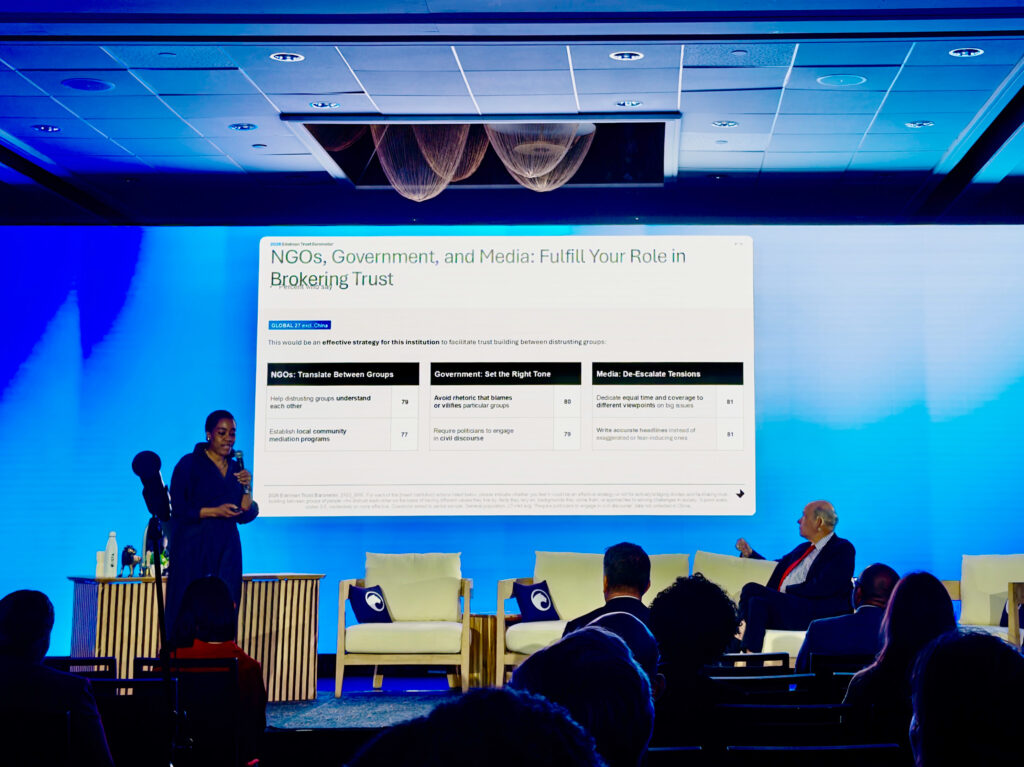
For a city like Montreal, this matters. Montreal is multilingual, multicultural, intergenerational and shaped by many histories and expectations. But diversity alone does not produce trust. Trust has to be practised.
That requires spaces where people can challenge one another without humiliation and share different views without every conversation turning into a fight.
The art of disagreeing should not belong only to political panels or professional commentators. It is part of the civic life Montreal needs to protect across neighbourhoods, workplaces, schools and public spaces.
Local journalism as trust infrastructure
Local journalism is one place to start.
The crisis of trust is not driven only by the common challenge of misinformation and disinformation. It is also shaped by narrowing exposure. The 2026 Edelman Trust Barometer Canada report shows that only 28 per cent of Canadians get information from sources with a different political leaning than their own at least weekly, down 10 points from 2025.
People increasingly consume information that confirms what they already believe. Complex, multi-faceted issues are flattened into conflict. The result is not a more informed public, but a more fragmented one.
Responsible local media can counter that. At its best, local journalism helps people understand not only what happened, but who is affected, what is at stake, and how different parts of a city are connected. It gives visibility to neighbourhoods, communities, and experiences that might otherwise remain outside the dominant conversation.
In a time of growing insularity, responsible local news is vital civic connective tissue.
Knowledge diplomacy starts at home
During the dialogue of “Knowledge Diplomacy: Universities, Resilience, and the Strategic Future,” François Gélineau, vice-rector for international affairs and sustainable development at Laval University, and Clara-Alexandra Volintiru, state secretary at the Romanian Ministry of Foreign Affairs, framed universities as more than centres of learning; they are bridges between research, policy, talent, and public life.
That idea has particular relevance for Montreal. The city’s universities and research centres already connect local expertise with global questions.
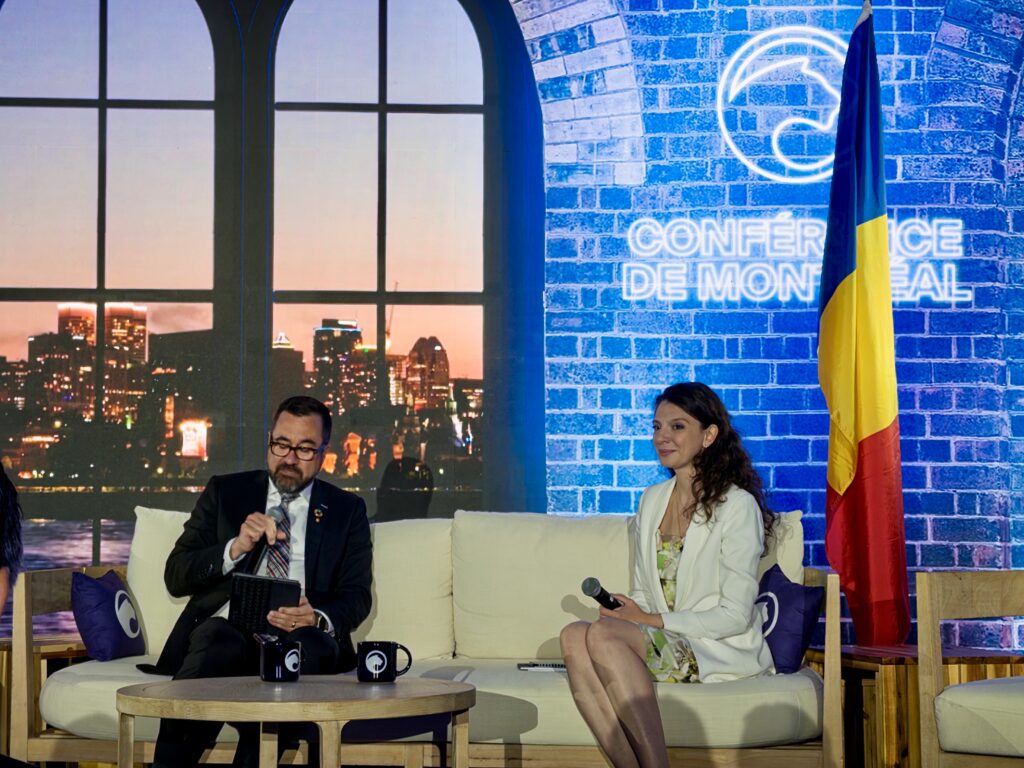
In moments of geopolitical tension, academic communities can keep channels of collaboration open when other relationships strain. In the age of AI, that role becomes even more important.
Montreal is a global AI hub, but responsible innovation cannot be measured by technical advancement alone. It depends on who is included, whose knowledge is respected, and who helps shape the tools being built.
Canada’s growing work around Indigenous participation and leadership in AI points to what this can look like.
In recent years, Indigenous-led approaches are becoming part of a broader knowledge diplomacy agenda, where data sovereignty, language, and technological self-determination are central to responsible innovation. Research institutions such as Mila – Quebec Artificial Intelligence Institute, alongside Indigenous-led technology organizations, are helping advance this shift.
Technology is moving quickly. Montreal’s advantage will come not only from accelerating, but also from reflecting and including.
Resilience needs youth at the table
Too often, young people today are described as anxious, easily offended, or difficult to engage.
A more nuanced reading is that many young people are highly attuned to instability. They have grown up with climate change, economic precarity, political polarization, digital overload, and a constant stream of global crises. Their concern is not weakness, but awareness.
Young people need civic literacy. They need to understand how decisions are made, who gets heard, how public participation shapes outcomes, and where their own voice can make a difference.
Meanwhile, institutions also need youth literacy. They need to understand how young people experience uncertainty, why they distrust certain systems, and what would make public life feel trustworthy again.
If Montreal wants resilience people can feel, it should not only teach young people how to participate. It should invite them to shape the spaces where participation happens.
The question Montreal has to answer
As Quebec approaches its scheduled provincial election this October, the question of trust becomes more urgent.
The future will require infrastructure, capital, talent, research and technology. But people will not support projects they do not understand. They will not collaborate with institutions they perceive as distant or defensive.
The harder question is not whether Montreal can build for the future. It is whether people will see themselves in that future.
That is where trust begins.
The Conference of Montreal wrapped up Wednesday.