South Shore man calls for probe into Quebec human rights watchdog for handling of racial profiling complaint
Posted June 16, 2026 12:37 pm.
Last Updated June 17, 2026 9:46 am.
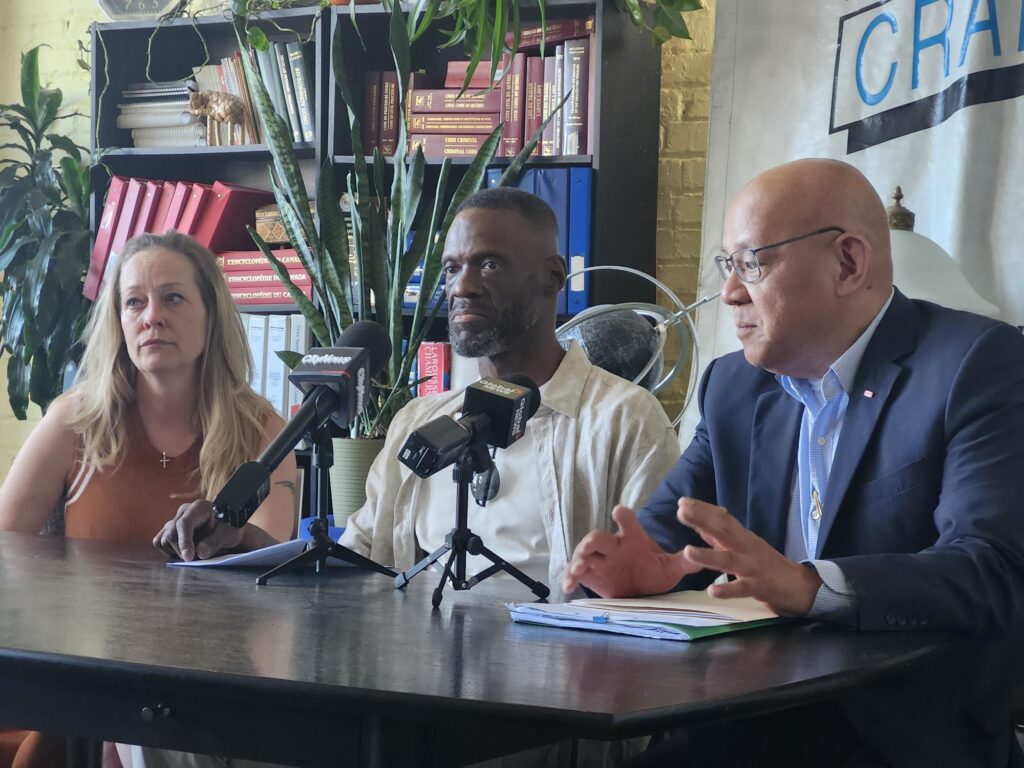
A South Shore resident is calling for an investigation into Quebec Human Rights and Youth Rights Commission (CDPDJ) after accusing the watchdog of arbitrarily closing his complaint file about being racially profiled by the Longueuil police (SPAL).
Halisi Giddings, who is Black, says the CDPDJ’s action has denied him “effective protection against discrimination.”
According to Giddings, Longueuil police (SPAL) stopped and fined him without any grounds while he was driving home from a shopping centre in January 2024.
He filed a racial discrimination and profiling complaint with the CDPDJ against the police with the help of the non-profit civil rights organization Center for Research-Action on Race Relations (CRARR) in March 2025.
CRARR had also filed complaints on behalf of multiple people.
According to CRARR, the CDPDJ closed the files of Giddings’ and those of three other Black men prematurely citing a recent court authorization of a class action filed by another victim of racial profiling against police services in the Greater Montreal area and the Sûreté du Québec.
“Although the individuals had until May 26 to opt out of the class action, the CDPDJ closed their files in late April,” CRARR said in a statement.
“I find that a slap in the face, it’s disrespectful. You’re just gonna close my file, not ask me anything. That’s like, that’s no respect,” said Giddings.
CRARR’s Executive Director Fo Niemi is concerned that there may be more Black individuals beyond Giddings and the three other Black men his organization is assisting who have been denied access to the CDPDJ for racial profiling complaints.
“We don’t know how many files, how many cases have been closed by the Commission because of its interpretation of the law vis-à-vis the class action lawsuit. We know of four Black men but there may be more,” explained Niemi. “There are a lot of people who go to the Commission on their own so it’s important that the Commission say how many files they have closed and more importantly what happened to those files.”
A spokesperson for the CDPDJ Jack Duhaime confirmed to CityNews that 15 cases were closed due to the class action.
“We have recently closed certain individual cases because they involved the same facts as a case that has gone to court—namely, a class-action lawsuit regarding racial profiling during traffic stops,” Duhaime said.
CRARR alleges that the CDPDJ’s decision to close the complaints before the deadline denied the men the opportunity to choose between joining the class action and pursuing individual complaints.
Giddings, who eventually opted out of the class action, says he has been unable to reopen his complaint file with CDPDJ. Other men assisted by CRARR who were automatically included in the class action were also unsuccessful in getting their racial profiling complaints reopened.
“The (CDPDJ’s) decisions runs directly contrary to the interests of victims of ‘Driving While Black,'” Giddings said. “The (CDPDJ) is making it more difficult for victims of racial profiling like me to access justice and protection.”
CRARR says that the CDPDJ considers the class action to automatically include all racialized persons who were subjected to a traffic stop without grounds, after May 22, 2019 by SQ or by one of several police departments, including Montreal, Laval, Quebec City, Longueuil, etc.
According to Quebec’s Charter of Human Rights and Freedoms, the watchdog has to stop its proceedings if someone who has a complaint open with it also decides to launch a legal action.
“The (CDPDJ) will file an amicus curiae brief with the Superior Court in this class-action lawsuit to ensure that the rights set forth in the Charter of Human Rights and Freedoms are upheld,” Duhaime said.
CRARR says the interpretation by the CDPDJ could result in complaints from other victims being refused and not investigated by the CDPDJ.
“We are very concerned that the (CDPDJ) is using a class action lawsuit to shut its doors on complainants,” said Niemi. “Victims must have the option to choose between participating in a class action and retaining access to Quebec’s human rights protection system.”