Quebec invests millions to boost French at English universities, with target set for non-Quebec students
Posted June 16, 2026 7:12 am.
Last Updated June 16, 2026 3:38 pm.
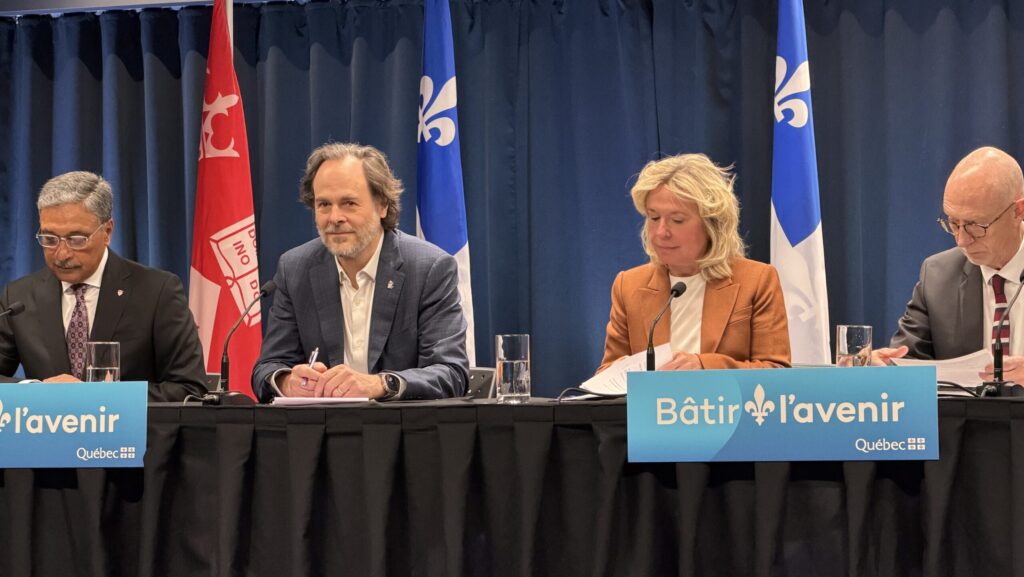
The Quebec government announced Tuesday it is investing up to $20 million a year to boost French-language learning at McGill, Concordia and Bishop’s — the province’s three English universities.
Under a new eight-year agreement, the province wants 60 per cent of non-Quebec students enrolled in on-campus undergraduate programs to graduate with a level-four of spoken French — the highest level of the beginner stage on the province’s scale.
“We are a drop of francophone surrounded by an ocean of anglophone and it’s always going to be a challenge for Quebec to protect itslanguage,” said Martin Biron, Quebec’s minister of higher education.
“The burden is on the shoulders of the universities. And universities, with the discussion I had with them, are quite ambitious and they want to succeed.”
Minister Biron made the announcement in Montreal alongside representatives from the three universities.
That target will apply to students starting university this fall, with the first oral proficiency tests being taken at the end of the 2029-30 academic year.
Penalties for not meeting target
The province is calling it a voluntary measure, meaning a student would still graduate their program if they don’t achieve level-four French proficiency, Biron explained. But the universities would be penalized if the targets are not met.
“It’s not going to be a requirement for a student to graduate. It is a requirement for the university to make the effort to achieve the target,” specified Deep Saini, the rector and vice-chancellor of McGill University.
“A target of 60 per cent, which would include… students who are francophone, who come from France and elsewhere, and we believe that that’s a reasonable target,” said Graham Carr, president and vice-chancellor of Concordia University.
Minister Biron says the penalties could be in the range of $1,500 per student, with a ceiling of $25 million.
“The penalties won’t be soon,” she reassured. “We’re gonna keep a time frame of four years to give time to universities to install these new measures.”
“Should one of us or all of us not be able to deliver with that investment what was agreed on or not spend that money, it’s perfectly fine if the government then says, ‘OK, give back some of that money,'” said Saini. “But it’s not like we’re going to be hundreds of millions of dollars of penalties on the universities, just simply withdrawal of investment if the program is not succeeding and that is a normal thing to do.”
Bishop’s won’t be subject to the penalties — only McGill and Concordia.
“Bishop’s University, given its unique context as a university that’s in the Eastern Townships and in Sherbrooke specifically, very predominantly Francophone community, is not subject to penalties,” explained Sébastien Lebel-Grenier, the principal and vice-chancellor of Bishop’s.
More French, Quebec culture courses
The English universities are encouraged to expand the range of French courses offered, immersion programs, and personalized student support.
“Each university will determine the means, learning pathways, and assessment tools that will allow it to reach the target, while respecting its institutional autonomy and academic freedom,” the Quebec government said in a news release.
The universities are expected to report annually on their progress to Quebec’s Ministry of Higher Education.
As Quebec enters an election period, questions are being raised about whether the plan will be maintained under a future government.
But funding has already begun, including a $15-million allocation this year, distributed across the three universities based on the number of out-of-province students. It also includes retroactive funding tied to last year. The money will go toward expanding French courses, hiring teachers, and adding programs focused on Quebec society, culture, and career preparation.
“We believe that students will be attracted by this, not discouraged by them,” said Carr.
What are students saying?
CityNews spoke to students outside McGill’s Roddick Gates following the announcement.
“That’s great because I think it’s not fair of us to come here and not learn French,” said McGill student Leo Gallagher.
“I don’t think all the students would be willing,” said Concordia’s Sarah Housley. “I would be, and I think a lot of students would be, but I think some people aren’t here to live and get back after, so they wouldn’t be interested in investing that way.”
“Especially for the undergrad students if they want to get a job in Quebec, they need to be almost bilingual,” said Jiyoung Kim, who is studying at McGill.
“I think it’s important since we’re in Montreal and being bilingual is pretty important,” added Maria Faddoul, also at McGill.
“It would really depend on the people’s schedule, I think,” said McGill student Sarhan Sokataoy. “But of course learning French is useful, but as a uni student, I don’t know if we would have the time to invest in wanting to learn French.”