Remembering the deadly Saguenay floods, 30 years later

Posted July 20, 2026 12:23 pm.
Last Updated July 20, 2026 5:40 pm.
It’s been 30 years to the day since catastrophic flooding swept through Quebec’s Saguenay region, one of the worst natural disasters in Canadian history.
Ten people were killed and some 16,000 residents were evacuated in the disaster that unfolded from July 19-21, 1996.
It began when torrential rains drenched the Saguenay–Lac-Saint-Jean region. In some areas, nearly 300 millimetres of rain fell in as little as 36 hours after an already rainy start to July.
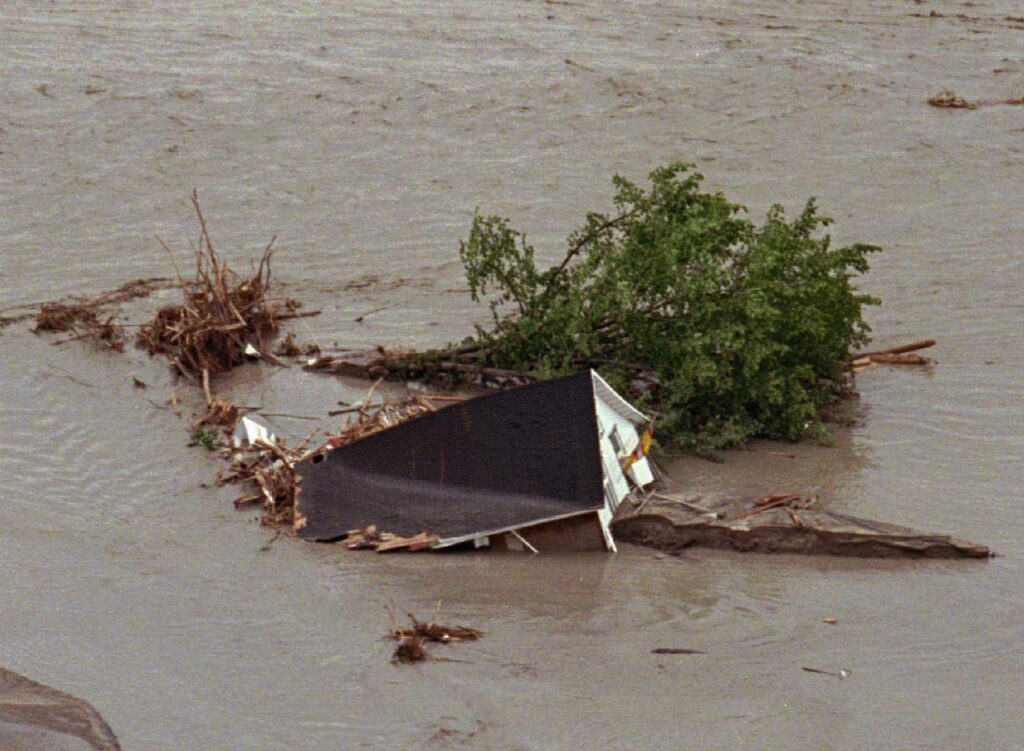
The downpour overwhelmed rivers and reservoirs, triggering floods, landslides and dam failures. Roads, bridges and homes were washed away as rushing water and debris tore through communities.

Hundreds of homes were destroyed, leaving families with nowhere to return.
The Canadian Armed Forces deployed troops to help rescue stranded residents, reinforce flood defences and evacuate isolated communities.
Damage estimates varied widely in the aftermath, ranging from several hundred million dollars to more than $1 billion. That higher-end damage estimate made the flood the first Canadian disaster to surpass the billion-dollar mark in losses, according to the Canadian Red Cross.
The floods also prompted an outpouring of support from across the country. A nationally televised telethon broadcast from Montreal raised more than $3 million for flood relief, with performances by Sarah McLachlan, Robert Charlebois and Gilles Vigneault. Céline Dion, Alanis Morissette and Bryan Adams also contributed.


Three decades later, the Saguenay flood is being for the scale of its destruction, but also the wave of solidarity and compassion from across Quebec and Canada.
Saguenay’s current mayor says the disaster changed how the area prepares for extreme weather, leaving it far better equipped to face another natural disaster.
“I’m convinced of it,” Luc Boivin said Monday. “What we lived through then serves today to make sure we’re better prepared today.
“There was disaster management before the flood and after the flood. The management of dams, high-risk zones and emergency response plans all changed.
“If Quebec has good risk-management plans today, the flood certainly contributed to that.”
In the years that followed, governments invested hundreds of millions of dollars to better protect the region from future disasters.
A commission led by engineer Roger Nicolet later recommended stricter inspections, improved operator training and stronger government oversight of dams.
For France Roy, those days 30 years ago remain impossible to forget.
“It’s a memory that’s still engraved in my mind,” Roy said Monday from her home in Chicoutimi. “When I think about it 30 years later, it still makes me sad.”
Roy was living in the rural sector of La Baie, near the Rivière-à-Mars, when the river burst its banks.
“I saw the river starting to come into our driveway,” she recalled. “The water was so loud. The river made so much noise.”
Roy said her sister rushed to warn her that the river was about to overflow. Alone with her three children, all under the age of seven at the time, she watched the water rise until a neighbour helped them escape in his camper van.
“We had to leave using old trails because the roads were flooded,” she said. “It was terrifying.”
She still remembers watching houses being swept away and uprooted trees carried downstream.
“It was like a horror movie,” she said. “Seeing rooftops floating, seeing those huge tree trunks in the Saguenay River … it really disturbed me.”