Walk to End PKD in Dollard-des-Ormeaux
Posted September 21, 2026 4:50 pm.
Luisa Miniaci-Di Leo lives with polycystic kidney disease (PKD).
It’s a disease that claimed the lives of her grandmother, her father and her aunt. It is hereditary and it has been passed on to her son. In 2024, Miniaci-Di Leo underwent a double organ transplant of her liver and kidneys.
On Sunday, she joined hundreds in walking in the walk to end PKD in Dollard-des-Ormeaux.
“I needed a liver and a kidney due to polycystic kidney disease because PKD doesn’t limit itself just to the kidneys,” Miniaci-Di Leo said. “I lost half the function of half my liver and the function of my kidneys.”
Dr. Ahsan Alam is a nephrologist at the McGill University Health Centre (MUHC), the medical director of the PKD clinic and medical co-director of the multi-organ transplant donation program.
“It’s very inspiring,” said Dr. Alam of Miniaci-Di Leo. “I mean, she is really an amazing voice for patients who are suffering with PKD and their families. She’s lived the experience and she’s shown that actually at the other end, even if the kidneys aren’t able to work, there’s options and hope for the future getting a kidney transplant. She’s actually had a double transplant with a liver and kidney. She’s really a survivor and a hero to many people.”
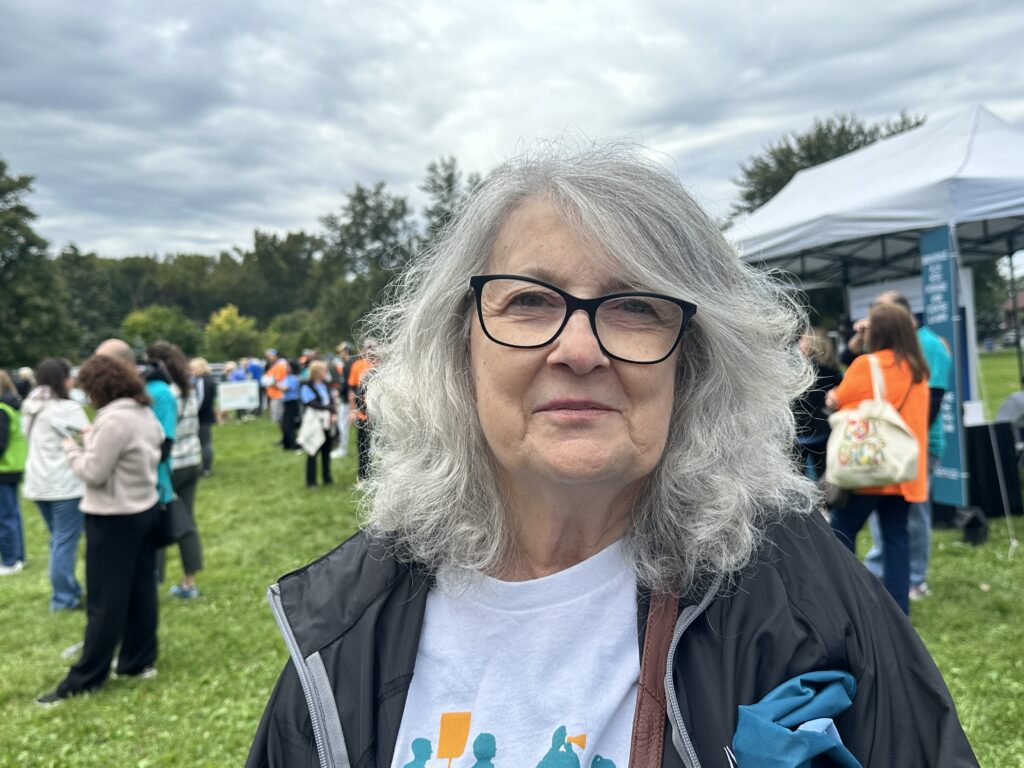
Christine Pisapia is the lead transplant ambassador at the MUHC and a living donor of a kidney to her brother.
“What inspired me is that I wanted to see my brother be back to being himself because when you’re in end stage kidney failure and you’re on dialysis, you’re not yourself anymore,” Pisapia said. “You’re really struggling and it was very hard to see him in that state. So I knew that there was this solution to be able to donate a kidney and so for me, it was a no-brainer.”
Greg Bradic is on the waitlist for a kidney. His kidneys currently function at only nine per cent.
“I’ve known about PKD from an early age,” Bradic said. “My father had it, my grandfather had it, my uncle has it, my brother, my cousin. It’s a family thing, like most people who have multiple generations of people that are impacted by it. I’m currently on the waitlist for a kidney transplant. I’m not on dialysis yet.”
Added Pisapia: “My most challenging part of the experience was that my brother himself, the recipient, was very reluctant to get a kidney from his sister because his fear was that he was going to put me in harm’s way. And interestingly, I’ve been a transplant ambassador for eight years now and he is not the exception. He is the rule. Most recipients are quite reluctant to get a kidney from a loved one.”
“You know, it’s quite easy for us as elected officials in many ways,” added Alex Bottausci, the mayor of Dollard-des-Ormeaux. “We see a cause, we raise awareness to it, we pass resolutions in council, bada bing badda bang, it’s all done, right? But it’s the people that are living with this disease, day in and day out, silently, quietly, having to put up with this.”

“We are here together to help raise funds for polycystic kidney disease because it affects one in 400 to 1,000 people all over the world,” Miniaci-Di Leo said. “So no matter the origin of your roots, we’re all in this together and we’re all walking together and fighting together to find the cure for polycystic kidney disease.
“I know that in some countries across Europe, there is a test that is being done for genetic diseases at birth for children. Therefore, I would like this done in our country. I would like this in our country, in our province, in the country, so that, you know, that expression nip it in the bud while it’s the same thing for disease. If you can detect it earlier, okay, it has less of an effect on the families who are dealing with this.
“You know, it’s $90,000 a year to do dialysis. If we could eliminate that, you know, there’s like hundreds of thousands of people in Canada that are doing dialysis. So if we could eliminate that, one, the government will save money and, you know, find something to help the patients earlier on in life so that, you know, we can continue to live, contribute to a society and so on and so forth.
I know research is being done with AI to help determine if you will need a transplant earlier or later on in life. So, you know, members in one family, like I know one family in this neighborhood that there are three members of the family living with PKD. We’re talking about a granddad, a daughter, and the grandson living in the same household. So we’re trying to also determine whether the progression of the disease is the same between all three of them.
“So I know there is research done on maybe repurposing an old drug. There’s programs with using AI to determine when you fall into kidney failure. So we need to help this research. We need to encourage the people, and we need to get governments involved to recognize that this devastating disease doesn’t only affect, for example, me. It affects my family and the families of my children. One of my two children has PKD. So, you know, this is going to affect them as well.”