Quicksketch of leaders vying to be next Quebec premier

Posted October 4, 2026 1:57 pm.
As Quebecers head to the polls Monday, here’s a quick look at the major party leaders vying to be the next premier.
More than 15,000 polling stations will be open from 9:30 a.m. to 8 p.m. Monday, Oct. 5 for eligible voters to cast their ballots to decide who gets to lead the province for the next four years
Parti Québécois leader Paul St-Pierre Plamondon

Paul St-Pierre Plamondon has led the Parti Québécois back from the brink since becoming leader in 2020. Now, the former lawyer is at the head of a party that is topping the polls going into the fall elections and has won four straight byelections. The PQ leader has been campaigning for a majority government.
Age: 49
Hometown: Trois-Rivières, Quebec
Early years: St-Pierre Plamondon was 18 the year Quebecers were called to vote on independence for a second time, in 1995. He was the only person in his family to vote to separate from Canada, he told The Canadian Press in 2023. He later became a federalist, accusing the independence movement of having “split Quebec in two.” His experience working as a lawyer was part of what led him back to being a sovereigntist, he said.
Before politics: St-Pierre Plamondon worked as a lawyer before joining the Parti Québécois. He was at the Stikeman Elliott firm from 2002 to 2009. He then joined the law collective Delegatus, where he was vice-president and worked until 2015.
Education: St-Pierre Plamondon got his bachelor’s degree in civil and common law at McGill University, graduating in 2001. He then studied business administration at Oxford University and got his master’s degree in 2006.
Family: St-Pierre Plamondon is married to Alexandra Tremblay. The couple has three children.
Political record: St-Pierre Plamondon ran to become leader of the Parti Québécois in 2016. At the time, he held no political office and lost the election. He was however appointed councillor to then-leader Jean-François Lisée.
St-Pierre Plamondon became party leader in 2020, replacing Lisée. He became a member of the National Assembly when he was elected in the October 2022 general elections.
Riding: Camille-Laurin, in eastern Montreal.
Quote: “It’s (former Quebec premier) Jacques Parizeau who said this, but don’t be afraid of your democracy, don’t be afraid of going to the polls, don’t be afraid to think about our future,” he said during the final debate on Sept. 23, urging Quebecers not to fear a referendum. “I think these are fundamental messages, the liberty of a people and democracy.”
Charles Milliard: The pharmacist who caught the political bug

On Monday, Quebec Liberal Leader Charles Milliard will try to join the ranks of the provincial legislature as the province’s premier and turn the tide for the Liberal party, which has been plagued by poor showings and scandals for years.
Milliard became the party’s leader in February 2026 acclamation, following an earlier attempt he lost. Along with Conservative Leader Éric Duhaime, Milliard is one of the two major party leaders campaigning from outside the walls of the national assembly, having never held elected office.
“I want to be premier of Quebec … to create wealth in Quebec, to redistribute it, to finance our social model, to support our regions and to nurture our culture,” Milliard said when he announced his second leadership bid. “I also want to reunite Quebecers. I want everyone to feel at home here, and to put an end to the divisions that slow us down and that frankly bother me.”
In debates, Milliard has presented himself as the only federalist among Quebec’s major party leaders. Paul St-Pierre Plamondon of the Parti Québecois and Ruba Ghazal of Québec solidaire run sovereigntist campaigns. The Coalition Avenir Québec’s Christine Fréchette and Duhaime have described themselves as “autonomist” and have closed the doors to a third independence referendum.
Milliard told The Canadian Press on Thursday that he wasn’t a die-hard federalist and that he also identified as a nationalist.
“For some people, the maple leaf is the most sacred thing on earth. For others, Canada is a good ‘deal’ or a convenient political arrangement. I lean much more towards the ‘Quebec-first’ end of the spectrum. But I’m convinced that Canada is something exceptional to which we have to contribute,” he said.
In his run for the Liberal leadership, he promised to renew the party, which had fallen out of favour with large swaths of the francophone majority.
Although Milliard caught the political bug at a very young age, he waited until his 40s before running for office.
Born in 1979 in Lévis, on the south shore of Quebec City, he began his career as a pharmacist. He quickly rose through the ranks at the pharmacy Uniprix, notably by writing health columns in Quebec media. In 2013, at age 33, he was named executive vice president of the pharmacy chain.
After a stint at the public relations firm National, he was appointed CEO of the federation of Quebec chambers of commerce in 2020. There, he voiced the concerns of the business community to the Coalition Avenir Québec government.
His work at the federation allowed him to broaden his focus beyond healthcare to include the economy, entrepreneurship, education, transportation and the environment.
He finally entered partisan politics in 2024, announcing his intention to run for the leadership of the Liberal party.
During the race, he defied the odds by giving the front-runner a run for his money. Former federal minister Pablo Rodriguez narrowly won in the second round.
A few months later, the expulsion of House Leader Marwah Rizqy and the “brownies scandal,” during which Rodriguez was accused of paying for votes, shook Rodriguez’s leadership, leading to his resignation.
Milliard won the leadership role by acclamation in a second leadership race.
“We have gone through a difficult period, but today we look forward,” Milliard said a few days after becoming the party’s leader. “Under my leadership, integrity, transparency, and accountability will be the watchwords because the party I want to lead must be above reproach, and trust is earned, not requested.”
If the Liberals emerge victorious from the election campaign, Milliard would become the first openly gay leader of a Quebec government.
An art lover, Milliard has served on the board of directors of the Montreal Symphony Orchestra and the TransAmérique Festival.
Coalition Avenir Québec Leader Christine Fréchette
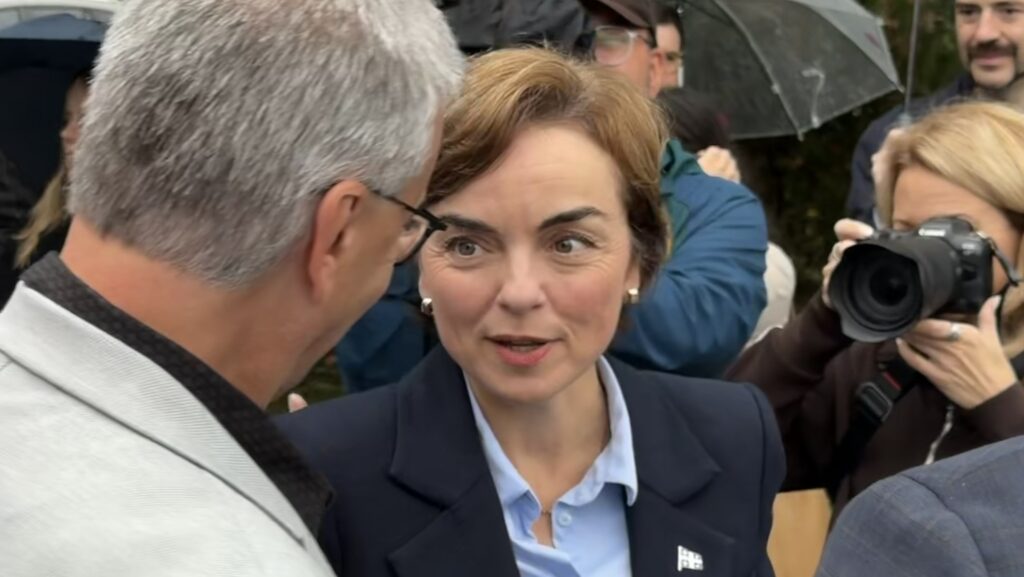
Christine Fréchette is asking Quebecers for her first electoral mandate as premier, less than six months after taking over the Coalition Avenir Québec from party founder François Legault.
Fréchette, who became premier in April after winning the CAQ leadership race, has spent her first provincial campaign as leader emphasizing economic uncertainty and the trade dispute with the United States. She has also sought to position the CAQ as an alternative to another sovereignty referendum, while campaigning on affordability, health care and support for families and seniors.
Age: 56 years old
Hometown: Trois-Rivières, Que.
Early years: Fréchette was a member of the executive committee of the Fédération étudiante universitaire du Québec in 1995 and 1996. The federation represented university students in the province. She later served on the board of the Conseil du statut de la femme, a Quebec government advisory body focused on women’s rights and gender equality, from 1996 to 2005. Between 2008 and 2012, she was featured as an expert on American politics for several broadcast media outlets in Quebec.
Before politics: Fréchette worked as director of external and institutional relations at Montréal International, an economic development agency that works to attract foreign investment, international organizations and talent to the Montreal region. She later served as president and CEO of the Chambre de commerce de l’Est de Montréal, a business organization representing companies in eastern Montreal.
Education: Fréchette holds a bachelor’s degree in business administration, specializing in economics and international trade, from HEC Montréal, and a master’s degree in international relations from Université Laval.
Family: Her partner is financier Guy Nadeau; she has one son.
Political record: Fréchette was deputy chief of staff to former Parti Québécois minister Jean-François Lisée from 2012 to 2014. Years later, Fréchette was elected as the CAQ member for Sanguinet, a riding on Montreal’s South Shore in 2022 and served as immigration minister before being appointed economy and energy minister in September 2024, replacing Pierre Fitzgibbon. She oversaw major legislative changes on energy policy, adopted in June 2025.
Fréchette ran to succeed Legault as CAQ leader and defeated Bernard Drainville last April with 57.9 per cent of members’ votes, compared with 42.1 per cent for Drainville. She became Quebec’s 33rd premier and the second woman to hold the office, after Pauline Marois. As premier, Fréchette has made affordability a key short-term priority.
Riding: Trois-Rivières. Fréchette will run in her hometown riding in the Oct. 5 election. The riding was previously held by outgoing CAQ MNA Jean Boulet.
Quote: “My opponent is Donald Trump; he is the real opponent,” said Fréchette on Aug. 27, in Quebec City, adding, “I’m asking for a mandate to move forward through a storm.”
Conservative Party of Quebec Leader Éric Duhaime

Former political commentator Éric Duhaime has led the Conservative Party of Quebec for five years. Duhaime has never held a political office, and the Conservatives did not win any seats at the last general elections, despite collecting close to 13 per cent of the popular vote.
Age: 57
Hometown: Montreal
Early years: Duhaime is an only child and grew up in the Montreal suburb of Laval. His mother was a bus driver and his father worked at a factory. Duhaime began to follow the news in primary school, reading the daily newspaper and watching nightly news broadcasts.
Before politics: Duhaime worked as a talk radio host, political commentator, newspaper columnist and author. He has also worked for the National Democratic Institute, a United States-based non-governmental organization that promotes democratic institutions.
Education: Duhaime studied political science at Université de Montréal for his bachelor’s degree and got a master’s degree in public administration from École nationale d’administration publique.
Family: Duhaime is openly gay and has been in a relationship for many years.
Political record: In the 1990s, Duhaime was a parliamentary aide and researcher for the Bloc Québécois and an adviser to the party’s leader. From 2000 to 2002, he was an adviser to the federal Canadian Alliance leader, Stockwell Day.
In 2003, Duhaime ran for provincial office in a Montreal-area riding as a member of the right-of-centre Action démocratique du Québec, coming third. He then worked as an adviser to the party’s leader until 2008.
Duhaime became the leader of the Conservative Party of Quebec in 2021, winning nearly 96 per cent of the vote in the leadership race.
His party did not win any seats in the 2022 general election.
Duhaime had another shot at a seat at the Quebec national assembly in the 2025 Arthabaska riding byelection, but lost to the Parti Québécois candidate.
Riding: Bellechasse, south of Quebec City.
Quote: “This year is our year. 2026 is the year of the Conservatives.”
Ruba Ghazal: from child of Bill 101 to aspiring premier

Ruba Ghazal says Québec solidaire is “tattooed on her heart.”
Twenty years after helping to found the party in 2006, she is leading the left-wing party into the Oct. 5 election, as its co-spokesperson and choice for premier.
Throughout the campaign, she has presented herself as the defender of public services in a climate where many other parties want to reign in spending. She also promised to tackle the high cost of living with measures such as a ceiling on rent hikes and a wealth tax on those with assets worth $25 million or more.
In a Sept. 23 debate, she promised to serve as the “bulwark against austerity.”
“Every time a Québec solidaire MNA has arrived at the national assembly, it’s made a difference,” she said,” citing work to combat femicides, protect elderly tenants, and support a ban on energy drinks for youth.
Ghazal, 48, has repeatedly cited her own immigrant background as an example of how politics should be more inclusive.
In August, she criticized Parti Québécois Leader Paul St-Pierre Plamondon’s decision to stand outside a school while making an immigration announcement, accusing him of blaming children for overcrowding and deteriorating school infrastructure.
Born in Lebanon to a family of Palestinian refugees in 1977, she arrived in Quebec at the age of 10 and grew up between Montreal and Laval. Ghazal notes that none of her family spoke French on arrival, but they integrated and learned, thanks in part to the laws requiring children to go to school in French.
“I was that immigrant child myself, a child of Bill 101,” she said.
Ghazal’s journey to becoming a candidate for premier spans decades. She has said that her parents initially hated politics, due to the association with violence and war.
Despite this start, Ghazal became one of the founding members of Québec solidaire in 2006, alongside Françoise David and Amir Khadir,
A year later, she ran for office under the party’s banner in the Montreal riding of Laurier-Dorion, finishing fourth. In 2008, she again failed to unseat the Liberal candidate but improved her showing by finishing third.
It was in the 2018 general election that Ghazal entered the legislature, after succeeding Khadir as the Québec solidaire candidate in Mercier, also in Montreal. She was re-elected in 2022.
It also took her two attempts to become the party’s female co-spokesperson. In 2023, Ghazal was narrowly defeated by Émilise Lessard-Therrien in the second round of the race to succeed Manon Massé.
She stepped into the job after Lessard-Therrien resigned, as the sole candidate in the running.
Before becoming a member of the legislature, Ghazal also worked in several factories, notably as a health, safety, and environmental consultant.
Ghazal has also pointed out that her father was a shopkeeper, rejecting notions that her party is anti-entrepreneur. For nearly 20 years, he ran a “dollar store” on Plaza Saint-Hubert in Montreal. Ghazal, her brother, and her sisters worked there in the evenings and on weekends.
She says she understands the realities of entrepreneurship after seeing her father make many sacrifices.
Ghazal says she’s been inspired by some of the women of Québec solidaire who came before her, including Manon Massé and Françoise David.
“In the 1990s … I would listen to Françoise David, a feminist who led the (women’s group) Fédération des femmes du Québec, and I’d think to myself: ‘My God, her words inspire me. Then I thought, ‘If Françoise ever goes into politics, well, I’m going to follow her.’ And in the end, that’s exactly what happened,” Ghazal recounted at a press conference last May.
Ghazal and her party also advocate for Quebec’s independence. Throughout the campaign, she’s promised to build a consensus that includes Indigenous people, immigrants and anglophones to achieve sovereignty for Quebec.
“For me, it’s a fundamentally democratic project, Quebec independence,” she said during one of the leaders’ debates.
On Thursday, Ghazal was back in Montreal — where her party’s support is highest — pitching a plan to put a moratorium on evictions during winter months and to reform the province’s housing tribunal to better protect renters.
Québec solidaire entered the race trailing in the polls, and remains an extreme long-shot to form government. But Ghazal has said she’s proud of the campaign she’s run, and urged voters not to vote strategically in any of the tight races.
“People are fed up with strategic voting. What they need is for their voices to be heard,” she said. “Me, I invite Quebecers to vote with their hearts.”