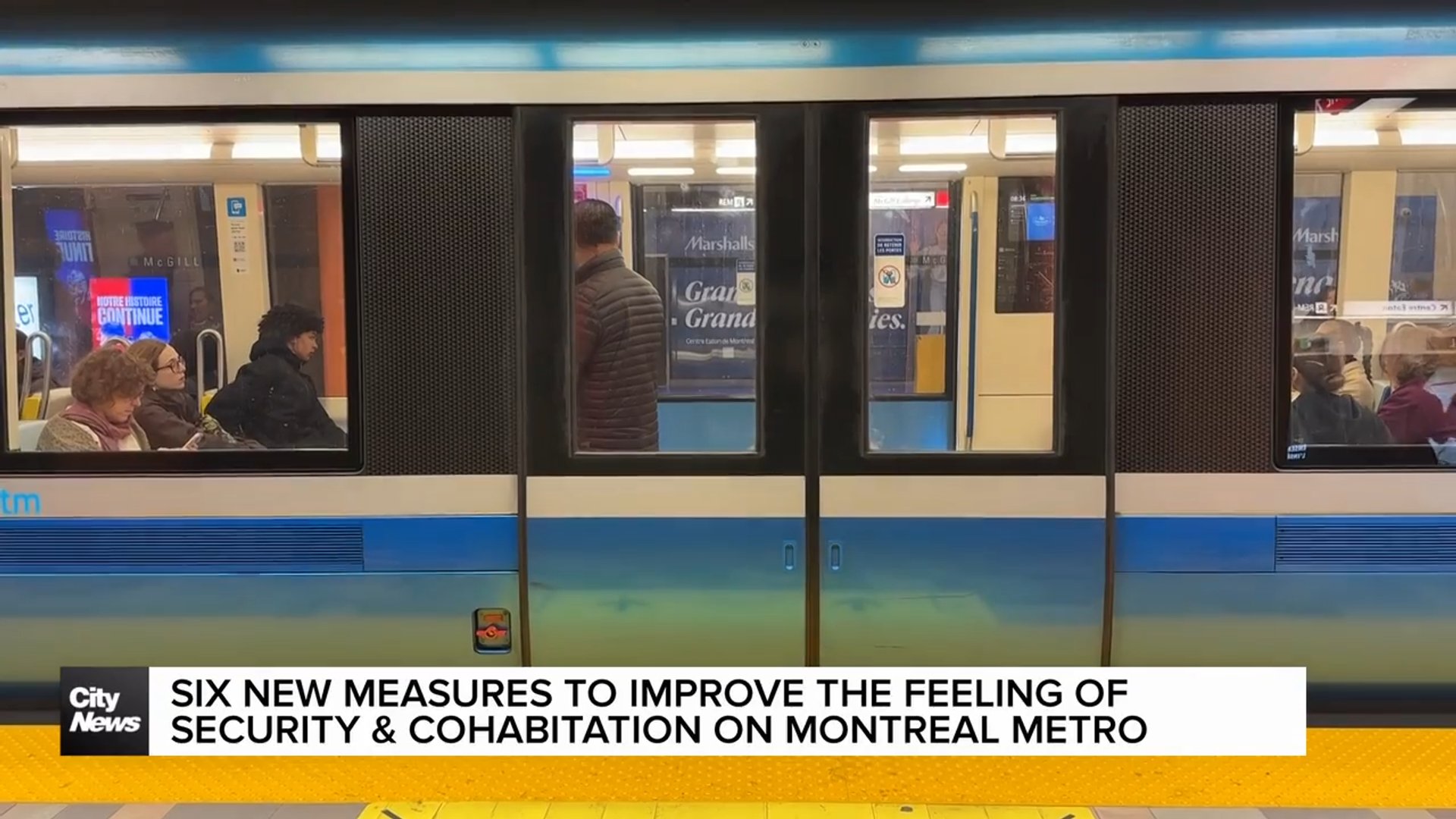
More cops, surveillance, social workers: STM beefs up security measures ahead of winter
Posted October 13, 2026 1:56 pm.
Last Updated October 13, 2026 5:03 pm.
STM commuters will see an increased police presence and more surveillance as they ride the metro this winter.
The City of Montreal and the transit agency announced they will be beefing up security measures, including hiring more constables, upgrades to security cameras, and increasing patrolling by police officers to improve a sense of safety among riders.
The STM will also be deploying social workers at metro stations starting this fall — with two teams consisting social workers, a security officer and a supervisor during the winter months – to support vulnerable individuals.
“The announcement that we’re doing today is to address, take different tools to address the issue of safety, but also address it in a way that is respectful for people that are in a vulnerable position in their lives,” said Montreal Mayor Soraya Martinez Ferrada.
“We need to increase the services of the public transportation if we want people to take it.”

“To continue increasing ridership on the metro, we must continue to improve passengers’ sense of safety on the system, and we are taking steps to do so,” Aref Salem, chairman of the STM’s board of directors, said in a press release Tuesday.
“It is important to continue our efforts to provide a safe environment that promotes the smooth flow and efficient operation of our services by limiting undesirable behavior on the metro.”
Martinez Ferrada also announced at the press conference that the city will invest $6.4 million annually to recruit 52 more special constables by the end of 2027. In the meantime, Montreal police (SPVM) will be deploying a dozen officers to patrol the network.
“These initiatives are part of a broader city-wide approach, which also includes the deployment of warming centres open 24 hours a day, seven days a week, to provide dignified care, support, and a safety net for those in need,” Martinez Ferrada said.
“They have allocated funding for 52 new constables. That is a welcome move,” added Kevin Grenier, president of the Fraternité des constables et agents de la paix STM-CSN. “We need more personnel—more constables. We have been saying this for a long time; we are overwhelmed with calls. Interventions are becoming increasingly difficult when dealing with the public.”
SPVM will also triple the number of officers assigned to the metro intervention and coordinate team to increase coverage during evenings and winter months, the city said.
These measures come in addition to the STM’s decision in April to extend a controversial anti-loitering ban until the spring of 2027. The move-along order which prohibits people from being stationary was first introduced in March 2025 after a spike in safety incidents.
“For us, this eviction on grounds of loitering is unacceptable in the current context, given the lack of alternatives. That is clear; it is documented,” said Annie Savage, director of the Réseau d’aide aux personnes seules et itinérantes de Montréal (RAPSIM).
“Certainly, in winter conditions—on a day like today—more people seek refuge in the metro, and it is important for us to be able to refer them and get them to the right resources and the right places,” said Marie-Claude Léonard, the STM’s CEO.
“The metro and the subway and the public transportation is not a shelter,” added the mayor. “We need to bring people to the right resources. And we increase the number of 24/7 shelters, warm shelters so we have to make sure that we have the connection between a person that’s in homelessness that is in the subway that we can bring them to that resource.”
The STM had announced earlier this month that it had hired former Sûreté du Québec chief Martin Prud’homme to lead the security. Prud’homme previously worked as a strategic advisor to the municipal administration until February 2026. He lost his job as part of Martinez Ferrada’s campaign promise to shrink the city’s workforce by 1,000 in the mayoral elections last year.
Martinez Ferrada said she will also be making good another election commitment to increase the STM service level. Next fall, the city plans to increase the frequency of the metro service by five per cent to reduce wait times in the evenings.
Ridership on the STM has been on an upswing in recent years after taking a plunge during the peak of the COVID-19 pandemic. However, the ridership declined to 294.1 million last year compared to 314.6 million in 2024 due to labour dispute and strikes by STM employees. In 2019, the ridership was 374.9 million trips.