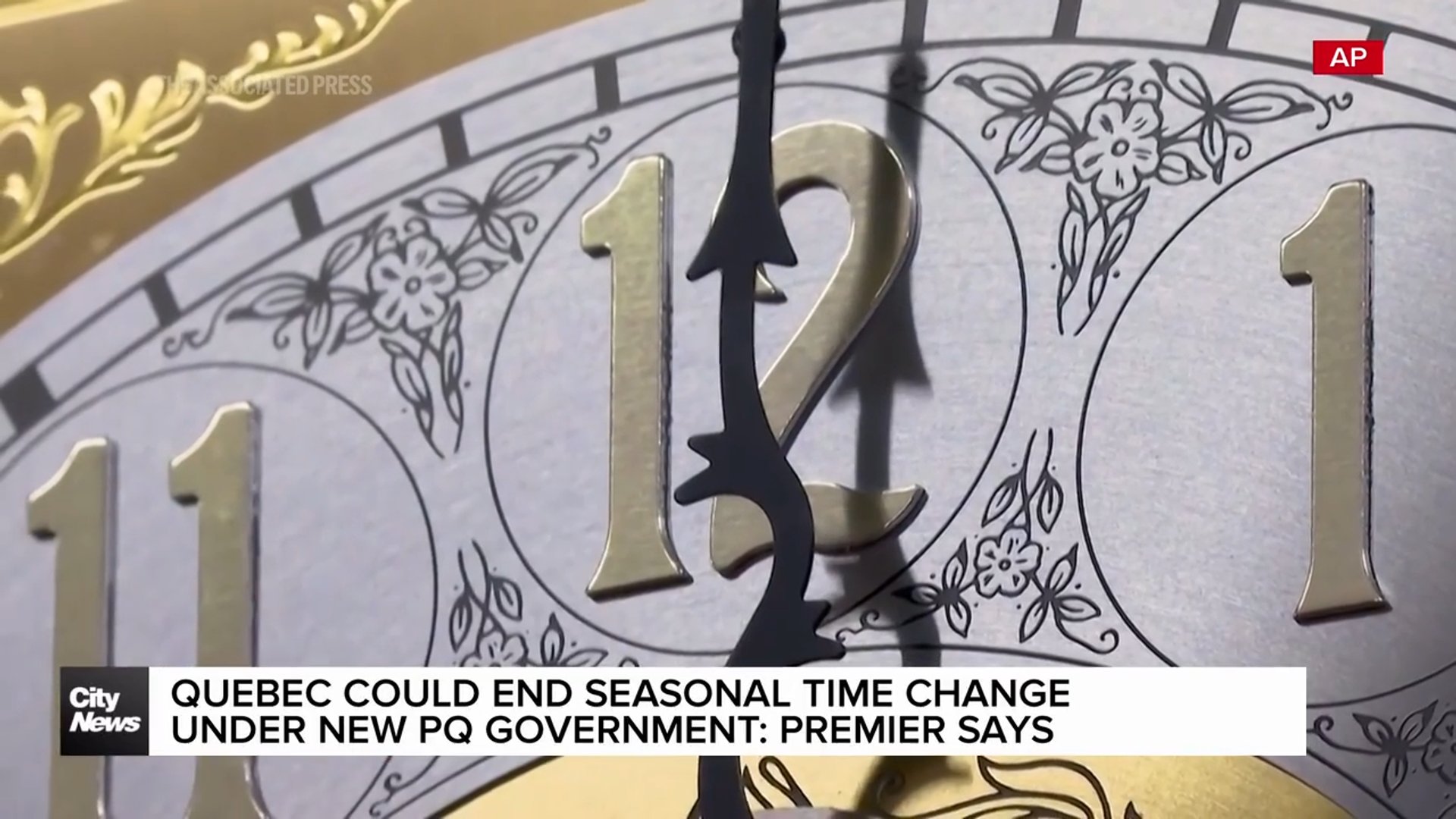
This could be last time Quebecers turn back clocks, PQ to table bill
Posted October 28, 2026 7:22 am.
This weekend could be the last time Quebecers turn back their clocks.
Premier Paul St-Pierre Plamondon says his PQ government intends to abolish the time change in Quebec. It remains to be seen, however, whether daylight saving time or standard time will be kept year-round.
St-Pierre Plamondon wrote on social media Wednesday morning that Quebecers will “most likely” set their clocks back one hour for the “last time” on the night between Saturday and Sunday.
His government intends to end this practice, which, according to several studies, is “counterproductive to health” and poses “adjustment difficulties for children,” he noted.
To determine whether standard time (winter time) or daylight saving time (summer time) will be retained permanently, St-Pierre Plamondon plans to consult with experts during a series of hearings set to begin “in the coming months.”
The premier wants to “ensure that the groundwork is properly laid and to determine whether it would be better to opt for daylight saving time or standard time.” He promises to hold a “short parliamentary committee hearing” on the subject.
“Dear parents who have to spend several weeks managing your children’s reactions to this time change, this is likely the last year we’ll be imposing such unnecessary constraints on ourselves. We invite the public to follow our work closely,” he wrote on social media.
This will not affect the time change this weekend, so remember to set your clock backs on Halloween night this Saturday.
Sleep researcher backs permanent standard time
Roger Godbout, a sleep and mental health researcher, supports keeping standard time year-round because of how our bodies respond to light.
“The master clock in our brain, the master circadian clock, the clock that rolls our many functions, such as sleep, of course, is primed by the morning light,” he explained.
He also mentioned the potential health concerns associated with seasonal time changes. He said the fall change can coincide with mental health difficulties, while the spring change has been associated with metabolic and cardiovascular issues.
“If we keep permanent standard time, so we will stick closer to the natural beat of our internal clock,” he said.
He said that keeping standard time year-round could mean less daylight in the evening than permanent daylight saving time, but believes the benefits of morning light are more important for maintaining healthy biological rhythms.
Godbout added that ending seasonal time changes would not solve every sleep problem, as work schedules, commuting and other daily demands would continue to affect how much sleep people get.
Economist questions the economic benefits
Moshe Lander, a senior lecturer in economics at Concordia University, questions whether abolishing the twice-yearly time change should be a government priority, arguing that its economic impact may be limited.
“On the surface it really shouldn’t affect much of anything,” Lander said.
He noted that many electronic devices now adjust automatically, reducing the inconvenience of changing clocks twice a year.
“In terms of confusion it’s very unlikely that that’s going to cause a problem,” he said.
Lander added that businesses and consumers are accustomed to navigating different time zones and can adjust their schedules when necessary.
“We’re adaptable. It’s an international world these days,” he said.
“If it’s really truly a problem rather than saying to the government, let’s abolish the twice-year time change, just change your operating hours,” he added.
However, Lander warned that Quebec’s decision could affect its time difference with neighbouring provinces and U.S. states, potentially complicating schedules for businesses operating across borders.
“If Quebec decides to abolish the time change and let’s say that New York State doesn’t, then are we going to have Quebec as an hour behind New York State or an hour ahead of New York State depending on the decision?” he said.
He also acknowledged that the choice between permanent standard time and daylight time could have implications for daily life, including road safety, children’s journeys to school and access to daylight.
Ultimately, Lander questioned whether changing the clocks is worth the potential disruption, arguing that people have adapted to the existing system.
“In a certain sense it really doesn’t matter if you change the clock or don’t change the clock,” he said. “We adapt. So what’s the reason to pick a fight here about changing something that we’ve had, whether you like it or not, it’s what we’re familiar with.”
He added that he saw little reason for governments to prioritize the issue.
Montrealers weigh in on ending the time change
Montrealers generally supported ending the twice-yearly time change. For some, eliminating the practice would make everyday life feel more normal.
“It’s better to remove it so people can have a normal life,” one man said.
Others pointed to the impact of reduced daylight on their social lives.
“I think it should be abolished because people have less time outside to spend with their friends or family,” a woman said.
One resident argued the change was long overdue.
“I think it should be abolished. I think it’s all a waste of time,” he said.
Another Montrealer described the effect it has on him.
“I think it’s painful to leave work and for it to be dark. I think it has a tremendous impact on the morale of people,” he said.
Others emphasized the importance of keeping the same time year-round rather than adjusting their clocks every season.
Quebec consultation found strong support for ending clock changes
The previous government, led by the Coalition Avenir Québec, had begun a review of the time change.
It launched an online consultation in late 2024, in which 91 per cent of the approximately 214,000 respondents said they wanted to end the time change. Among those who wanted to end the time change, 72 per cent wanted to keep daylight saving time year-round.
The then-Minister of Justice, Simon Jolin-Barrette, noted, however, that the consultation had highlighted several issues, including expert opinions.
By keeping daylight saving time year-round, Quebecers would enjoy a later sunset during the winter. However, this would mean the sun would rise an hour later in the winter, which could have negative consequences, according to several experts.
An analysis published a few weeks ago by four researchers from British Columbia in the Canadian Medical Association Journal concluded that, when abolishing the time change, it would be preferable to keep standard time year-round.
Other provinces have moved toward permanent time
If Quebec were to move forward with abolishing daylight saving time, it would follow in the footsteps of several Canadian provinces—including British Columbia, Alberta, and Manitoba—which ended the practice this year.
These three provinces have chosen to keep daylight saving time year-round, as have the Northwest Territories.
In Ontario, certain regions in the northwestern part of the province will also keep daylight saving time year-round to align with Manitoba.
In 2020, Ontario passed a law to make daylight saving time permanent, but it has not yet taken effect. The province noted that coordination with its neighbors, such as Quebec and New York State, was essential.
Saskatchewan has not changed its time since 1966, while the Yukon ended the practice in 2020.
— With files from The Canadian Press