Stop dismantling encampments: OCPM report on homelessness and social cohabitation
Posted July 10, 2025 8:17 am.
Last Updated July 10, 2025 6:10 pm.
The Office de consultation publique de Montréal (OCPM) unveiled their report of the public consultation on homelessness and social cohabitation in Montreal on Thursday.
The nearly 300-page report includes 22 recommendations for the City of Montreal.
Philippe Bourke, president of the OCPM, presented some of the Commission’s recommendations including for the City to formally declare—for example, through a City Council resolution—that Montrealers experiencing homelessness are citizens of Montreal on the same basis as those who are housed.
“There is a need to think about risk management because that is the issue, and it is not easy, it is an ethical dilemma,” Bourque said.

When it comes to homeless encampments, the OCPM says they were not an integral part of the mandate, but they were one of the most frequently discussed issues throughout the consultation process.
The conclusion of the report finds that “considering its harmful effects on citizens experiencing homelessness, we believe, like the majority of opinions gathered, that the City’s current approach, based on bans and dismantling, is unacceptable.”
The OCPM recommended that the City suspend dismantling “until a new policy is adopted by City Council, and that it establish a balanced multi-stakeholder committee, necessarily including community organizations and people experiencing homelessness, to design it.”
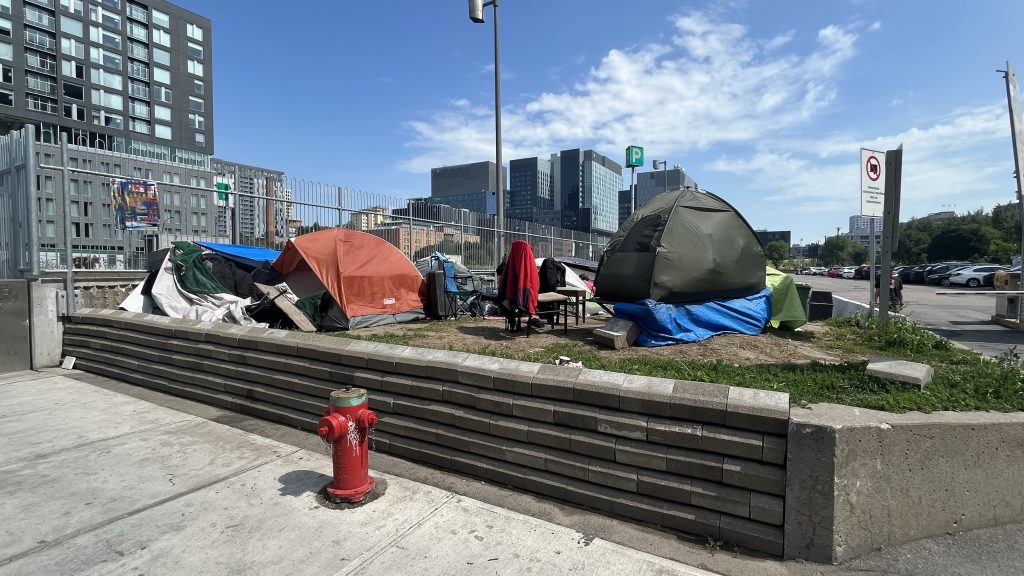
The OCPM wants the City to improve living conditions in encampments by “developing nearby sanitation facilities, including access to drinking water, toilets, and waste collection services, as well as by facilitating basic access to electricity and nearby storage facilities.”
“When people experiencing homelessness don’t have these basic services, they’ll find them elsewhere,” said Bourque. “And that’s what’s disruptive in the neighborhood. Because they don’t have toilets, they will disturb. So, we’re living together here.”
This comes as multiple stakeholders, including the City and Quebec’s Transport Ministry (MTQ), came to an agreement to not dismantle a homeless encampment on Notre-Dame St. in Montreal’s east end until at least July 21.
“When we start the discussion around, well, ‘How do we manage our public spaces better, so that everybody can live together? — that assumes that people are going to continue to be homeless and that people, that the inflow is going to continue,” said Sam Watts, CEO and executive director of Welcome Hall Mission. “And of course, I believe that there’s a way to prevent people from becoming homeless in the first place.”
The OCPM also finds that the City should substantially increase funding for community organizations, in addition to their core mission, so that they can effectively fulfill this role, particularly in the areas of social inclusion, support, awareness-raising, and diversion.
Bourke says it’s important to put order in governance, citing how the fight against homelessness is often passed between the City and the Quebec government. He says that Quebec has the responsibility to take hold of the issue.
The Commission recommends that the City redefine the role of the Commissioner for People Experiencing Homelessness so that its functions better reflect the City’s responsibilities and the priority it places on this issue.
Another recommendation: establishing the conditions to provide culturally appropriate services for Indigenous people experiencing homelessness by contributing to better funding for organizations that work with Indigenous people experiencing homelessness so that they can develop more services for these communities.
“What would be great is this question of dignity, of respect, of this humane approach that we need to treat the people who experience homelessness as citizens of Montreal who have rights and that we need to incorporate in all the decisions that we take, that we make at the city level, the government level,” said William Hodgson, senior advisor of public affairs and government relations at the Old Brewery Mission.
In regards to supervised consumption services, the OCPM says the City should request more of the resources across the island, but to consult with all of those involved and affected by them, to find the best locations.
The Commission recommends that the City stop using private security agencies to oversee the sharing of public space related to homelessness, as what has been done in Chinatown.
Instead, the OCPM says the City should rely on a greater presence of teams trained to manage social coexistence issues, such as the ÉMMIS or the SPVM’s community service agents.
The full report can be found on the OCPM’s website.
The activities of the consultation began in October when the OCPM launched a commission to examine the integration of homelessness and social cohabitation.
Then in January and February, they held more than two weeks’ worth of hearings for their public consultation.
The Commission heard from over 3,900 different stakeholders, including nearly 1,000 citizens, people who are experiencing or have experienced homelessness, and various organizations such as the Réseau d’aide aux personnes seul et itinérantes de Montréal (RAPSIM), the Native Women’s Shelter of Montreal, Centraide, the STM, Montréal centre-ville, the Movement to End Homelessness in Montreal, and the Collective for the Defense of Mental Health Rights of Montreal, among many others.
The goal was to find solutions to ensure better social cohabitation and a more harmonious integration of resources for people experiencing homelessness.
“The reality is that the situation has continued to get worse over a number of years now,” said Watts. “And in order to put the brakes on that, it’s going to take more than one report, it’s going to take some action.”
In Montreal, visible homelessness has increased by 33 per cent between 2018 and 2022.
“There are recommendations that can be implemented in a few days,” said Bourque. “But others will take time. But if they take time, often they are the ones that will be the most structuring, the ones that will last the longest.”