Montreal’s MUHC launches AI pilot project to ease nursing workload
Posted September 24, 2025 4:55 pm.
Last Updated September 24, 2025 5:38 pm.
Nurses at Montreal’s McGill University Health Centre (MUHC) may soon spend more time with patients and less time behind a screen, thanks to a new artificial intelligence pilot project.

What is ENACT and why it matters
The initiative, called ENACT — short for Empowering Nurses with AI for Care Transformation — was launched this week during the ALL IN 2025 conference at Palais des congrès in Montreal. The event brings together thousands of AI experts, business leaders, and researchers from Canada and abroad. This year’s programming explores themes such as business transformation, the future of work, and responsible innovation.

Developed in collaboration with Montreal‑based tech company Airudi, the project aims to automate routine documentation and other tasks that pull nurses away from direct patient care. ENACT will simplify administrative processes, improve work planning, and give back time to nurses for what matters most: direct patient care.
“Our heart at the MUHC is with our patients and their families. They are our raison d’être, which is why spending as much time with them by the bedside is vital to our nursing teams,” said Dr. Lucie Opatrny, President and Executive Director, MUHC. She emphasised that administrative duties often pull nurses away from patient care, where compassionate, attentive presence is crucial.
Goals and timeline: when change begins
The project aims to have its first use case in action by January 2026, with a full implementation planned by December 2026.
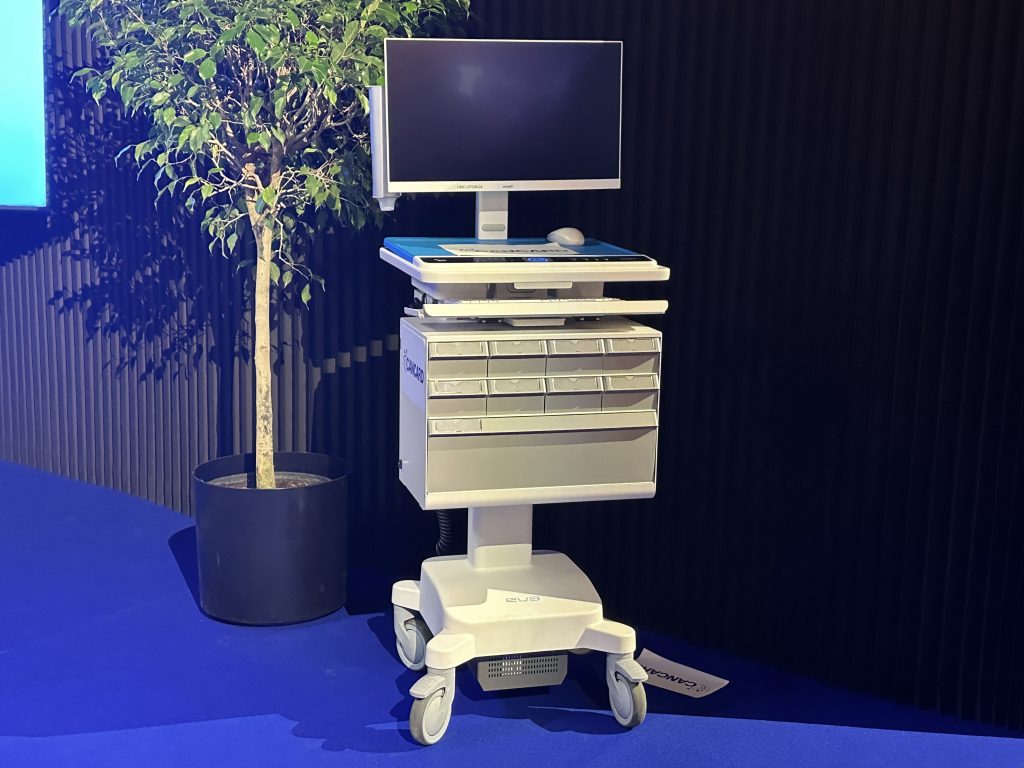
One element of the project is workstations on wheels (WAUS), which nurses can carry from room to room. These mobile stations will display daily tasks, help with prioritizing those tasks, and suggest when tasks might be delegated to licensed practical nurses or orderlies. This aims to help nurses better organize their days.
“We want to give time back to our nurses using artificial intelligence,” said Alain Biron, Director of Nursing, MUHC. He added that everything diverting them from the bedside — documentation, shift hand‑offs, non‑patient tasks — is a candidate for automation.
The design phase is underway now, and prototypes have already been shown to nursing staff. Feedback so far has been “quite positive,” Biron said.
Ensuring AI helps, not replaces
One concern around AI in healthcare is that it might displace human judgment. ENACT addresses this directly:
“Clinical judgment will always prevail,” Biron said. “The nurse will always be able to override the decision … We want to give an hour per nurse per week back to them.”
While ENACT uses automation and algorithms to streamline many tasks, final responsibility, especially around patient care and safety, remains human.

Real challenges & collaboration
Developing ENACT has not been without hurdles. One major obstacle: data. Much of the existing medical record-keeping at MUHC is mixed between paper and electronic systems, which makes extracting the relevant data difficult.
“Access to data is really a challenge because it’s still fragmented … Until everything is moved to an electronic version of the medical record … it’s going to be a challenge to extract the data,” Biron said.

To ensure the tools actually meet nurses’ needs, they are being co‑designed. Nurses are deciding which applications are priorities and have been shown prototype versions. According to MUHC, this collaborative approach strengthens trust and relevance of the solutions.
What this means for patients
By freeing up nursing time, ENACT could lead to safer and more responsive care. When nurses are less bogged down by non‑clinical tasks, they can spot issues sooner, build better relationships with patients, and be more present. Safety, quality, compassion — all potentially improved.
The goal of returning approximately one hour per week per nurse to the bedside could translate into many more meaningful patient‑nurse interactions across the hospital.