Sonia LeBel has no intention of changing Quebec’s three-tiered school system
Posted October 15, 2025 9:47 am.
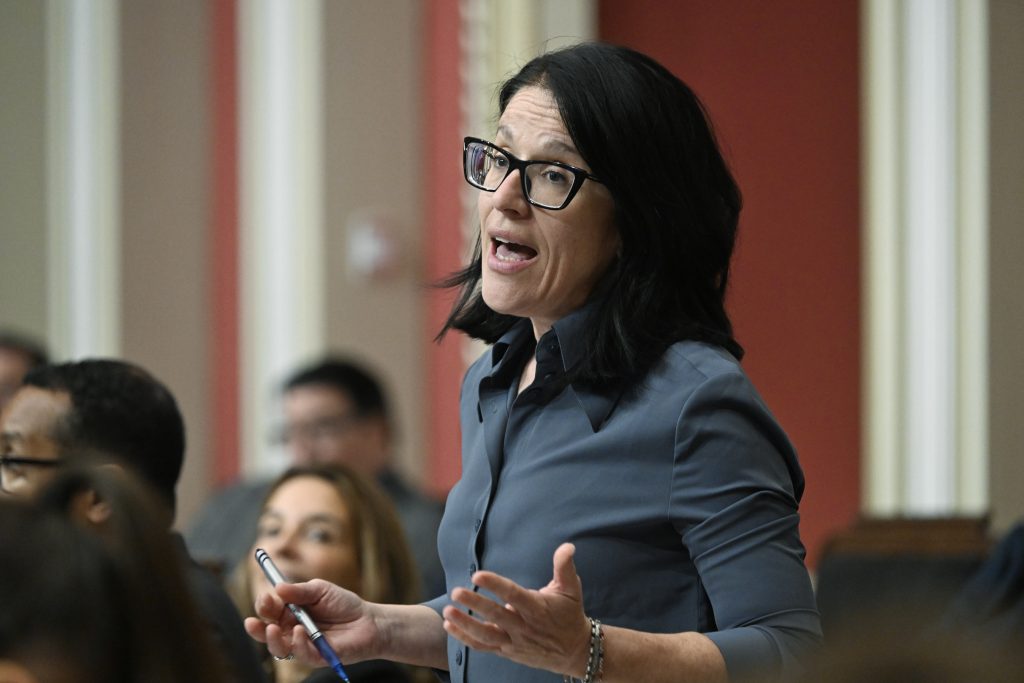
The new Minister of Education, Sonia LeBel, is following in the footsteps of her predecessor, Bernard Drainville, stating that she has no intention of changing the “three-tiered school system.”
This expression refers to the three levels of the system: private schools, public schools with special projects, which also sort students, and regular public schools, the lesser-known ones.
LeBel made her position known to The Canadian Press on Tuesday through a statement from her office. She declined the news agency’s interview request.
“The private sector complements the public sector. It doesn’t replace it, but it is part of it and shares the same goal: student success,” the minister declared.
“It’s up to families to choose what works best for them. We shouldn’t pit the two against each other. We must all work together toward the same goal. That’s what we’re doing,” she stated.
Upon taking office in 2022, Drainville also defended the status quo, believing that the private, selective public, and regular public sectors were “complementary.”
However, for several years, experts have denounced Quebec’s “three-tiered” school system, which they believe reproduces social inequalities, as the most gifted and affluent students flee to private schools.
Consequently, disadvantaged students or those with learning difficulties are overrepresented in public schools, causing an overload of work for teachers.
The Conseil supérieur de l’éducation even declared in a 2016 report that Quebec’s school system was the most unequal in Canada.
In 2019, a study by the Université de Montréal showed that barely 15 per cent of students in regular public school classes go on to university, compared to 51 per cent of students in enriched public schools and 60 per cent of those in private schools.
A year later, the late sociologist and former member of the Parent Commission, Guy Rocher, described Quebec’s three-tier system in an interview with La Presse as a “human waste.”
“It’s unacceptable. We’re a long way from the goal of social equality we set for ourselves,” he declared.
Furthermore, a 2022 study by the University of Toronto concluded that Quebec is the Canadian province with the highest socioeconomic segregation.
This study, entitled “Won’t You Be My Neighbour? Socio-Economic Segregation Between Schools in Canada,” was reiterated in July 2025 in an Australian report that praised Ontario’s approach.
Unlike Quebec, Ontario does not subsidize its private schools, which are therefore prohibitively expensive for the middle class. The province relies on its public system, which is free and accessible to all.
The issue of school segmentation in Quebec is regularly debated in the National Assembly.
In 2023, the Parti Québécois proposed entering into a contract with private schools, provided they cease selecting their students. Those that refused would gradually lose their government funding.
A PQ government would also commit to ensuring that all publicly funded schools offer a choice of special projects to all students.
It should be noted that Québec solidaire also introduced Bill 895 last February, which it developed in partnership with the École ensemble movement.
The bill takes up the idea of grouping together public and private schools within a common network that agree to stop selection based, in particular, on grades.
This proposal for a “common school network” would receive the support of 85 per cent of Quebecers, according to a CROP survey conducted for École ensemble.
For its part, the Federation of Private Educational Institutions advocates for the status quo.
It recently argued in an interview with The Canadian Press that private schools now accept 20 per cent of students with special needs, compared to only 5 per cent a few years ago.
–This report by La Presse Canadienne was translated by CityNews