Quebec urged to invest in second-stage shelters for women fleeing violence
Posted January 5, 2026 7:01 pm.
Last Updated January 5, 2026 7:53 pm.
Advocates and researchers are urging Quebec to increase funding for second-stage shelters for women escaping violence –transitional homes that play a crucial role in preventing homelessness and protecting women and children.
A new study by the Quebec Homelessness Prevention Collaborative (QHPC) highlights the effectiveness of second-stage shelters, which provide longer stays, specialized services, and secure, confidential environments for women after leaving emergency shelters.
Supporting stability and reducing risk
Pearl Eliadis, associate professor at McGill University’s Max Bell School of Public Policy and co-author of the QHPC study, says second-stage shelters are crucial for women leaving emergency shelters.
“We’re only now starting to understand the importance of providing transitional housing after emergency shelters to make sure that women do not fall back into homelessness, that they’re less likely to be exposed to violence,” she said.
Eliadis explains these shelters also help the entire system work more effectively.
“They have many characteristics, if you will, or dimensions that make them especially good at protecting a certain group of women who need confidentiality afterwards. So you’ve got this additional transitional housing after the emergency shelter to make sure that women can get access to permanent housing, do more stable housing afterwards, and that’s what the data shows. They are also much less likely to go back to the person who perpetrated the violence on them or their kids.”

The study found that 69 to 90 per cent of women in second-stage shelters accessed stable housing, compared with 43 to 64 per cent after first-stage shelters. Women in second-stage shelters were also far less likely to return to an abusive partner — four to five per cent versus 11 to 36 per cent.
Eliadis warned about the impact of limited second-stage resources.
“When there aren’t enough resources available for second stage, what happens is that there’s a bottling up of people in the first stage shelters that are not properly resourced for long-term stays,” she said. “What happens then is that when you have that box, if you will, of first stage shelters full of people who are not leaving, what happens? Women who need access to the first stage shelters are blocked because there aren’t enough resources.”
She also emphasized the need for longer stays.
“The average stay right now in Quebec is around eight months in second-stage shelters. We’re advocating for it to go up to one to two years so that women have the ability to go into those shelters and receive services, access permanent housing, put their kids in schools, access health care. That longer transitional period means women are less likely to fall into homelessness and more likely to engage in habits and activities that will preserve their physical safety and security and the security of their kids.”
A long journey to shelter
Melpa Kamateros, executive director of Shield of Athena Family Services, described the 15-year effort to open her organization’s first second-stage shelter.
“Our second step began in 2010 because the social workers of Athena’s House decided to make a position paper to the board saying that finding a very good, safe place for women and their children to transition from violence was the single most difficult thing for them to do,” she said.
Kamateros explained the process.
“It took five years at the governmental level to understand what it was that we were talking about at the social housing level. Then another five years to find the funding and be declared a correct project that we would be vibrantly correct. And then another five years because we landed in the pandemic to build the building. So it took us effectively 15 years of mobilization, stress and anxiety to finally establish the second-step shelter, which I’m very happy to say we just opened in autumn of this year.”
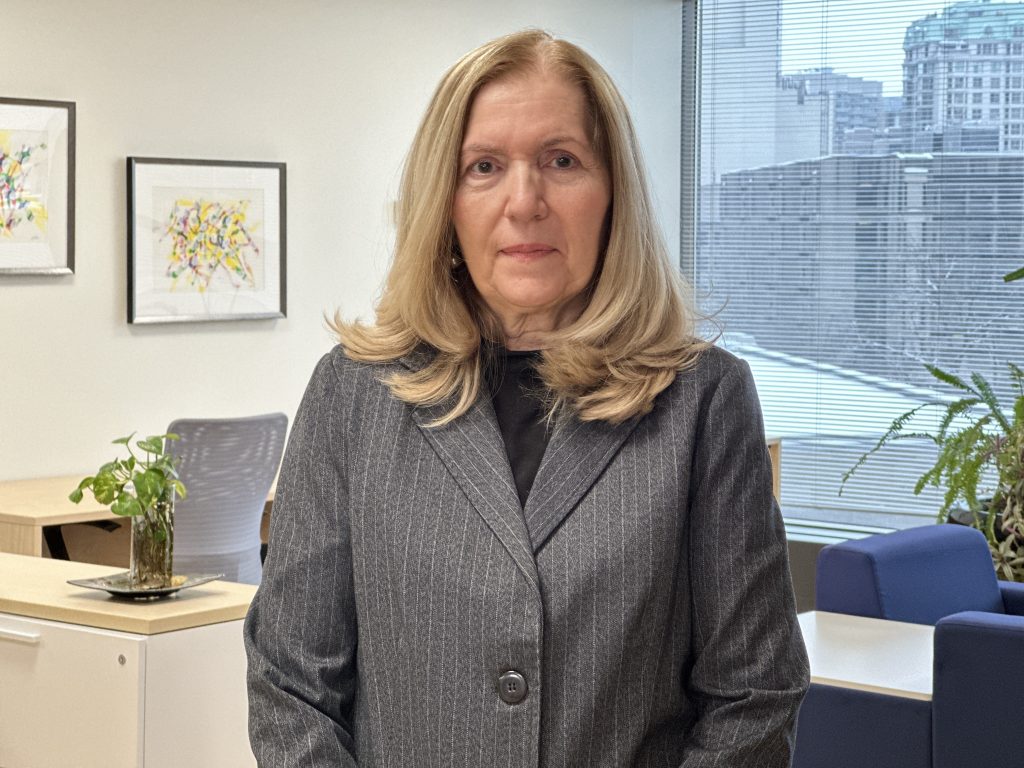
She stressed the importance of transitional housing for women after leaving emergency shelters.
“For women fleeing violence, the single most important thing for them is to go somewhere where they are secure. That place has to be secure, confidential, and has to provide them with the services that they need to overcome the violence for themselves and their children,” Kamateros said.
She explained the limitations of emergency shelters.
“A stay at an emergency shelter is very limited. It is usually one to two months, but recently women are staying longer because there’s nowhere else to go after their stay is finished.”
The challenge extends to social workers, who must find follow-up options for women and children leaving emergency shelters.
“The single most important thing for the social workers or the case workers at the emergency shelters is to find out where they are going to be referring the women and the kids after. And that’s a big problem. There is a very, very hard procedure in trying to access social housing. It’s very, very time consuming. It’s not very accessible.”
Kamateros emphasized why second-stage transitional homes are essential for women fleeing violence. She explained that these shelters provide more than just a roof; they give women the time and resources to rebuild their lives.
“What women who are fleeing violence need more, more than social housing, access to social housing, has access to specific shelters, transition homes where they can transition for a longer period of time from the abuse of situation and become autonomous and remain in a very confidential and secure setting.”
She highlighted that even after leaving an abusive situation, women remain at risk.
“As they are still theoretically in a huge period of potential violence, up to a year after the decision to leave the abusive relationship.”
Kamateros pointed to the consequences when these second-step resources are not available.
“What we have found is that if the women cannot access second-step resources, then it becomes very difficult for them, and we do have perhaps one in four going back to an abusive relationship.”
Government commitments fall short
The QHPC study found Quebec has fallen 33 per cent short of its 2021 commitments to second-stage shelters.
“We think that having that kind of support, that kind of transitional support, making sure the public understands that it is not only critical for women’s lives and security, which of course is the priority, but also making sure that we’re demonstrating that this is a fiscally responsible use of public resources. We would very much like the government to take that message seriously,” Eliadis said.
Eliadis also highlighted a significant legal gap in access to second-stage shelters. She said that while policies may allow women who are not citizens or permanent residents to use these resources, the law itself does not guarantee it. She warned of the potential consequences of this disconnect.
“Because technically what that means is that any day the government can say, ‘we changed our minds. We don’t want to have immigrants. We don’t want to have migrants. We don’t want to have refugee women accessing this.’ And if they did that, they could fall back on the existing legal framework.”
Eliadis stressed the need for reform.
“So we think this is an important change that needs to take place so that we have the ability to have a legal framework that supports the kinds of measures that we’re talking about and the right to adequate housing as part of Quebec’s legal framework.”
Calls for action
Both Eliadis and Kamateros called for urgent measures: increased funding, faster construction of second-stage shelters, longer stays of one to two years, and legal access for non-permanent residents.
Kamateros added a message directly to women in abusive situations: “They should not worry. They should call. They can access services and a better life is there for themselves and their children.”