Women 28% less likely than men to receive CPR from bystander: Montreal study
Posted September 19, 2023 11:06 am.
Last Updated September 20, 2023 10:46 am.
Women in situations of medical distress in public are reportedly less like likely to receive CPR from a bystander, according to a recent study by Montreal researchers.
The study, with results outlined in The Telegraph, does not draw conclusions for the discrepancy. But one researcher suggests bystanders could be concerned about “hurting or touching women” during a period of cardiac arrest.
Bystanders are 28 per cent less likely to assist a woman than they would a man.
The researchers at the Montreal Heart Institute and Montreal’s Sacré-Cœur Hospital found this was only the case in public places – not at home or in other privates places.
Eddy Afram, the chief of Emergency Medical Services with the City of Côte Saint-Luc, said the findings were disappointing.
“It comes from a very wrong narrative that’s been enforced in the last 20 years. We’ve had a lot of people who were afraid of approaching a victim and providing care,” said Afram. “Thankfully, we’re seeing a shift away from there and we’re seeing now more and more responders or even late rescuers providing care and offering help to anyone. The whole idea that you could go and you could be sued is just ludicrous. We actually have an obligation to provide help in Quebec.
“They’re finally exposing some things we’ve been observing for years in the pre-hospital sphere. I’m a bit disappointed in the population as a whole.”

Louis-Pierre Fournier, a first responder for the city of Côte Saint-Luc, demonstrates proper CPR technique Sept. 19, 2023. (Gareth Madoc-Jones, CityNews)
The study looked at 39,000 cardiac arrests in Canada and the U.S. – from 2005 to 2015 – that happened outside a hospital setting.
Overall researchers found 23 per cent of cardiac arrests happen in public locations, with most cases (71 per cent) involving men. The average age of the victims was 67.
In just above half of the cases (54 per cent), the victims received CPR from a bystander.
“We see often with witnesses when we arrive as first responders or paramedics, nobody’s performing CPR,” said Afram. “And that will often, the comment we get is, well, we’re afraid of hurting them. We weren’t sure. So to that, I have a very easy answer. It’s if they’re already in cardiac arrest, the only negative thing that can happen is that they remain dead.
“The fact that you’re not trained should not restrict you or restrain you from offering help. Again, the consequences of certain death versus any positive outcome is better. Locate the nearest defibrillators, get some awareness about them. And the combination of early CPR and early activation of an AED (automated external defibrillator) combined with 911 is how we end up saving more lives in Quebec.”
CPR basics
The basics of CPR are relatively simple, with chest compressions being the main technique.
“Make sure the person is unconscious, the person is not responding, you call 911, ask for an AED. And then you start to do the compressions,” said Louis-Pierre Fournier, a first responder with the City of Côte Saint-Luc.
While CPR is very important, Fournier adds using an AED can increase the chances of survival.
“The defibrillator, it’s going to analyze the rhythm in the heart,” he said. “And if it’s indicated that a shock will be recommended, the person needs to press on the button to give the shock and the shock we hope is going to restore the normal heartbeat afterward.”
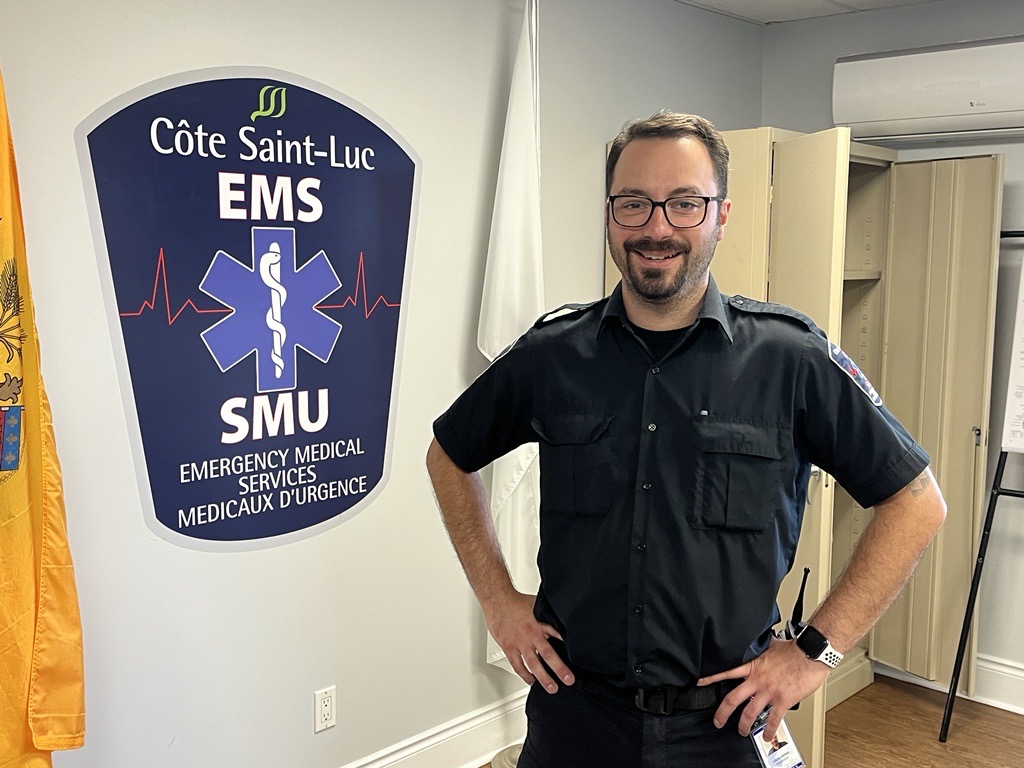
Louis-Pierre Fournier, a first responder for the city of Côte Saint-Luc, Sept. 19, 2023. (Gareth Madoc-Jones, CityNews)