Quebec prosecutors challenge law that withdrew their right to strike
Posted April 9, 2025 11:29 am.
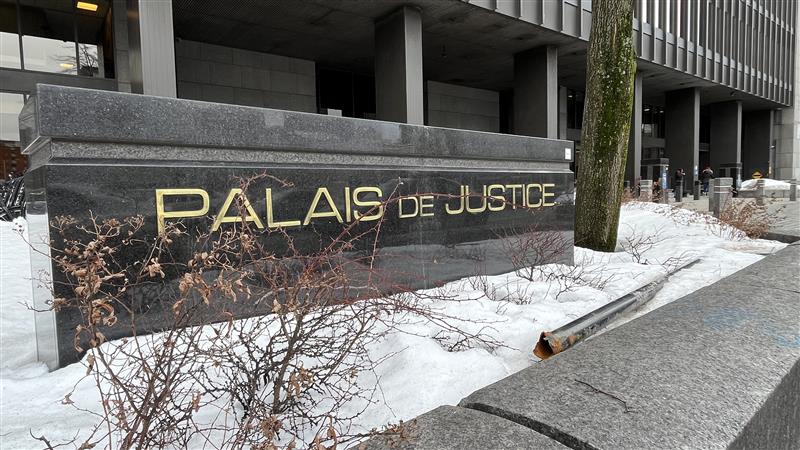
The Association des procureurs aux poursuites criminelles et pénales (APPCP) has just filed a motion with the Quebec Superior Court, asking it to invalidate several sections of a law that they say had removed their right to strike.
This 2011 law was adopted after a prosecutors’ strike.
The law had removed their right to strike and, in return, prosecutors say two separate mechanisms were established for deciding on increases to their compensation and their standard clauses.
It is these mechanisms that the APPCP is challenging, arguing that they are neither fair nor equitable, nor binding on both parties.
Compensation
The mechanism for deciding on their compensation involves a committee that must evaluate it every four years based on seven criteria.
However, this compensation committee only makes recommendations to the government.
For example, when it came to deciding on prosecutors’ compensation for the years 2019 to 2023, the three committee members were divided. Two recommended granting prosecutors a 19.25 per cent raise over four years, and the other recommended a 10 per cent increase. The government chose to follow the dissenting member’s recommendation.
Furthermore, prosecutors cannot negotiate certain working conditions, such as the pension plan and parental rights, since this is not provided for in the committee’s mandate.
“The conclusions of the Committee’s report on compensation have no binding or coercive consequences for the government, since the conclusions are not binding on the National Assembly, which is free to approve, modify, or reject these recommendations, in whole or in part,” the Association emphasizes in its petition.
Regulatory Clauses
The second mechanism, which aims to rule on regulatory clauses, provides for negotiation between the Association and the Director of Criminal and Penal Prosecutions, or failing agreement, arbitration. Here too, the arbitrator’s decision constitutes a recommendation to the government, which ultimately decides.
Again, when the arbitrator rendered his decision in September 2023, for the years 2023 to 2027, “the government modified 13 recommendations and rejected two other recommendations from the arbitrator,” the association points out in its petition.
The Association maintains that, so far, in its application, “the law has simply had the effect of removing the negotiating power held by prosecutors and transferring it, in its entirety, to the government.”
Right to Strike and Mechanisms
The Association recalls that in January 2015, the Supreme Court of Canada ruled in the Saskatchewan decision that the right to strike must be constitutionally protected and that it is an essential component of collective bargaining.
“The existence of a genuine and effective dispute resolution mechanism becomes mandatory as soon as the legislature restricts or prohibits the exercise of the right to strike: such a mechanism is therefore not an option, but an obligation,” the Association emphasizes in its motion.
“The Supreme Court establishes that to ensure a genuine and effective replacement process, it must have the following characteristics: it must be effective, fair, allow for the resolution of disputes, be equitable, rely on an impartial and independent third party, compensate for the loss of employee power resulting from the deprivation of the right to strike and place employees and the employer on an equal footing, and finally, it must not exclude matters open to negotiation,” the Association states in its motion.
The association also argues that this fair process “must necessarily be binding on the parties and enforceable.”
The association therefore argues that the law is unconstitutional because it violates the Quebec and Canadian Charters of Rights and Substantially Impairs its right to a meaningful collective bargaining process.
It is asking the Superior Court to order the establishment of a genuine dispute resolution mechanism, consistent with the constitutional requirements regarding the right to strike.
–This report by La Presse Canadienne was translated by CityNews