‘Why did you release him?’: Montreal rescues blast SPCA replacement Proanima’s approach to animal care
Posted February 5, 2026 9:44 am.
Last Updated February 5, 2026 3:20 pm.
There’s a boogeyman term among animal rescuers in the Montreal area – a derogatory symbol denouncing unethical animal care.
It’s uttered in moments of exasperation – on the drive to a cat colony after a long shift at work, in a veterinarian’s waiting room, or on the innumerable Facebook pages that are the heart of the community’s network of operations.
The last thing any group mandated to care for animals in Montreal wants to be compared to is this: Berger Blanc – the boogeyman of the shelter world.
“I remember it very well. April 2011,” longtime trapper Isabelle Caron told CityNews, the date at her fingertips. That’s when news broke of severe animal cruelty and neglect allegations at the Laval shelter that has never quite managed to shake the controversy and public outrage.
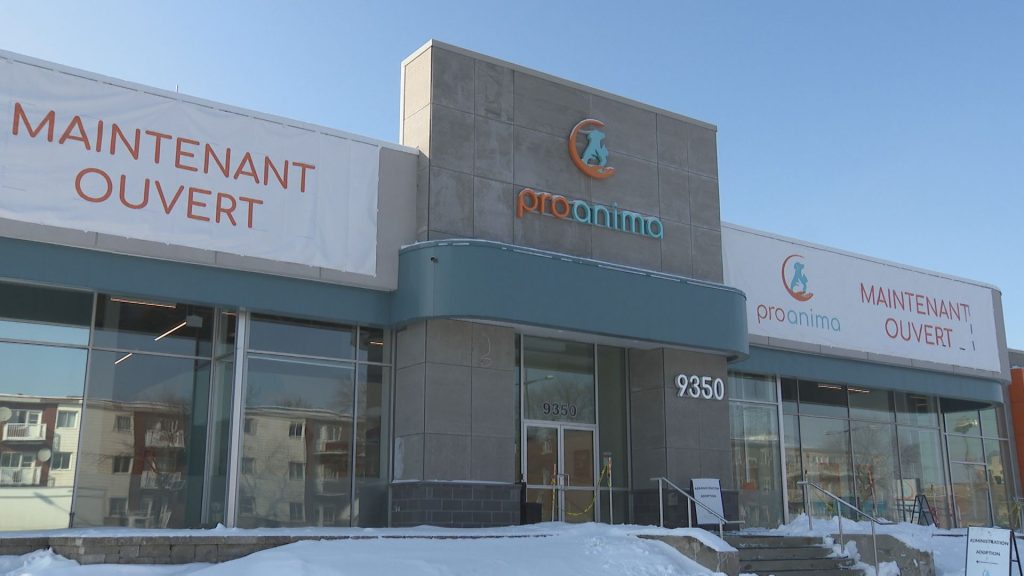
So, when Proanima, the organization that took over animal management services for Montreal from the SPCA on Jan. 1, began getting compared to Berger Blanc by cat trappers and rescue owners and all-around animal lovers, it was hard not to take notice.
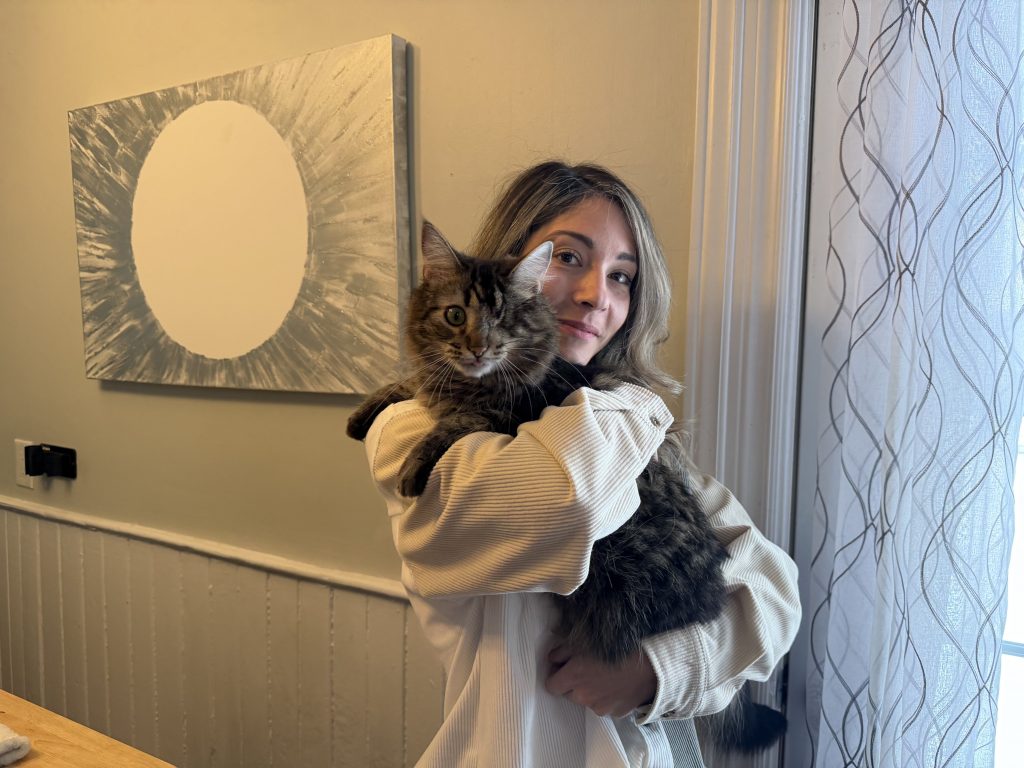
It’s a comparison Billie Rousse, the co-founder of a non-profit Montreal cat rescue, took one step further during a lengthy conversation this week about Proanima’s practices and their philosophy.
“With Berger Blanc, they put the animals up for adoption, and then people pool their money to get them out of the shelter. With Proanima, we don’t even have that option because as the animal gets there, they euthanize them,” said Rousse, who co-founded Refuge ABC’S Rescue last July.
It’s an accusation Proanima’s director of shelter medicine, Dr. Vincent Paradis, described as “highly inaccurate” misinformation that is “profoundly harmful to animal welfare.”
Rousse claims Refuge ABC’S Rescue caught an all-black female stray cat who had a respiratory infection on Jan. 8. She says her group brought the feline to Proanima that day, and the organization put her down the following morning – less than 24 hours later.
“It was a cold,” Rousse said. “They weren’t hit by a car. It was something very treatable, and they euthanized her. As soon as a stray cat has a little something, a cold, an eye infection, things like that, they’re not going to treat it, they’re going to euthanize it.
“We don’t want to trap for them anymore because we know that if there’s something minor, since we can’t take care of them after they’re sterilized, they’ll be euthanized.”

That’s the sentiment from the animal rescue community just weeks into the changing of the guard from the Montreal SPCA to Proanima, the organization that began in the South Shore and expanded to Montreal this year after signing a $158-million contract over 10 years with the city.
Proanima opened its first physical location on the island of Montreal – in Villeray—Saint-Michel—Parc-Extension – last month; a second shelter is planned for the city’s west end.
Resorting too easily to euthanasia, which Dr. Paradis asserts is “entirely false,” is among the most damning in a long list of accusations against Proanima.
“Animals presenting only minor conditions – such as the examples mentioned (ocular infections or feline upper respiratory infections) – always receive appropriate treatment immediately,” Paradis wrote to CityNews in an email after postponing an in-person interview. “We treat systemically way more complex conditions than these superficial health problems.
“Euthanasia decisions are strictly based on two core principles: the welfare of the animal and public safety.”
Paradis says half of euthanasia cases involve major medical problems, including “severe hit-by-car trauma, advanced cancers, unstable advanced metabolic disorders, uncontrolled seizures and other medical conditions that had not been addressed before intake and are therefore beyond recovery at intake moment.”
He says 21 per cent of euthanasia cases involve “highly dangerous behaviour” like severe bites or repeated aggression, and 11 per cent are “humanitarian decisions” to relieve suffering.
He adds the remaining 18 per cent is an assemblage of “nuanced and specific cases, but never the reckless euthanasia of animals for minor health conditions.”
Paradis says Proanima is considered a no-kill shelter because it has a more than 90 per cent “live release rate.”
Straying from the SPCA?
Some of the other major complaints against Proanima are in fact core elements of the organization’s philosophy, written in black and white on their website and in the Capture-Sterilization-Return-Maintain (CSRM) program guide given to rescue groups, trappers and cat colony guardians.
Animal rescuers, for instance, are unhappy Proanima releases back into the wild months-old kittens; newly sterilized cats before their sutures have healed; and cats that rescuers consider affectionate with a high potential for socialization. They say cats are even released during winter storms and plummeting temperatures.
On the claim that Proanima does not release stray cats at the exact location they were caught – something considered deplorable practice in trap-neuter-release because it significantly decreases an animal’s chance of survival – the organization says that simply isn’t true.
Other complaints certainly appear more minor, but the rescue community says it’s all part of a series of impediments that make trapping and rescuing animals more difficult under the new system.
Those include Proanima not allowing trappers to release their own captured animals post-sterilization; a lack of communication between Proanima and rescues about animals they brought in, such as their gender, age, and health; inflexible drop-off hours; and restrictive rules that see Proanima keep a rescue’s live traps for days, preventing trappers from swiftly clearing out an entire colony.
Rescuers say it’s all in sharp contrast with how things operated previously under the Montreal SPCA.
Nicole Sanschagrin, a trapper who works with multiple Montreal rescues, says Proanima’s philosophy “doesn’t make sense” and “their method doesn’t work.”
“It’s like they are incredible control freaks, which we didn’t have with the SPCA. The SPCA trusted the trappers. It’s not normal,” said Sanschagrin, who is in the process of capturing more than two dozen cats from a colony in Montreal North.
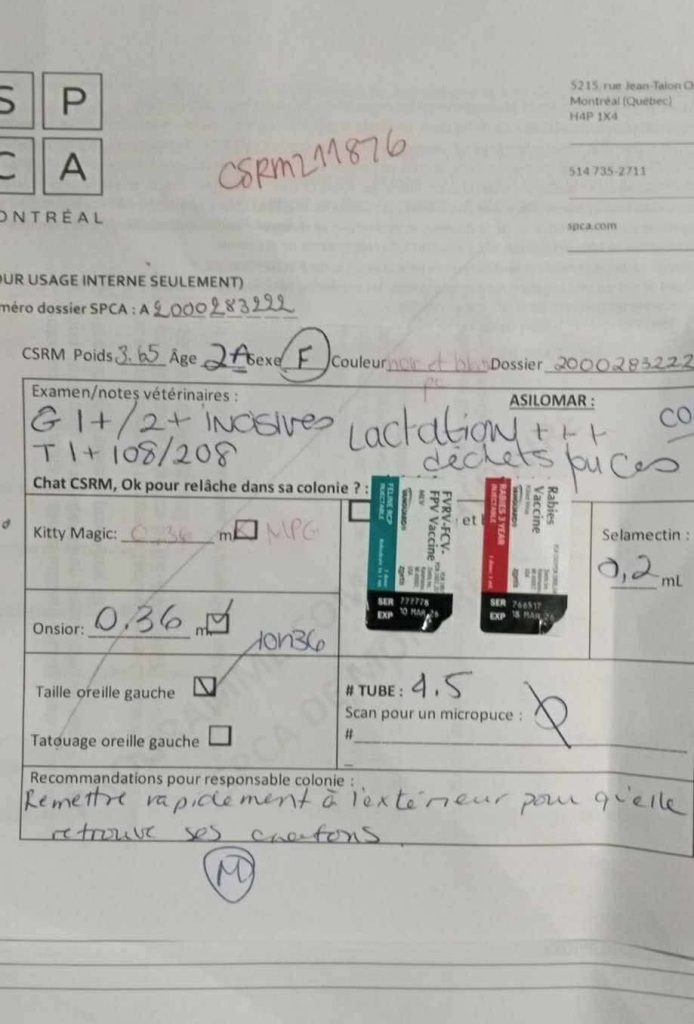
“When we brought a cat to the SPCA, they gave us a picture of the cat. We knew its age. We knew if it had no teeth left. We knew if it was sick. We knew if it was pregnant. We knew if it was lactating. Because if I catch a cat that’s lactating, I can’t tell. So when they tell me, it means I have to find the kittens. I release the mom right away for the kittens. She’ll bring me her kittens in a month or two.
“But they don’t want to tell us anything. They tell us it’s confidential.”
Rousse says the SPCA would provide a trapper with the cat’s health form. Not anymore.
“It allows us to know how many males and females there are, a census in our colonies,” she said. “Was the vaccination done correctly? Was the sterilization done correctly? Were there any diseases they’ve seen, like mites or ticks? … Was the animal treated with a dewormer or antiparasitic? Because we know that diseases and things like that spread in a colony, we need to know.”
The Montreal SPCA, which says it will now shift its focus toward strengthening animal cruelty investigations and law enforcement, rejected CityNews’ request for an interview.
“Each stakeholder in the field has their own approaches and intervention frameworks,” the SPCA wrote in a brief statement that went on to encourage Montrealers not to capture domesticated cats.
The SPCA also denied a request for statistics, from previous years, concerning the proportion of stray cats that were released, put up for adoption, or euthanized.
Proanima’s release-first philosophy
Proanima is by no means denying its approach to feline population control and its community cat management initiatives are avant-garde and “progressive.”
Citing scientific studies, some of which are linked on their website, Proanima says programs focused on adoption or even eradication don’t work because of something called the “vacuum effect.”
It posits that when stray cats are trapped and removed from the area they call home, new cats move into the vacated territory and begin their own colony, thus increasing the overall cat population. In contrast, the studies suggest, if a cat is temporarily removed, sterilized and then returned, that keeps other cats away and prevents a new colony from forming.
That’s the theory. Proanima says it’s been putting it into practice for years – with results.
Though the organization’s presence in Montreal is but weeks old, Proanima has been operating on the South Shore since it was founded in 2012, and later in Saint-Jean-sur-Richelieu.

When it introduced its “return-to-field” initiative in 2018, Proanima says the results were instant. “That year, we saw a drastic drop in euthanasia rates thanks in part to this expert‑recommended program,” Paradis explained.
But Montreal’s animal rescue community believes the science is flawed.
“We don’t know where they got their analysis,” Sanschagrin said. “I told the girl from Proanima, if I lived in Spain, where it’s always warm, look, I wouldn’t even hesitate: I’d release them all. But here in Quebec, it’s minus-25 outside. We have lots of injured cats stuck outside.”
“It’s based on science?” added Caron. “I mean, the SPCA’s best practices for CSRM were also based on science.”
Proanima’s director of shelter medicine says the methods being advocated by Montreal’s cat rescuers – a larger emphasis on socialization and adoption – has “consequences (that) are often ignored.”
“A traditional shelter without progressive cat management is continuously overcrowded with cats,” Paradis said. “It operates beyond its capacity, which often means it cannot provide all the appropriate care. Cats become stressed and sick; outbreaks spread easily – people often talk about shelters full of “rhino” (rhinotracheitis). In the end, many healthy cats are euthanized simply because the shelter lacks space or because they do not qualify for adoption.
“Such a shelter may ‘protect’ cats from the harshness of outdoor life, but it inevitably guarantees the death of a significant number of them.”
Dr. Paradis says the alternative for such a shelter – at overcapacity but wanting to avoid relying on euthanasia – is to drastically limit intake.
“It only accepts a small number of cats in line with its capacity,” Paradis said. “The harder‑to‑adopt cats are not euthanized and can stay longer even if they are terrified in the shelter, but because of this, the shelter only helps a very small number of cats each year. It changes the lives of a few cats but has almost no impact on the broader cat population.”
Freshly sterilized kittens released
The fundamental disagreements between Montreal’s cat rescue community and Proanima run deep – from what age cats should be before they are released to how many days removed from their sterilization.
On age, the rescuers say Proanima is releasing kittens that are far too young back into the wild. Proanima’s guidelines state cats that are five months and older are returned where they were captured.
“The socialization window for kittens closes at 12 weeks,” Paradis said. “Socializing an older juvenile is still possible, but much slower.
“At five months old, a cat is generally less open to socialization and already sexually mature.”
But Sanschagrin accuses Proanima of slyly blurring those very guidelines. She shares the story of a kitten she captured who may have been significantly younger than Proanima ultimately decided.
“I emailed them: ‘I don’t understand, why did you release him?’” Sanschagrin recounted. “‘He’s a five-month-old kitten. You tell me it’s all kittens under five months old. He’s five months old.’ They replied, ‘five months and a few weeks.’ And when I asked how old he is, because I tried to find out over the phone, they told me the vet wrote: six weeks to five months. That’s a big difference between six weeks and five months.”
On post-surgery recovery time, Proanima’s guidelines are also clear: cats are released the day after surgery, “ensuring that all anesthetic drugs have dissipated.”
“Rapid release after surgery is recommended to avoid complications associated with captivity‑induced fear,” Paradis wrote.
A next-day release is far too quick, according to the rescues, especially if it’s a female cat given the sterilization procedure is more complex than with male cats.
And it’s a far cry from how things were done under the Montreal SPCA, according to Rousse.
“If, for example, we brought in a spayed female with her belly shaved to ensure her stitches were intact, and then it was winter, they asked us to keep her until she was healed before releasing her,” the Refuge ABC’S Rescue co-founder said. “This meant her fur would grow back tightly. It was always recommended. Then they made us sign a paper to make sure it was done and respected. They asked if we could keep her. Otherwise, they would keep her for up to two weeks, and then we had to come and collect her.”

Proanima does say it adds a “temperature criteria” to ensure the cats are released in “local normal weather condition” during the winter.
Again, Sanschagrin is questioning how closely Proanima adheres to its own rules.
“Last week, on the 22nd, I caught two cats,” she said. “They wanted to release them on Saturday. But it was minus-19. In the guide they gave us, they say they don’t release cats below minus-10.”
That was also the recent experience of Brigitte Lévesque, the founder of Réseau d’entraide pour les animaux d’Ahuntsic-Cartierville (REAAC) – a network of volunteers helping with everything animal related in the Montreal borough.
Lévesque says she received a call Jan. 18 from three neighbours looking for a live trap to capture a female cat in heat. She was captured and brought to Proanima. Two days later she was released back where she was caught – freshly sterilized.
It left Lévesque scratching her head.
“There’s still a recovery period at home,” she said of domestic cats after surgery. “We’re careful not to let the cat outside. We need to monitor its healing. Is it healing well? Because sometimes there can be an infection. Sometimes it can happen that it doesn’t heal properly. The cat needs to be kept calm. We don’t recommend letting it outside.
“It’s possible that it could get infected or that there could be a problem after surgery. That’s why we wait at least a week before letting them out to recover.”
Lévesque is also wondering if Proanima ignored the temperature criteria given a storm was on the way when the cat was released.
“Is it really a humane approach to have released a cat first when they were forecasting a polar vortex, and then a female so soon after? Maybe that’s their way of doing things, I don’t know. But what I can say for sure is that it happened, and it’s true.
“I’m a little disappointed by the experience I had. Maybe it’s an isolated case. I don’t even know, but I hope it is.”
‘If he’s friendly, put him up for adoption’
Adding to the confusion for Lévesque and the three Ahuntsic neighbours was the fact the female cat appeared quite docile for a stray; they were able to pet her shortly after capturing her.
Lévesque says the women were convinced she would be put up for adoption and would quickly find a home.
“I imagine she didn’t pass the adoption test,” Lévesque supposed. “How did she behave there? I can’t say. I don’t know. But in any case, if they decided to send her back outside, it’s because they considered her unadoptable.”
“I’ve rescued street cats who were in very poor health. … Then they’re adopted and they become incredibly affectionate, they no longer want to go outside. They don’t ask to go outside at all.”
—Brigitte Lévesque, founder of Le REACC
Though it’s quite possible the opposite happened, that the cat was deemed too friendly to be a stray.
“A highly social cat outdoors almost certainly has a home,” Paradis said. “This simply means an owner is allowing the cat outdoors, as 39 per cent of cat owners do.”
Lévesque’s main criticism: “You can’t evaluate a cat in a day.”
“It’s possible that for the first two days they might hiss and not be friendly, but after that, when they understand there’s food, they don’t need to fight outside to survive, their attitude can change everything,” she said.
“I’ve rescued street cats who were in very poor health. Seeing them afterward, when you treat them after that, you put them in a family, then they’re adopted and they become incredibly affectionate, they no longer want to go outside. They don’t ask to go outside at all. It’s not true that it’s natural. It’s about survival. They survive outside. These cats, they survive.”
It’s yet another breakdown between two very different mentalities and approaches to animal care.
According to Proanima, cat adoption is simply “not the primary plan.”
“A social cat already has a home to return to,” Paradis reiterated. “A feral cat would ultimately be euthanized due to lack of adoptive interest if adoption were forced. Adoption is therefore a Plan B – only used for cats who are not fit for outdoor life, cats who are sick or in distress, or kittens that are too young.”
Sanschagrin sees it completely differently.
“This cat was born outside, but he doesn’t have to stay outside,” she said. “He didn’t ask to be outside all the time.
“If he’s friendly, put him up for adoption. Someone will give him a chance.”
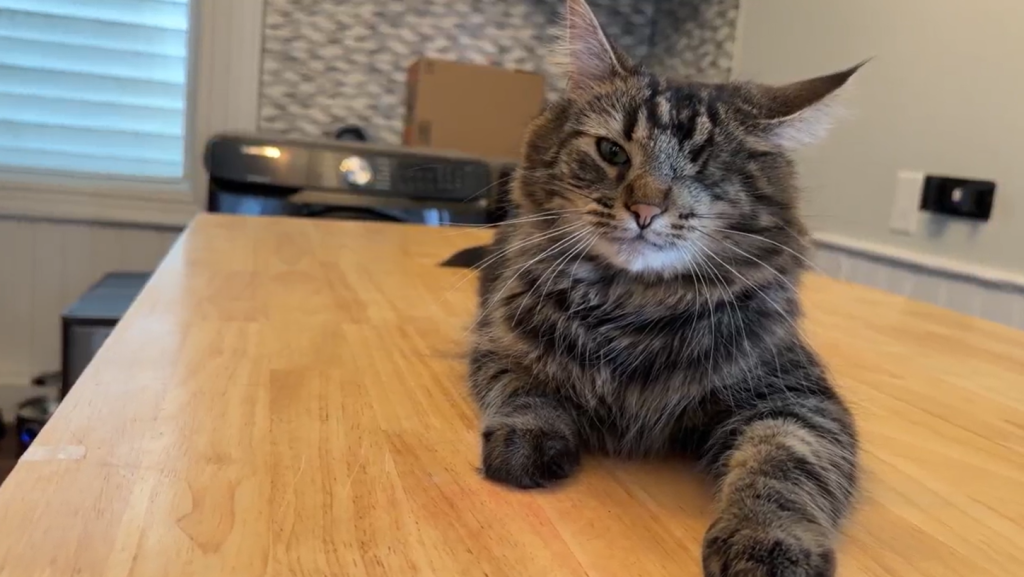
That’s ultimately what the neighbours in Ahuntsic did. After the female cat was released, she returned to the property four days in a row. On that fourth day, the women managed to trap her again. Lévesque suspects one of the neighbours will adopt her for good.
Taking advantage of the system?
It’s something Proanima frowns upon.
It means a cat was sterilized on their dime; they weren’t reimbursed through adoption fees; and there’s no “vacuum effect” now that it becomes an indoor cat.
That’s precisely why Proanima is adamant about its protocol – unlike the Montreal SPCA – to release all sterilized cats themselves back where they were captured. Previously, the cats were returned to the trappers who had brought them in, and it was the trappers who released them back into the wild.
But the cat rescue community believes Proanima is delusional for thinking there’s a network of money-hungry trappers looking to save a few bucks on sterilization and vaccination fees to then turn a profit on adoptable cats.
“I trap, I release. I trap, I release, I trap, I release,” said Caron. “If by chance there are some who are sociable, well then maybe we can think about it… It’s a fiction to imagine that every trapper is going to take advantage of the system.”
As far as Sanschagrin and Rousse are concerned, Proanima’s funding structure – receiving public money instead of relying on donations – justifies the occasional exception to the rule.
“They’re subsidized by the City of Montreal to reduce the stray cat population in Montreal,” said Sanschagrin. “So they’re paid to do it.”
“Given the time it takes to socialize them, they shouldn’t be afraid,” added Rousse. “I think our taxes, even as a trapper, pay for their government program; they receive funding. My taxes can be used to sterilize a cat from outside the area. I have no problem with that, and I think a lot of people in the population are very fine with it too.”
Cutting ties with Proanima?
We’re just a few weeks into the new year and already some animal rescuers are rethinking their affiliation with Proanima.
Sanschagrin says she feels like she’s faced with a “heartbreaking choice.”
“It’s either we work for Proanima because we don’t want any more stray cats outside, or we stop and tell them to deal with it themselves.”
The cat trapper believes that’s what Proanima wants – for rescue groups to stand down.
“Because you can imagine the expenses they incur paying someone to release the cats. We used to do it all for free. What they’re going to do is, next year, they’ll say there are too many stray cats. Well, then we’ll need people to go trap them. Then they’ll ask the city for even more money. It’s a free-for-all. I’m telling you right now. It’s a free-for-all.
“It’s a shame because if they were open, it would be a wonderful collaboration for stray cats. That’s what I want. We all want that.”
Meanwhile Rousse says she doesn’t want to trap for Proanima anymore.
“I can’t bring myself to release them in conditions like that after sterilization, especially the females. Releasing a female who’s just had treatment and then risking her life outside… it’s less dangerous for her not to have her spayed. However, the downside is that they continue to get pregnant.”
Rousse feels it could be Montreal’s feline population that pays the price.
“There are 200,000 cats in Quebec that live outdoors, without homes,” said Rousse. “These aren’t indoor cats we trap. These are outdoor cats with no chance of survival, hit by cars, disease, panleukopenia, frost, cold, and summers with temperatures reaching 40 degrees Celsius, no water, and death from heatstroke.
“Right now, there are plenty of trappers who no longer want to work with them.”