St-Lawrence River cleanup efforts begin in Montreal
Posted August 6, 2025 11:15 pm.
Last Updated August 6, 2025 11:23 pm.
Mission 1000 Tonnes and Stratégies Saint-Laurent have teamed up once again for a major cleanup of the St-Lawrence River and its shores.
The expedition began Wednesday morning at the Soulanges Canal Park in Pointe-des-Cascades, and then moved to Montreal on the banks of the Lachine Canal by late afternoon, where they removed as much waste and polluting materials from the river with the help of a dedicated team and members of the public.
“We’re leaving with a bus of 18 people inside. We have an ecological restoration team, a team of scuba divers, a team of scientists, a youth team, and a communications team,” expedition leader Jimmy Vigneux said in an interview with The Canadian Press.

“Our goal is to conduct shoreline cleanups throughout Quebec along the St. Lawrence and its watersheds, in order to remove waste, but also to mobilize citizens and municipalities to collect waste with us and reduce the amount of waste we generate throughout Quebec.”
Vigneux told CityNews, “Last year we removed eight tons and so this year we will see. We were in Pointe de Cascade just this morning and we removed 1,700 pounds in just two hours. So it’s a big start.”
For this second edition of the cleanup, the team managed to add an extra six municipalities this summer, for a total of 22 locations they’ll visit across the province of Quebec.
During the various cleaning chores, it is essentially the same waste that citizens find on the banks.
“The expedition is going to make 22 cleanups all around the province of Quebec. So, we’re starting in Montreal after we’re going in the direction of Quebec City and after Tadoussac and we’re going back to go across the other side of the St. Lawrence River we’re going to the Gaspésie,” said Vigneux.
“We find a lot of single-use plastic. So, plastic bottles, coffee cups, fast-food packaging from major chains, food packaging. We also find a lot of cigarette butts, cans, and a lot of Styrofoam.”
This waste comes from different sources.

“Sometimes beachgoers will leave their trash,” and in other cases, the wind pushes trash onto the shores, and the river waters carry it over long distances,” Vigneux said.
The St. Lawrence River is indeed one of the most polluted rivers in the world with microplastics.
Many micro and nanoplastic particles come from the degradation of larger plastic items, but most importantly, from our clothing.
A recent study by the National Institute for Scientific Research (INRS) and Laval University shows that the most abundant microplastics in the St. Lawrence River are polyester textile fibers. When synthetic clothing is washed in a washing machine, tiny plastic fibers are released, which end up in aquatic ecosystems.
The overabundance of plastic waste and microplastics in rivers has also led the team to take sediment and water samples along their route to study the effects these plastics are having on the St-Lawrence.
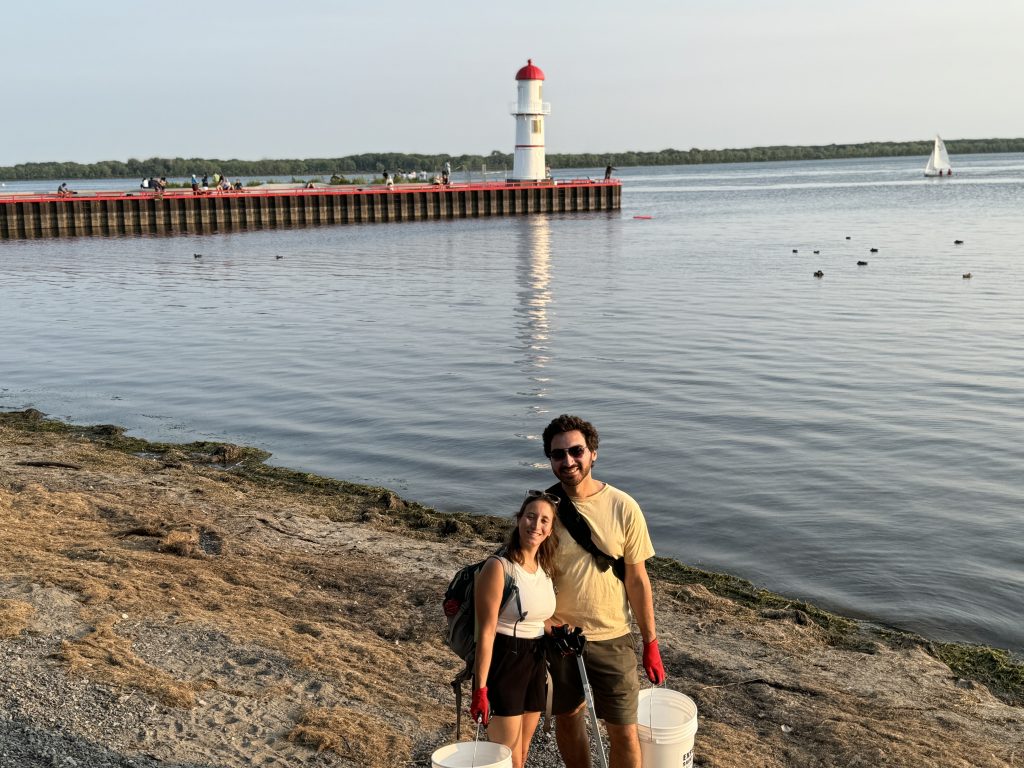
“It’s important to gather data about the presence of microplastics in the St. Lawrence. There’s not much data about it,” said Sira Chayer, the communications coordinator, St-Lawrence Expedition. “It’s also with numbers that we can convince people, the elected people and the community and the citizens to act.”
Vigneux added, “My biggest objective is to convince people to reduce our consumption of plastic because that’s the way to make a real difference is to reduce our utilization of this plastic.”
Up next on the ‘Watershed Expedition’, the team is heading North to the Laurentians for the third scheduled cleanup, where they’ll make their way to their final destination in the Gaspé on Aug. 22.
-With files from the Canadian Press