Quebec committee recommends extending religious symbols ban to daycare workers, ending funding for private religious schools

Posted August 26, 2025 12:18 pm.
Last Updated August 26, 2025 5:42 pm.
With just over a year to go before the next provincial election, secularism is back at the forefront of Quebec politics. A report released Tuesday, commissioned by the Legault government, proposes, among other things, to extend the ban on wearing religious symbols to educators and management staff in early childhood centers (CPEs) and subsidized daycare centers.
However, the dense, nearly 300-page report suggests a grandfather clause that would ensure that educators already employed would not have to comply with the ban.
It also suggests “closely” monitoring CPEs and subsidized daycare centers that are “de facto religious so that true secularism can be implemented.”
Among the document’s 50 recommendations is a proposal to “gradually end state funding for private religious schools.”
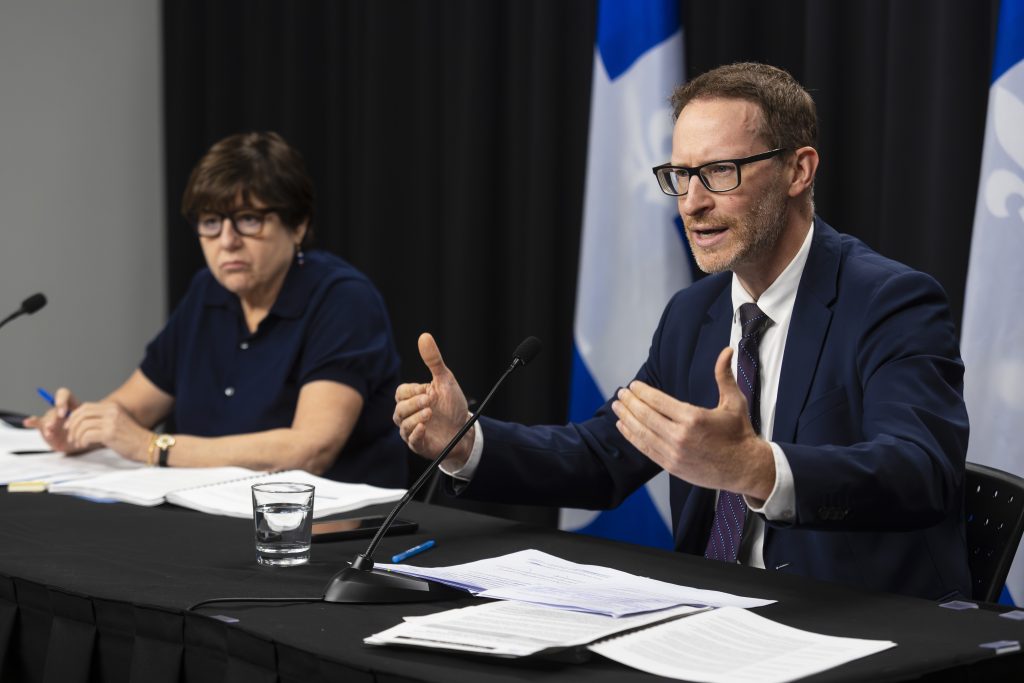
“It’s the whole religious atmosphere that is taking hold that has no place in a secular state,” Christiane Pelchat, a lawyer who co-chaired the committee, told a news conference.
Pelchat and co-chair Guillaume Rousseau, a lawyer and professor at Université de Sherbrooke, want the government to limit religious accommodations, force municipalities to regulate public prayer and create a national day for secularism.
“At the same time, it is proposed that these schools continue to receive public funding as long as they become secular,” said Rousseau.
To do so, schools will have to respect the four principles of state secularism, namely: the separation of state and religion; the religious neutrality of the state; the equality of all citizens; and freedom of conscience and religion.
“But we don’t have exact details on what the secularization of private schools would mean in concrete terms,” Rousseau qualifies.
The CAQ government had closed the door on defunding religious schools. However, Premier Legault has said he is open to discussing the issue “in good faith” with the opposition parties.
Street prayers
Last December, the premier raised the possibility of banning street prayers.
In its report, the committee suggests that it should be up to municipalities to adopt policies to regulate this practice.
“We believe that municipalities should manage this, because it’s not the same thing in downtown Montreal as it is in a village in Mauricie. So municipalities need to have a policy and manage this issue with government approval to ensure a minimum of consistency,” said Rousseau.
Last March, Education Minister Bernard Drainville introduced Bill 94 in the wake of breaches of secularism observed in several Quebec schools, including Bedford in Montreal.
The legislation aims to expand secularism in Quebec schools and will, in particular, prohibit the wearing of religious symbols by all public school staff.
The report tabled on Tuesday proposes to “explicitly give universities the power not to provide prayer or meditation rooms.”
With regard to CEGEPs, it is recommended that prayer rooms be set up that are “accessible to one or two people at a time, excluding rooms dedicated exclusively to prayer or any other form of appropriation of common spaces, such as washrooms and stairwells, for religious purposes.”
“Many CEGEPs are under pressure from religious groups to provide prayer rooms. Often, men and women are separated in these rooms. We find this inappropriate,” explained Rousseau.
“Strengthening the secular nature of the state”
Last March, after investigations into 17 schools in Quebec for breaches of secularism, Minister Jean-François Roberge announced the creation of the Study Committee on Compliance with the Principles of the Act Respecting State Secularism and Religious Influence.
Its mandate was to “paint a picture of respect for secularism and religious neutrality within state institutions, document the phenomenon of religious influence, and make recommendations to the government to strengthen secularism in Quebec.”
On Tuesday, Minister Roberge said he welcomed the committee’s report “very favourably.”
“We have always said that we want to strengthen secularism in Quebec. The points raised by the committee provide us with excellent avenues for modernizing the law. We are continuing to analyze the report and will be back soon with the next steps,” he wrote on social media platform X.
The committee was co-chaired by former president of the Conseil du statut de la femme Christiane Pelchat and professor at the Faculty of Law at the University of Sherbrooke Guillaume Rousseau.
Stephen Brown, CEO of the National Council for Canadian Muslims, said extending the ban to daycare workers would exacerbate an existing shortfall of daycare spots, and said the idea is based on “zero evidence.”
“What the (committee) is saying with this is that if your kids see somebody from another religion it could harm them,” he said. “It’s asinine.”
Asked why she believes there’s an increasing influence of religion in Quebec institutions, Pelchat pointed to an “influx of believers” to the province, especially from North Africa. She stressed that the phenomenon is “really concentrated in Montreal.” The report provides little quantitative data.
However, Brown said there’s “absolutely no problem” with religious accommodations in Quebec right now. “I don’t think that there’s a greater presence of religion in schools. I think there’s a greater number of people that don’t come from a Christian background in schools,” he said.
“We really need to get back to focusing on the real problems that we’re facing as a society, as opposed to these distractions that don’t help anybody.”
Other recommendations:
– End the practice of writing to parents to inform them in advance that content related to sexuality will be taught to their children.
– End funding for anti-choice and discriminatory organizations.
– Document issues related to religious influences promoting fasting among school-aged children and the effects of this type of fasting on these children with a view to improving methods of raising awareness of these issues.
– Prohibit the representation and wearing of religious symbols on posters and in advertisements by the government and public institutions, with some exceptions.
– Create a National Secularism Day.
– Gradually phase out tax benefits and subsidies granted to religious organizations, after conducting a consultation and impact study.
-With files from Maura Forrest, The Canadian Press
–This report by La Presse Canadienne was translated by CityNews