Montreal mayoral candidates faced off in a debate Tuesday
Posted September 16, 2025 5:53 pm.
Last Updated September 17, 2025 1:10 am.
Montreal mayoral candidates faced off in a townhall-style debate Tuesday night as the campaign gets into full swing.
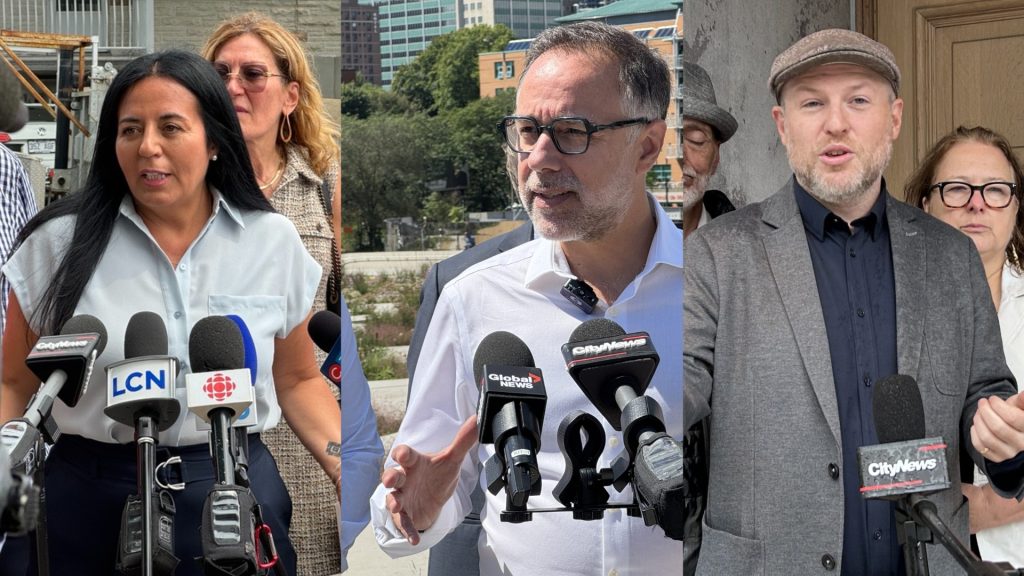
Soraya Martinez Ferrada of Ensemble Montréal, Luc Rabouin of Projet Montréal and Craig Sauvé of Transition Montréal took questions from Montrealers.
The debate dubbed as a “Citizen Dialogue” by its organizers Transition en commun (TEC) and the Institut du nouveau monde (INM) was moderated by Maude Goyer, an independent journalist to a packed audience at the BAnQ auditorium.
Ahead of the event, Claudette Carboneau, a resident of Old Montreal, said “I want a city that is open, a city that is harmonious, a city that also addresses its housing problems, including social housing, a city that promotes a certain social diversity.”
Griffintown resident Kyle Spanz said housing was his top issue. “The rent is too high the price of homes is too high the housing crisis is the most important thing in this election and bike lanes second second priority,” he said.
The debate focused on three themes around: citizen participation in community development, inclusion of marginalized voices and equity in representation.
Citizen Participation
The debate began with the theme of citizen participation and the level of engagement in political processes in the city.
Martinez Ferrada said it was necessary to have citizen engagement in the decision making processes and to have diverse opinions heard.
“I think we need to trust the lived intelligence of people in their neighbourhoods, the knowledge that comes from local experience, and I believe that’s the best way to ensure we have projects that truly reflect what citizens want,” she said.
Sauvé said that the present moment was one of multiple crises (“polycrise”).
“We want people to be able to take part in democratic life, but if they’re always running just to survive, we’re going to have a lot of problems. That’s why we need to work on housing, on non-market social housing, on the homelessness crisis, on making life easier and more affordable for people,” Sauvé said.
Rabouin said it was important to give voice to those who aren’t politically engaged.
“The challenge for us, when it comes time to make decisions, is to make sure we’re not only listening to those who are well organized and speak the loudest, but that we also think of the people who could benefit from a project but aren’t there to voice their needs,” Rabouin said.
Representation
On the theme of equity in representation across boroughs, Sauvé said that he supported a proportional representation system which he said will allow for multiple parties to be represented and reflect the diversity of neighbourhoods. He also called for other electoral reforms such as a ranked choice system for the Montreal mayoral election.
“When you have a party that wins 100 per cent of the seats with only 38 per cent of the vote. The other 62 per cent of people that did vote feel unrepresented in that government and feel that their point of view is not represented in that local administration,” he said.
Sauvé said his proposals would also address the concerns of Ville-Marie residents about having their own mayor instead of sharing a mayor with the City, which was described as a “democratic deficit” in a citizen question.
Martinez Ferrada said that she agreed with the concerns of the borough residents, but said that the mayor of Montreal needed also ensure that downtown was run properly.
“I’m very open to the idea of nominating a mayor for the borough. What people need is having sure that they have a mayor that will be there 100 per cent of the time for their borough,” she said.
Rabouin said he was committed would create three councillors positions directly elected by Ville-Marie residents so that they have a bigger representation in the City council, while eliminating the two designated positions. But, he agreed with Martinez Ferrada that the mayor of Montreal should have control over the downtown areas.
Polarization
In response to question about democratic discourse and the social climate, Martinez Ferrada said that she found the social climate in the city fragile.
“I find democratic dialogue to be extremely polarized at the moment,” she said, “The best example I can give you, and I’ve been a victim of this myself, is the issue of bicycles. You can’t have a conversation about bicycles without being called anti-bicycle,” she said.
Rabouin said that in his view the discourse in social media was more polarized than in real life.
But, he said Martinez Ferrada put the issue of bike paths into the public debate by making electoral promises. “It’s interesting because she raised the question. It’s not me or anybody [else…] And this is her first electoral commitment, she said would revise all the bike paths,” he said.
Sauvé said that the current City council was polarized and that his proposal for electoral reforms would reduce the polarization by forcing the political parties to work together.
“I think people will feel a little bit more represented, it will reduce cynicism as well in politics, there’ll be more people that will want to go vote. I think it’s a way to really depolarize things. I want to see a City council where there are five or six parties, where there’s constant coalition building, where there’s negotiation, where there’s working together. I think we can get there, I think Montrealers are ready for that, but I think we’re mature enough as a society to be ready for that as well,” Sauvé added.
Tuesday’s debate came at the heels of intention polls which showed that 41 per cent of Montrealers still did not have a preference for who should be their next mayor.
However, former federal minister under Justin Trudeau, Martinez Ferrada (18 per cent) had a slight lead over Rabouin (15 per cent), the current mayor of Plateau–Mont-Royal, while city councillor Sauvé (seven per cent).
Montrealers head to the polls on Nov. 2.