François Legault was able to speak with new Newfoundland counterpart Tony Wakeham
Posted October 17, 2025 7:54 am.
Last Updated October 19, 2025 12:33 pm.
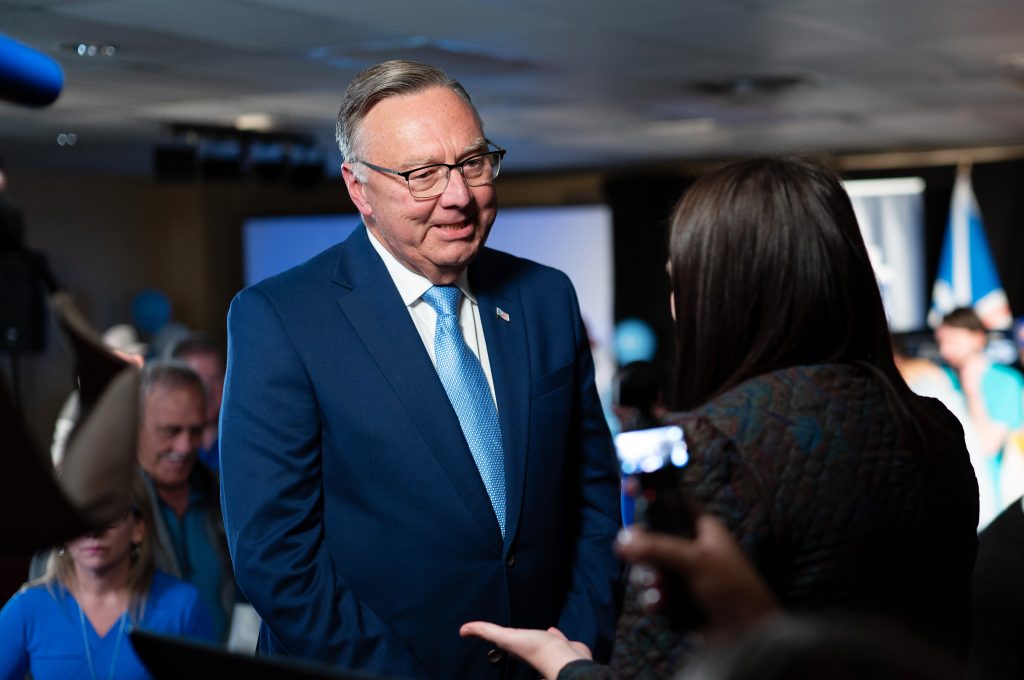
Premier François Legault was finally able to speak on Thursday with his new Newfoundland counterpart, Tony Wakeham, who is questioning the proposed agreement with Quebec on the supply of electricity from Churchill Falls.
In a message sent to The Canadian Press on Thursday, Legault’s team indicated that the two men spoke during the day.
It was simply a “courtesy call,” it was reported. Legault congratulated his interlocutor on his election victory.
Earlier, the Quebec Premier’s office had suggested that Legault wanted to speak with Wakeham “very soon.”
Uncertainty currently hangs over the memorandum of understanding worth more than $33.8 billion, which could provide an additional 7,200 megawatts that Quebec needs for its decarbonization.
The goal is to sign a final agreement by April 2026, but in an interview with The Canadian Press on Thursday, Wakeham suggested he was not bound by this deadline, which he considers “arbitrary.”
Quebec itself will be immersed in an election campaign in the fall of 2026, but Wakeham suggests he is not afraid of the possible election of the Parti Québécois (PQ), which is leading in the polls and may also want to renegotiate the terms of the agreement.
In a message on the social network X on Wednesday, Legault said he was “convinced” that the current agreement in principle on energy development in Labrador was “beneficial for both Newfoundland and Labrador and Quebec,” but Wakeham clearly disagrees.
Félicitations à Tony Wakeham pour son élection comme nouveau premier ministre de Terre-Neuve-et-Labrador.
— François Legault (@francoislegault) October 15, 2025
Je suis convaincu que l’entente de principe sur le développement énergétique du Labrador est bénéfique tant pour Terre-Neuve-et-Labrador que pour le Québec.
Soyez assuré…
The draft agreement was signed in December in St. John’s, NL, by Legault and Liberal Premier Andrew Furey, who subsequently resigned last spring. His successor, John Hogan, had to step in to defend the agreement.
The election campaign that ended Tuesday brought to power his Conservative opponent, Tony Wakeham, who had repeatedly criticized the MOU.
He pledged not only to have the text reviewed by an independent committee and obtain more favourable terms for his province, but also to put it to a referendum.
Wakeham believes that the information released so far does not allow us to determine whether the new MOU is the best possible agreement for his province.
But last December, during the official signing ceremony in St. John’s, one of the architects of the draft agreement, then-Hydro President Michael Sabia, was clear: “Can this agreement change significantly? In our opinion, no.”
Why is this agreement so crucial and controversial?
It would terminate a contract signed between Newfoundland and Hydro-Québec in 1969, with a scheduled expiry date of 2041, for the operation of the Churchill Falls dam in Labrador—a contract that Newfoundlanders have always considered unfair. Hydro-Québec purchases electricity at 0.2 cents per kilowatt-hour, which it then resells at a high price.
Under the new agreement, which would run until 2075, Hydro-Québec would gradually increase the royalty until it reaches 6 cents per kWh, a 30-fold increase.
In addition, Hydro-Québec would become the prime contractor for the expansion of the existing Churchill Falls generating station, as well as for a second nearby generating station, as well as a generating station downstream on the Churchill River at Gull Island, projects valued at a total of $25 billion.
Quebec would thus have access to an additional 7,200 MW to meet its needs.
Currently, Churchill Falls’ capacity is 5,400 MW and it provides 15 per cent of Hydro-Québec’s electricity.
–With information from Michael MacDonald in Halifax
–This report by La Presse Canadienne was translated by CityNews