Over 1,000 km of roadway need maintenance in Montreal, more orange cones since last year: report
Posted December 11, 2025 9:16 am.
Last Updated December 11, 2025 6:08 pm.
Montreal’s long-running construction gridlock isn’t improving, and in several key areas, it’s getting worse, according to a new report published Thursday.
The study, titled “Maximum Blockage,” is an update of an initial study on construction site management carried out in January 2023. The report was co-presented by The Montreal Chamber of Commerce and Tourisme Montréal.
The report’s inaugural issue was named “Minimum Blockage” at its inception. But with this year’s results, officials say the 2025 edition warranted being described with the higher superlative.
The report paints a picture of a downtown still overwhelmed by simultaneous roadwork, failing infrastructure and a city administration that, according to the study’s authors, still lacks the basic tools to track and coordinate its own construction sites.
“There’s a lack of coordination,” Chamber of Commerce president Isabelle Dessureault said at a Thursday morning press conference, “a fragmented governnance of the work that is being done.”
This year across the island, 31 per cent of the city’s roadways were considered in “poor” or “very poor” condition, a figure that climbs to 41 per cent in Ville-Marie, the heart of downtown.
Roughly 1,260 km of roadway require maintenance or full reconstruction, the equivalent distance between Montreal and Chicago, the report says.
While the number of obstructed arteries in the city’s hypercentre technically dropped by nearly 40 per cent from last year, the study warns this decline reflects a slowdown in construction starts, rather than a sign of speedy road fixes. The structural problems, it says, remain untouched.
And even with the slowdown, one in four downtown arteries this year were partially or completely blocked. In total, that represents about 18.7 km of roadway, up from 10.7 km in 2024.
‘The capital of orange cones’
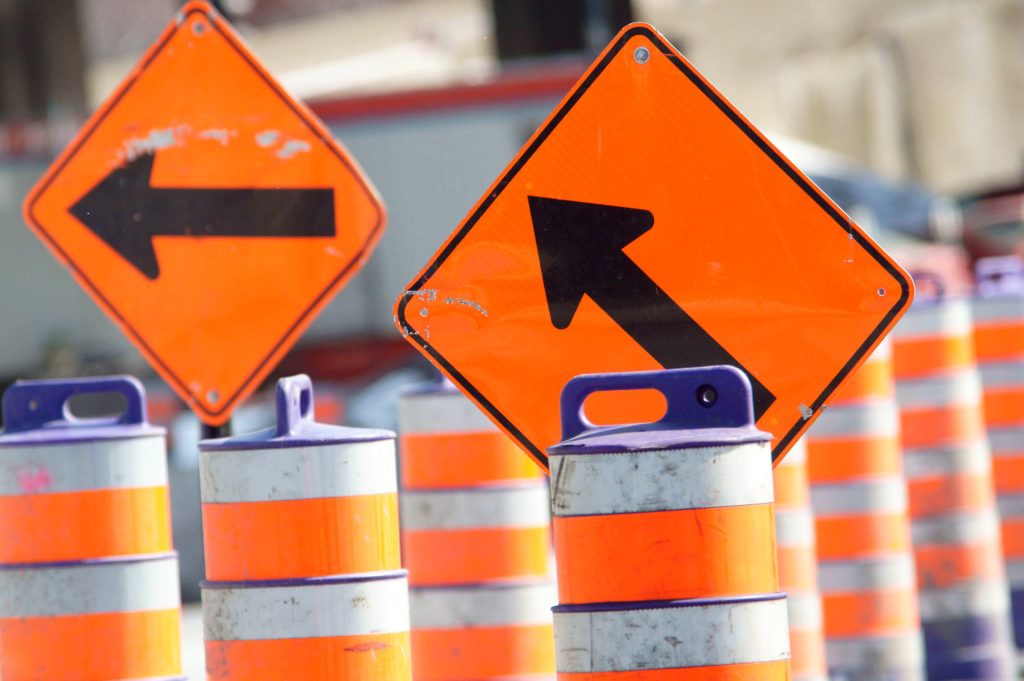
The amount of orange cones laid on city streets, what the study’s authors referred to as “the unintended symbol” of Montreal, has risen since 2024.
In a single downtown quadrilateral — Sherbrooke Street to René-Lévesque Boulevard, Guy Street to Drummond Street — researchers counted 343 orange cones, more than 100 above last year’s total of 232.
“There’s (nowhere) that has so much visual pollution as we have,” Tourisme Montréal president and CEO Yves Lalumière said.
The authors also say even basic monitoring has become impossible. While the study previously tracked the annual proportion of obstructed arteries in Montreal’s hypercentre — 94 per cent in 2022, 93 per cent in 2023, 87 per cent in 2024 — this year, they were unable to perform the analysis at all.
The city’s data, they say, was delivered in such a disorganized format that it was “unusable.”
Dessureault said that the lack of data poses a major hurdle for any attempt on the city’s behalf to better coordinate road work.
“You can’t control what you don’t measure,” she said.
The report also points to what it calls a culture of “laissez-faire,” that allows traffic lanes to be obstructed even for trivial tasks during rush hour.
Excessive and unmodulated signage and traffic control elements, the study said, further contribute to the perception of a downtown “paralyzed by construction.”
“Montreal deserves better than to be caricatured as the capital of orange cones,” Dessureault and Lalumière wrote in an open letter penned Thursday.
‘Maximum de-Blockage’: City says construction task force already in the works
The report points to what it calls Montreal’s technological mastery in AI and engineering as the way forward to overcome the city’s construction hurdles.
“Researchers already master these cutting-edge tools and deploy them elsewhere in the world,” the open letter reads. “It is now up to us to showcase this local expertise and fully integrate it into more modern construction site management.
“The real issue is no longer understanding, but taking action.”
Lalumière and Dessureault also called on the city to create a “construction site crisis unit” within Montreal Mayor Soraya Martinez Ferrada’s first 100 days in office to oversee the city’s construction planning.
“The main lever is coordination, and this should be at the highest level,” Dessureault said. “Enough is enough.”
Holding a printed copy of the report with the title page marked in ink to read “Maximum de-Blockage,” Alexandre Teodoresco, city councillor and executive committee member responsible for optimization, told CityNews Thursday that the Martinez Ferrada administration is already developing a centralized planning committee for construction.
He said the new task force will consist of himself, executive committee member responsible for mobility and infrastructure Alan DeSousa, Société de développement commercial (SDC) executive director Glenn Castanheira, among others. They will report directly to the mayor.
“We need to have all the decision makers at the same table infused with a sense of urgency and really break down barriers,” Teodoresco said.
The construction planning committee will set their sights on tackling Ville-Marie as a pilot project in the near future, Teodoresco said, though he was not able to provide an exact date on when the team will be fully active.
Teodoresco also said that while AI won’t serve as a “magic wand” to fix the city’s construction problems, officials can leverage the tool to do the heavy lifting in planning what construction sites go where.
“AI can be used to really do predictive analysis on the state of infrastructure to better plan,” he said.
Using AI to expedite road work planning was one of Martinez Ferrada’s flagship promises during her campaign, with her pledging to host an AI summit in Montreal during her term as mayor.