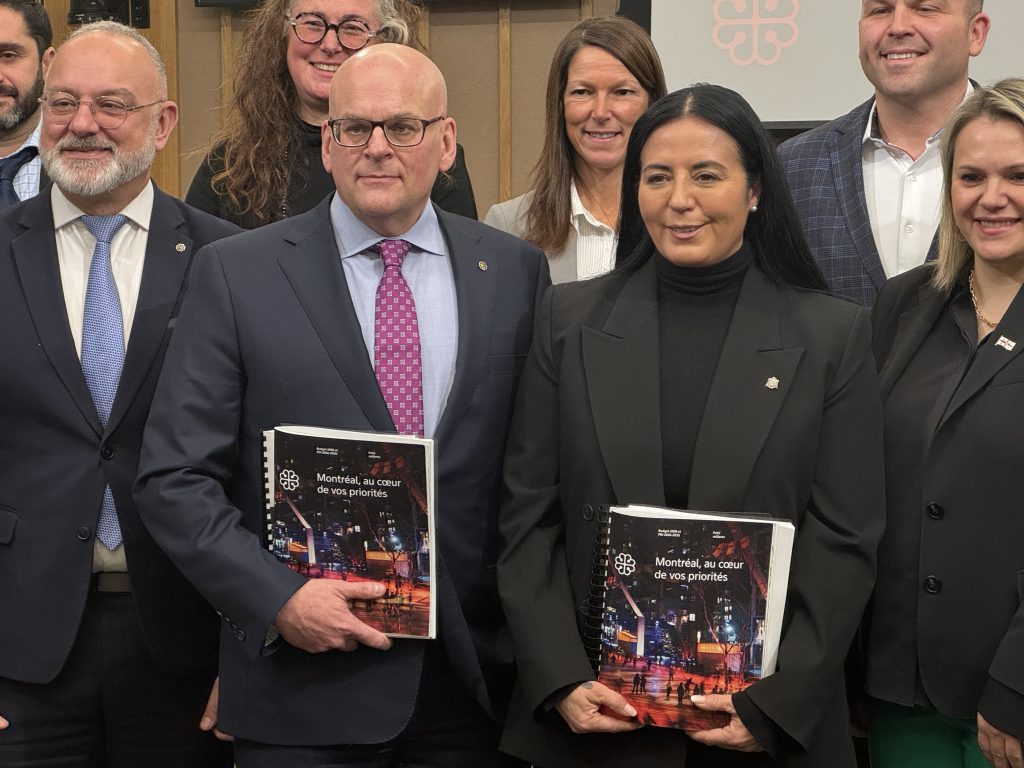
Montreal Mayor Soraya Martinez Ferrada unveils $7.7B budget, homelessness and housing top priority
Posted January 12, 2026 11:10 am.
Last Updated January 12, 2026 5:53 pm.
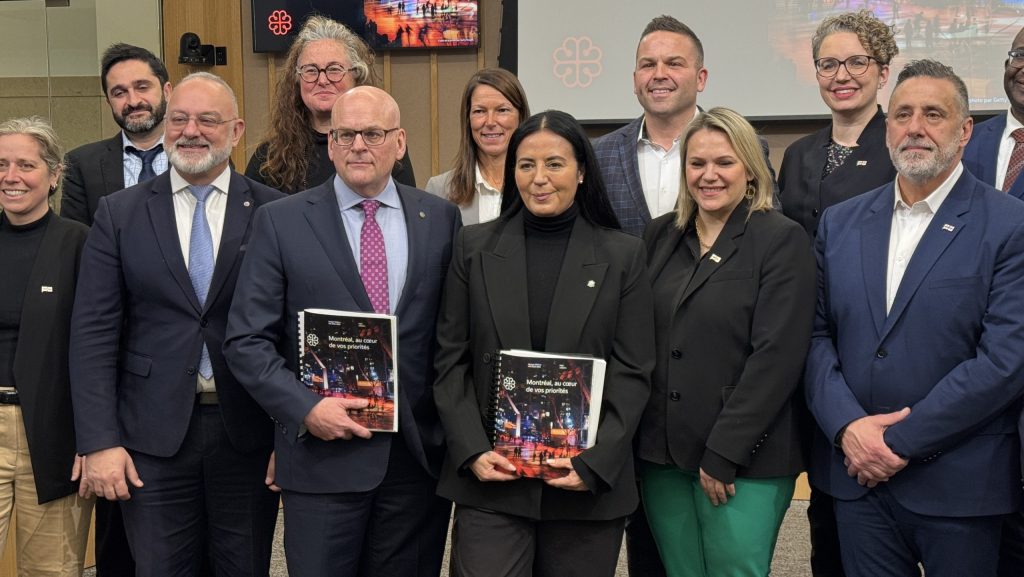
Montreal Mayor Soraya Martinez Ferrada’s $7.67 billion budget presented Monday promises to be balanced while tripling the homelessness budget, upping property taxes and bringing down the debt-to-income ratio to 100 per cent by the end of the year.
The plan is described to be fiscally “rigorous and responsible,” made amid “an uncertain economic situation” and “possible recession,” according to Benoit Dagenais, director general of the City of Montreal, during a Monday morning technical briefing.
The budget represents a 5.3 per cent increase compared to Montreal’s last budget tabled in late 2024 by Martinez Ferrada’s predecessor Valérie Plante.
“As promised, this first rigorous budget aims to provide quality services and improve the daily lives of residents of the metropolis, while limiting tax increases to inflation,” said Martinez Ferrada in a statement penned Monday.
“I know expectations are high, very high. We’re delivering on what we promised.”

Executive committee president Claude Pinard marked the occasion in new shoes – a long time city hall tradition representing Montreal taking a step forward.
“We’re getting back to the basics of what the job is as a city,” Pinard said.
Homelessness: The city’s ‘top priority’
As the weather gets colder, Martinez Ferrada has gone multiple times on the record that addressing homelessness in Montreal will be her administration’s priority number one.
“We are investing significant sums, which have tripled, to reduce homelessness and promote harmonious coexistence,” she said.
“Budgets (are) about choices. And our first choice and the absolute priority is the fight against homelessness.”
By 2035, the city plans to invest $100 million to acquire and renovate buildings for emergency shelter spaces.
Martinez Ferrada will also spend $29.9 million in 2026 alone for community organizations working directly with people experiencing homelessness or supporting cohabitation. In 2024, the Plante administration allocated $9.8 million, making this a threefold increase.
“Getting people off the street is essential,” the mayor said. “But first and foremost, we need to prevent them from getting there in the first place. So, housing will be the other priority that is important when you want to fight against homelessness.”
Political analyst Daniel Tran calls those added investments in homelessness a key component of Martinez Ferrada’s first budget.
“That’s definitely a big plus for the city,” said Tran, the director of communications and governmental affairs at Casacom.
The city also plans to expand the number of multidisciplinary teams on the ground, made up of police officers and social workers. It will also formalize a “Tactical Homelessness Response Team” that will coordinate interventions in the field in collaboration with various partners, including the Quebec government and front-line organizations.
The new response team is intended to compliment the city’s already existing “crisis cell,” created in December 2025, according to the budget.
Addressing the housing crisis
Housing is the budget’s other dominant pillar. Montreal is now committing $578.7 million over 10 years to acquire buildings for social and affordable housing, including $100 million tied directly to homelessness-related housing needs.
The city is also scrapping its existing “20-20-20” bylaw, which required developers of large new projects to include 20 per cent of each: social housing, affordable housing and family housing, or else pay a fine.
Rather, the city will now offer “financial incentives” and “closer partnerships” with developers, non-profits and private builders to speed up construction.
Six major development zones — including Lachine-East, the Blue Line Corridor and Bridge-Bonaventure — are being prioritized to eventually accommodate nearly 75,000 housing units by 2050. In total, these projects will see a $47.6 million increase in investment.
The new administration will also spend $1.5 million over three years on investments in tenant rights organizations, comprising of $500,000 in 2026.
Taxes and debt
City officials are framing the budget as a balancing act, tightroping between expanding social spending and infrastructure while “limiting tax increases to inflation,” according to Martinez Ferrada.
The mayor previously promised tax increases in line with inflation. For 2026, residential property taxes will rise 3.8 per cent, while non-residential taxes will increase 3.4 per cent.
According to Quebec’s institute of statistics, the rate of inflation in Montreal was 3.4 per cent in September 2025. This was the highest inflation rate rose in 2025, the lowest being in May at two per cent.
“And I’ll remind you that in Laval, it’s four per cent. Longueuil, 3.4 per cent,” Martinez Ferrada said.
With the administration touted the budget as financially responsible, Tran agreed it was a “cautious” one.
“At the end of the day, when inflation happens, you don’t decide what number is going to come here,” he said. “Of course, Montrealers are going through a lot, we are in an affordably crisis. But that affordably crisis is also a reality for all levels of government, including the municipal level. So when we think about, of course, we think about a tax hike, but we have to think about how much it costs more for repairs of the road. How much does it cost more to pay the employee? How much does it cost more to provide the equipment that they need to protect themselves as well.”
Montreal also says it will return its debt ratio — the proportion reflecting the city’s net debt compared to its annual total revenues — to 100 per cent by the end of this year. Tran called this decision “really surprising.”
A 100 per cent debt ratio means the city’s total net debt is exactly equal to its total annual revenue.
“The credit card of the city was maxed out,” the mayor said.
“It was imperative for our team to return, starting this year, to the City of Montreal’s ability to pay,” added Pinard. “This work will continue throughout the mandate to slow the growth of City spending.”
The total amount of debt Montreal will hold is expected to rise by $180 million, totaling to a projected $1.4 billion in 2026.
The city is planning to carve out 16.6 per cent of its total budget, around $1.27 billion, to pay for the debt in 2026.
To do that, some projects will be delayed, including construction along Camillien-Houde Way, now pushed to 2029.
Funding for programs like Bixi is also expected to be cut by about 50 per cent next year.
Opposition leader Ericka Alneus says the budget lacks long-term vision.
“When you’re doing it without vision, it kinda smells like austerity.” Alneus said.
Public security: ‘Montrealers feel less safe in their city’
Public safety, representing the largest section in Montreal’s expenses at 17.9 per cent, will see to acquire new investments aimed at prevention, surveillance and emergency response, the budget says.
“Because many Montrealers feel less safe in their city, we are taking concrete steps to prevent youth violence, build stronger community ties, improve safety in public spaces, and prevent fires,” the mayor said.
The city plans to fund body cameras for police officers, expand the use of public-space cameras and increase budgets for youth violence prevention and school-zone safety, including more crossing guards.
In 2026, $17.4 million will be invested into school safety services, while $15.8 million will go to reducing the rate of youth violence.
Over the next 10 years, $40 million will go to spending on new body cameras for police.
Fire services are also seeing major investments, with funding allocated to modernize emergency vehicles, replace firefighter equipment, and renovate stations. These investments will total to $252.2 million from 2026-2035.