International unionized professors at UQAM speak out against Quebec’s abolition of PEQ
Posted January 29, 2026 3:02 pm.
Last Updated January 29, 2026 7:19 pm.
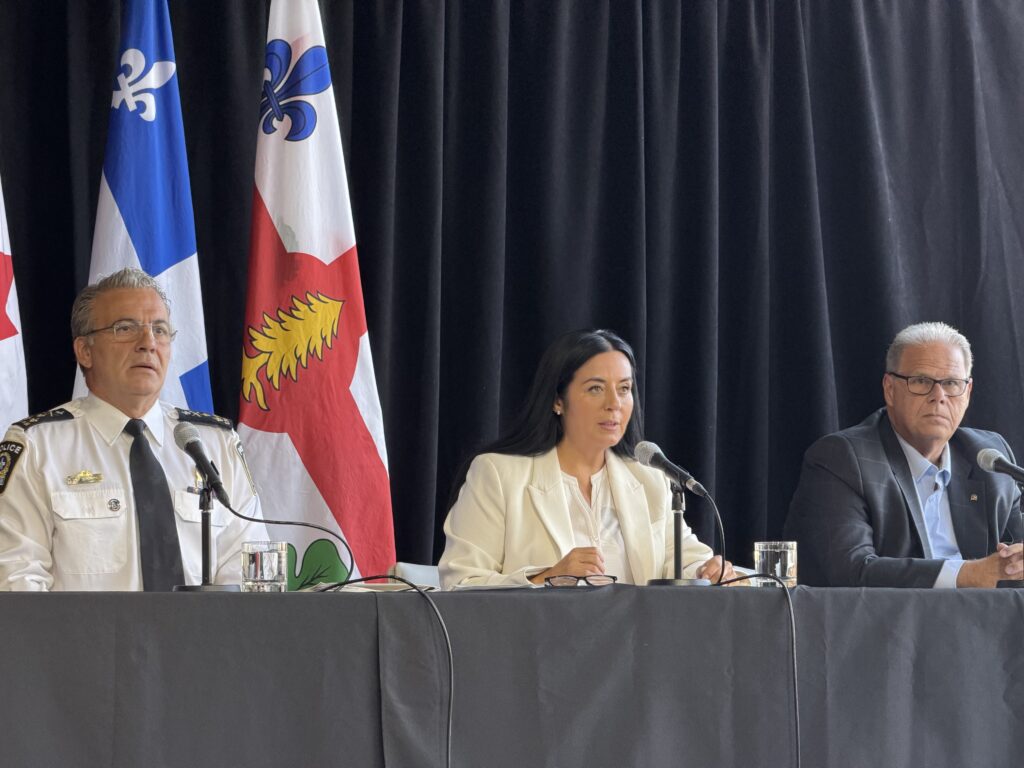
A press conference was held by the CSN union and the SPUQ, the union representing teachers at l’Université du Québec (UQAM), to address growing concerns regarding Quebec’s abolition of the province’s fast track immigration stream – known as the Programme de l’expérience Québécoise (PEQ).
The SPUQ, the union representing teachers at l’Université du Québec (UQAM), announced that 25 international professors across various disciplines, such as mathematics, education and arts at UQAM, may have to leave the province due to the PEQ’s closure.
Speakers, alongside international unionized professors at UQAM, urged the government to implement a grandfather clause for those who already had a temporary immigration permit when the program was abolished.
The PEQ was Quebec’s only fast-track program offering a direct path to permanent residency for temporary foreign workers or foreign students who graduated in the province. It was abolished in November when the CAQ government cut immigration by around 25 per cent.
Since the abolition of the program, advocates say those who had not yet been granted residency have been left in limbo.
Applicants are now redirected to apply to the Skilled Worker Selection Program (PSTQ), which unlike the PEQ, uses a points-based system that ranks candidates on education, French-language skills and work experience. The PSTQ also prioritizes selecting immigrants who settle outside Montreal and Laval.
But the CSN hasn’t been alone in calling for a grandfather clause.
Mayor Soraya Martinez Ferrada denounced the removal of the program on Monday, unanimously calling for a grandfather clause. The mayor also urged the Legault government to find pathways to residency for temporary workers who came to Quebec for the PEQ.
Premier François Legault responded by refusing flexibility for Montreal immigrant workers on Tuesday. “The government is now refusing to grant work permits in the Montreal and Laval region. This measure must be lifted immediately,” said Geneviève Hervieux, President of the SPUQ, in a press release.
“If these professors have to leave, suddenly, we have a loss of expertise that makes us a little embarrassed in our programming at all levels,” said Hervieux.
Alejandro Morales Borrero, a Columbian professor in the Department of Mathematics at UQAM, expressed his concerns regarding the removal of the PEQ on his career and family. He moved to Montreal with his wife two and a half years ago, where they are now raising their nine-year-old daughter under the uncertainty that they may be forced to leave Quebec.
When Morales Borerro was eligible to apply for the PEQ last summer, the program was already frozen. Morales Borerro submitted an application for the PSTQ last February, which is set to expire next month. He is planning to reapply to the program to maximize his points and chances of staying in the province.
“In my job, I solve problems. So this is a new problem we have to solve and maximize, optimize, and try to find a way,” said Morales Borerro.
Morales Borerro’s daughter was born in the US, and is now 9 years old. After spending two and a half years in the province, she is now trilingual – speaking Spanish, English and French.
“Now, she speaks French to us” with a “beautiful Quebecois accent,” Morales Borerro said proudly.
Despite the uncertainty, Morales Borerro and his family plan on staying in Montreal until they get a response from the PSTQ.
Morales Borerro was joined by another UQAM professor, who chose not to disclose her name to CityNews. She said she would have been eligible for permanent residency in December if it weren’t for the program’s abolition a month prior.
“I also feel very integrated into Quebec society. The vast majority of my friends here are Quebecers,” she said.
For those who submitted applications before the PEQ was abolished, they will still be processed. However, the PEQ is no longer accepting new applications.
“The rules are arbitrary,” said Caroline Senneville, the President of the CSN union. The CSN is “appealing to the government’s sense of responsibility.” But as the CAQ slides in the polls, eyes are turning to the Parti Québécois (PQ), which says a future PQ government would grant limited grandfather clauses on a case-by-case basis.
“In some cases, grandfather clauses will be granted, but let’s be clear: grandfather clauses cannot be granted to all federal temporary employees,” said PQ Leader Paul St-Pierre Plamondon.
With a growing demand for change, Senneville hopes the unions can put the CAQ government in a position where a “‘no’ will become, ‘we’ll see what we can do.'”