New program to admit 29,000 economic immigrants annually: Quebec immigration minister
Posted January 30, 2026 10:51 am.
Last Updated January 30, 2026 5:55 pm.
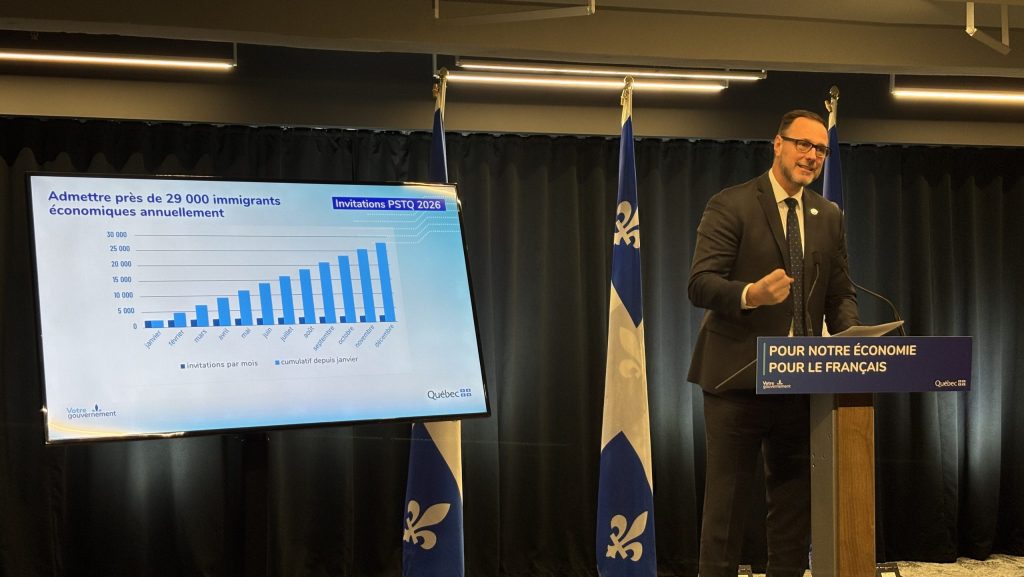
Quebec Immigration Minister Jean-François Roberge announced that a new economic immigration program will let in 29,000 people each year to the province.
That accounts for nearly two-thirds of the 45,000 permanent residents the province says it will admit overall in 2026 – a total that’s 25 per cent lower than last year.
At a press conference Friday, Roberge said the government will send out permanent residency invitations each month under the skill-based program being called Programme de sélection des travailleurs qualifiés (PSTQ), until the cap is reached.
Roberge confirmed that the ministry had begun sending out invitations under PSTQ with 2,549 people invited so far this year.
“With invitations sent on a regular basis and according to clear guidelines, the government offers predictability to individuals who wish to obtain permanent residence in Quebec,” the ministry said in a statement.
For 2026, Quebec says priority will go to three main groups: graduates of Quebec universities, workers in key sectors like health care, education, construction, daycares and engineering, and applicants the government says show the strongest potential to integrate economically and linguistically.
Immigration lawyer Viviane Albuquerque said while the new priority categories bring some clarity, especially after weeks of uncertainty, there are still big unanswered questions. Namely, which jobs inside those priority sectors will be put on the top of the list.
“For the healthcare industry, what does it mean? Does it mean administrative assistants working in the legal field, does it mean doctors already working? Does it mean the individuals are already apart of a professional order?,” Albuquerque asked.
Nearly two-thirds of those who were invited this year were graduates from Quebec and 32.7 per cent worked in one of the strategic sectors. Similarly, 65.9 per cent were living outside of Montreal and Laval areas.
The PSTQ is the only program available for workers in Quebec seeking permanent residency after the CAQ government cancelled the Programme de l’expérience Quebecoise (PEQ) program in November.
PEQ had been in place since 2010.
The PSTQ also prioritizes applicants who settle outside Montreal and Laval.
“If they live here in Montreal, they have less points because they’re advantaging people to go to the regions. But people already moved,” said Montreal Mayor Soraya Martinez Ferrada, in response to Friday’s conference. “What I’m asking is that we be treated the same.”
Friday’s new guidelines come following a week of backlash featuring advocacy groups denouncing the governments decision to cancel PEQ affecting thousands who were already in the province.
The Martinez Ferrada administration denounced the program on Monday, echoing demands for a grandfather clause. The Legault government responded the following day, refusing flexibility for Montreal immigrants.
On Thursday, UQAM professors and union representatives also urged the government for a grandfather clause.
Speaking to reporters Friday, Roberge responded to the 25 professors affected by the abolition of the PEQ. “I was surprised and shocked to see professors believing that they would not be selected as permanent residents here. Universities have worked very hard to attract talented individuals who come to contribute to our universities, particularly in the field of research,” he said.
“There is no reason why these people should not be selected,” said Roberge.
Roberge encouraged UQAM professors to apply for PSTQ’s stream 4 — Exceptional Talents, which is an additional selective process that evaluates whether foreign nationals have exceptional expertise and can contribute to Quebec’s prosperity. It considers non-French speaking individuals.
According to the ministry of immigration, out of the 2,549 invitations to the PSTQ that they issued this month, applications under stream 4 occupied less than 1 per cent acceptances.
The Immigration Minister also pushed back against concerns about uncertainty, arguing it’s the federal government – not Quebec – fueling panic. He said Ottawa is to blame for letting temporary work permits expire.
“The ‘Sword of Damocles’ hanging over the temporary workers right now is not the PSTQ; it’s the federal government saying, ‘In March, February, September, I’m not renewing your work permit,'” said Roberge.
According to Albuquerque, many French-speaking temporary workers are leaving Quebec in favour of faster federal options. Notably – the new Express Entry for French-Speaking Skilled Workers, which is a federal program geared for those willing to settle outside Quebec.
“So we are looking at about between 15 to 20 months via the Quebec route,” said Albuquerque. “An Express Entry, if you’re bilingual, can do it in six months.”
Cheolki Yoon, President of the Board of Directors at Immigrant Workers Centre, said Quebec’s more restrictive system affects immigrants across the board, leading some to think twice before applying to the province.
“For that reason, some people leave Quebec for other provinces expecting to get admitted to the programs open in other provinces,” said Yoon.