The Cheese Route allows you to discover local cheese shops across Quebec
Posted July 19, 2026 12:02 pm.
Last Updated July 19, 2026 12:04 pm.
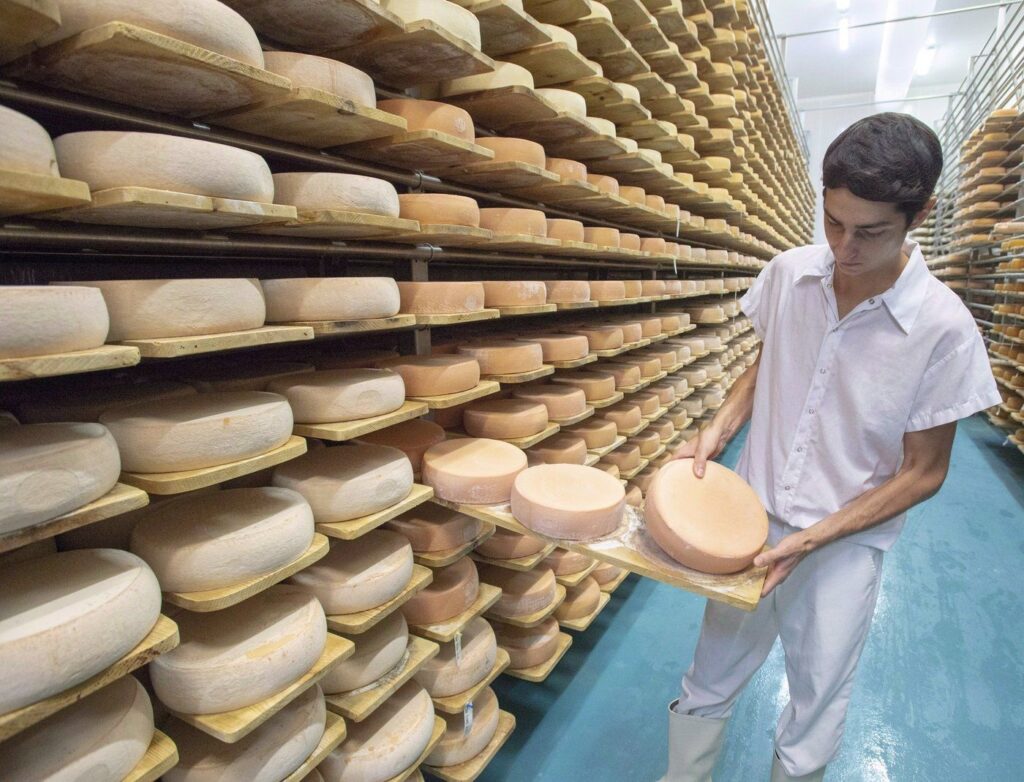
Lovers of Quebec cheeses will be able to hit the road, travel across the province and discover its cheese factories thanks to the Cheese Route, an initiative of the Quebec Dairy Industry Council (CILQ), launched at the beginning of the summer.
CILQ’s general manager, Charles Langlois, explains that the idea behind this tool is to support regional businesses and showcase the Quebec cheese industry, but above all to reveal “the people behind the cheeses”.
“It responds to a need to know who makes our cheeses. We want to know who the artisans are who make this product. We want to know their stories,” he says.
The website offers 15 routes that take the traveler to discover a little over 70 Quebec cheese shops, through a pre-made itinerary that opens in Google Maps.
The council, which represents the interests of Quebec’s dairy industry stakeholders, created this tool at the request of its members.
The route previously existed as an application, but this new deployment revolves around the simple use of a mobile website, in combination with a turnkey use of Google Maps.
Marie-Chantal Houde is co-owner of Fromagerie Nouvelle-France, which has been open for 16 years in Racine, in the Eastern Townships.
As a member of the CILQ’s board of directors, Houde recounts the discussions surrounding the Cheese Route, which brings together large industrial players as well as independent cheesemakers. “Both very large companies and small ones, like mine, are wondering how to promote our profession.”
Making a big deal out of Quebec cheeses
Houde celebrates the inclusivity of the Cheese Route, on which her cheese factory is featured.
For a long time, his cheese factory was excluded from the “Fromages d’ici” website, which only represents cow’s milk cheeses.
The star of the Nouvelle-France cheese factory, the “Zacharie Cloutier,” made with sheep’s milk, is therefore not featured on this website. Yet this cheese has won the Caseus d’Or several times, an award that recognizes the best Quebec cheeses.
Cheese dairies like his, which work with sheep’s or goat’s milk, therefore do not benefit from the publicity given by “Fromages d’ici”.
“I created ‘Fromage d’icitte’ to include everything!” she jokes. “But it’s pathetic. And that’s something I’ve been asking for for a long time, ever since we first won an award.”
According to Catherine Noppen, a professor of tourism techniques at the Quebec Institute of Tourism and Hospitality, the associative nature of the project allows cheese factories to gain more visibility, particularly for promotion.
The organization Terroirs et Saveurs and the Économusées network, both of which work in agritourism and gourmet tourism, already offer themed routes to discover producers, including cheesemakers.
But Noppen believes it is to the advantage of cheesemakers to create their own route, since not all of them can be included on those laid out by these organizations.
Master cheesemakers at our place
Quebec’s cheese heritage includes approximately 1,200 different cheeses. Charles Langlois applauds the quality and richness of Quebec’s cheese heritage. “It’s unique in Canada, and perhaps even in North America. We rival what’s done in Europe, in terms of variety,” he emphasizes.
Marie-Chantal Houde, for her part, observes that while her business is booming, this isn’t the case for all cheese shops. “I would say that cheese imports are a significant factor. Prices are being driven up, and some very good European cheeses are being imported.”
The idea of the Cheese Route fits into two broader trends, namely agritourism and buying local.
“Agritourism is becoming more and more popular; people are curious to go and see our regions,” says Charles Langlois, who believes that this tool satisfies the need for “different” tourist experiences and promotes local purchasing.
“I think reviving it at this time is a very good moment, especially since buying local is something Quebecers look for when they travel,” says Catherine Noppen.
For the past seven years, Noppen has observed the popularity of Quebec among its residents, “whether you are a Quebecer from Abitibi with the desire to travel in the Lower St. Lawrence or a Gaspé resident with the desire to visit the greater Montreal area.”
She believes that the majority of tourists in Quebec in the summer are Quebecers, and that international tourists are in the minority.
The difficulty of traveling outside the country during the pandemic triggered a surge in tourism to Quebec’s regions. The economic uncertainty into which the American trade war and international conflicts plunged Quebecers then allowed the province to capitalize on this trend.
It is precisely the need for certainty that maintains Quebecers’ interest in their province, according to Noppen. She believes that security is one of the reasons why people tend to explore their own territory.
“Tourism, by definition, is always about the idea of a stay,” says Noppen. A route like the cheese trail would encourage people to stay in the regions and explore them in depth.
If the project is to evolve, she hopes that the routes of this road will be integrated into all the tools of regional tourist offices and associations.
It also invites the Ministry of Tourism and the Quebec Dairy Industry Council, or any organization wishing to implement discovery tools, to enter into discussions in order to contribute mutually to their respective expertise.
–This report by La Presse Canadienne was translated by CityNews