‘Freedom is freedom’: Archbishop of Montreal denounces Quebec’s proposed ban on prayer in public places
Posted September 2, 2025 11:47 am.
Last Updated September 2, 2025 5:23 pm.
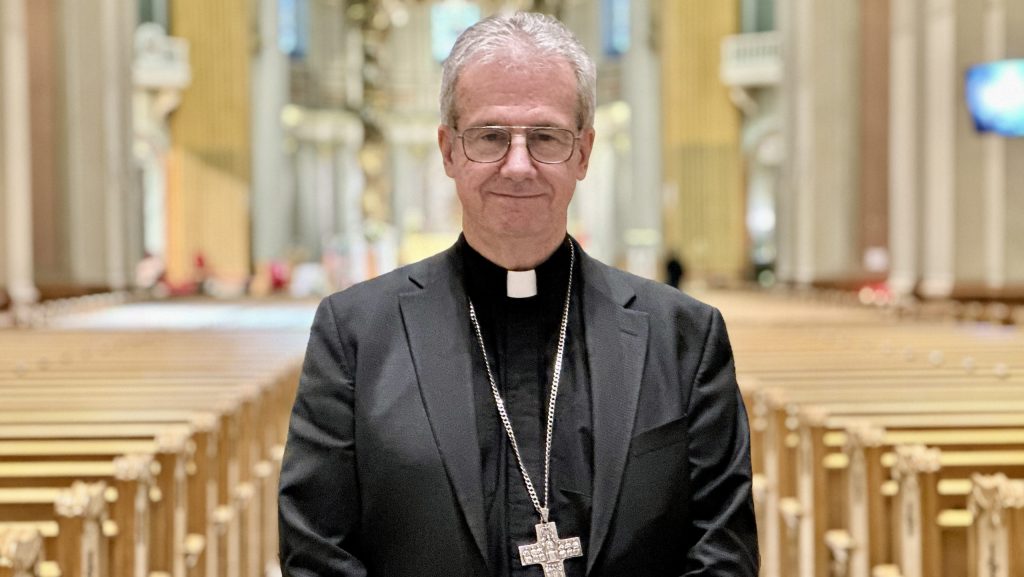
The Archbishop of Montreal believes the Quebec government’s plan to ban prayer in public places is a violation of the “fundamental freedoms in a democratic society.”
In an op-ed published in La Presse Monday morning, Archbishop Christian Lépine was responding to the CAQ government’s announcement that it intended to introduce a bill this fall to ban public prayers in a bid to strengthen secularism in the province.
“Religious freedom is not confined to places of worship: it is an integral part of living together. Restricting prayer to the private sphere would amount to reducing the space for freedom in all of society,” Lépine wrote in the op-ed titled “What if we banned… thinking?”
“I think it goes against democracy because it goes against the whole of the person,” Lépine told CityNews in an interview later Tuesday.
“It impacts freedom because if you begin to choose what do you have the freedom to do, that you cannot do. No, it’s freedom. Freedom is freedom.”
Lépine says the right to pray – both indoors and out – is recognized by the Universal Declaration of Human Rights, the Canadian Charter of Rights and Freedoms and the Quebec Charter of Human Rights and Freedoms.
“The secular nature of the State guarantees that institutions remain neutral in the face of diversity of beliefs, serving and benefiting all members of society,” he wrote. “But it does not require the public erasure of faith in society – quite the contrary.
“Confusing state neutrality with the neutralization of society would lead to serious regression. In a democratic society like ours, diversity of beliefs is not to be feared: it is welcomed and contributes to the richness of Quebec, strengthened by a culture of dialogue and encounter.”
Quebec’s bid to strengthen secularism
The Quebec government maintains there has been an increase in public prayers in the province, especially in Montreal, calling it a “serious and sensitive issue.” The proposed ban would be one aspect of a bill whose broader objective is to strengthen secularism.
The head of the Archdiocese of Montreal described the proposed legislation as “impractical and discriminatory.”
“How can we distinguish a prayer from a moment of silence or contemplation?” Lépine asked. “How can we legislate on an intention, a whisper, an inner thought? And above all, who would decide what is prayer and what is not? Such a ban could only be applied at the cost of arbitrariness and would fuel mistrust and prejudice.”
Archbishop Lépine says a public prayer ban would jeopardize long-standing traditions in Quebec like the Palm Sunday March or the Peace March.
“Whether private or public, prayer offers a space of comfort, eases tensions, reminds everyone of the dignity of others, and inspires justice and peace.
In a world gripped by economic, social, and environmental crises, is it in our best interest to discourage actions that foster hope and solidarity? Ultimately, isn’t wanting to ban public prayer a bit like wanting to ban thinking?”
In March, the government mandated a committee to make recommendations to strengthen secularism. However, the committee’s report, released last week, suggests that municipalities should instead adopt policies to regulate this practice.
Guillaume Rousseau, the co-chair and co-author of that report, clarified the committee never proposed a ban.
“We’re proposing that there should be a framework that is clear,” Rousseau said. “And that means that there should be some coherence, but it’s also a case by case issue. So if somewhere there’s a prayer that lasts two minutes, well, it’s not the same thing as a prayer or a procession that lasts four hours and that is blocking many streets for many, many hours.”
CityNews reached out to the office of Quebec’s secularism minister but did not immediately hear back.
Other religious leaders react
Last week, the Canadian Muslim Forum (CMF) expressed “deep concern” for the proposed legislation, calling public prayers “freedom of expression” guaranteed by the Quebec and Canadian Charters.
“There is sort of despair within the community,” CMF president Samer Mazjoub told CityNews Tuesday. “And I don’t think it is limited to the community. With all respect, we in Quebec, we are facing a lot of challenges, extreme, heavily challenges.
“If you give a green light to target you because of what you are, me of my background, other elements within the society will say it’s good to target anyone. OK, so this is extremely, I always say this is extremely outreaching danger more than the law itself.”
Meanwhile Montreal rabbi Reuben Poupko believes public prayer can lead to disruptions in every day life.
“One of the difficulties of this conversation is that when you use the expression ‘separation of church and state’ anywhere in North America, besides Quebec, it means we will protect religion from the intervention of government,” Poupko said. “In Quebec, it means we will protect government from the intervention of religion.
“When religion is weaponized to disrupt life in downtown Montreal, as it has been persistently for the last couple of years, and citizens are increasingly outraged by the disruption to their lives, and businesses are disrupted, and business owners are complaining about the inability of customers to enter their facilities, it’s hard not to sympathize with a desire to restrict the use of prayer in a public setting.
“When it’s (religion) used as a camouflage for violent rhetoric, actions like that do trigger a response. And the response is a desire to limit the ability of certain people to use religion to disrupt life.”
Rabbi Poupko says no organized religion is demanding prayer in a public space.
“That is not the part of any religious obligation,” Poupko said. “Right, we have synagogues, we have mosques, we have churches, we have temples, people can pray at all times. We have unfettered access in Quebec; there’s complete and total freedom. To go ahead and begin to restrict certain activities in a public space is not absurd. I’m not allowed to have a picnic on René-Levesque. There are a lot of things I can’t do on René-Levesque. … And prayer being one of them.”
–With files from Tehosterihens Deer