Quebec family doctors work enough, data shows
Posted October 28, 2025 12:47 pm.
Last Updated October 28, 2025 5:46 pm.
There is no collective disengagement among family physicians, concludes a new study from the Centre de recherche du Centre hospitalier universitaire de Sherbrooke. Their workload has been transformed by an increase in case complexity.
Presented by the Claude Brunet Foundation, the data suggests that physicians work enough. They devote an average of 46 to 47 weeks to their practice per year, and breaks in practice of more than 90 days are rare and decreasing.
The Legault government’s rhetoric implies that doctors are not treating enough patients, particularly since 1.5 million Quebecers still do not have a family doctor.
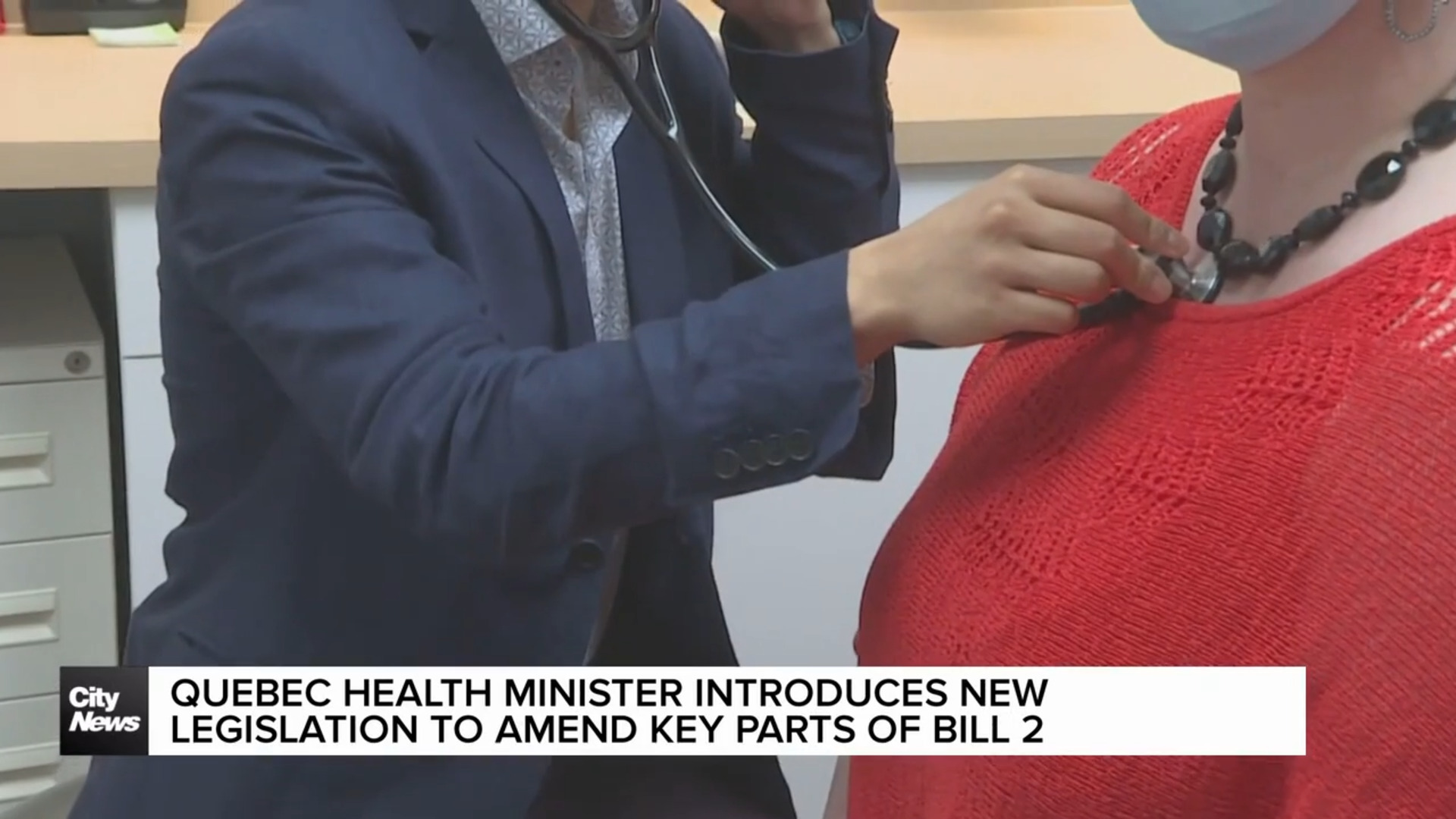
Health Minister Christian Dubé’s Bill 2 seeks to link physician compensation to performance indicators. This has sparked widespread discontent among the medical profession. The aim is to “control” based “on volume indicators,” according to the study’s author, Damien Echevin, an economist and researcher at the Centre de recherche du Centre hospitalier universitaire de Sherbrooke.
“What we can conclude from our study is that too much control will harm the mission. We have forgotten complexity, we have forgotten quality. Rigid volume and quota targets discourage the management of complex cases,” he said Tuesday at a press briefing in Montreal to present his results.
“To achieve more volume, you have to spend less time with the patient and therefore choose less complex patients,” he explains.
Alongside him, Paul G. Brunet, president and CEO of the Council for the Protection of the Sick, expressed concern about the measures provided for in the law to monitor doctors’ attendance.
“Can you imagine the monitoring and inspection, and the number of people we’ll have to hire in the offices to monitor and inspect and ensure the job is done? Yet more millions that we’ll spend and that won’t be used to treat people,” he denounced.
During a technical briefing Tuesday afternoon, a Ministry of Health official said that for the time being, there would be no new hiring for surveillance. The ministry and Santé Québec will initially use the tools at their disposal, such as dashboards.
Not ‘a lack of effort‘
Many doctors say they can’t take on more patients without additional tools and staff to help them. The data tends to back them up.
“Physicians’ working hours are constrained by a systemic capacity that is saturated, and the workload has been transformed by the increasing complexity of needs, not by a lack of effort. Since the problem is organizational and medical time is a saturated resource, any investment policy that ignores this fundamental constraint is doomed to failure,” the study reads.
Echevin is clear on the issue: “there has been no disengagement of doctors over the last 20 to 30 years in Quebec.”
However, it is true that there are more doctors in Quebec and less access compared to the Canadian average. Quebec has 112 general practitioners per 100,000 inhabitants, compared to 108 for the country as a whole. It therefore has a medical density slightly higher than the national average.
When looking at accessibility, the number of gross visits per physician has declined by 40 per cent in nearly three decades. The study mentions that this fuels the idea of lower productivity. However, Echevin points out that there is an increase in case complexity. By measuring comorbidity and the burden of care, the patient complexity index increased by 35 per cent between 1996 and 2022, notably due to the aging of the population and the increased prevalence of chronic diseases.
During the COVID-19 pandemic, many doctors worked extra hard to maintain the healthcare network. The health crisis acted as a kind of test to assess the system’s resilience, explains Echevin. His analysis shows that despite “unprecedented mobilization, the maximum increase in effort was only 5 to 6 per cent (days worked and visits).” He concludes that the system is already operating at its maximum capacity and that to make gains in care, work must be reorganized.
The solution should focus on reducing paperwork to free up physicians’ time. “Reducing the non-clinical burden would free up capacity equivalent to adding several hundred new physicians,” the study states.
It is also emphasized that adopting mixed remuneration models (capitation, salaried, and fee-for-service) can improve access to care. Except that unlike Dubé’s law (which proposes this shift in remuneration), this must promote the management of complex cases, Echevin qualifies.
–The Canadian Press’s health coverage is supported by a partnership with the Canadian Medical Association. The Canadian Press is solely responsible for this journalistic content.
–This report by La Presse Canadienne was translated by CityNews