Quebec Liberal Party leadership race begins Monday
Posted January 11, 2026 12:28 pm.
Last Updated January 12, 2026 4:19 pm.
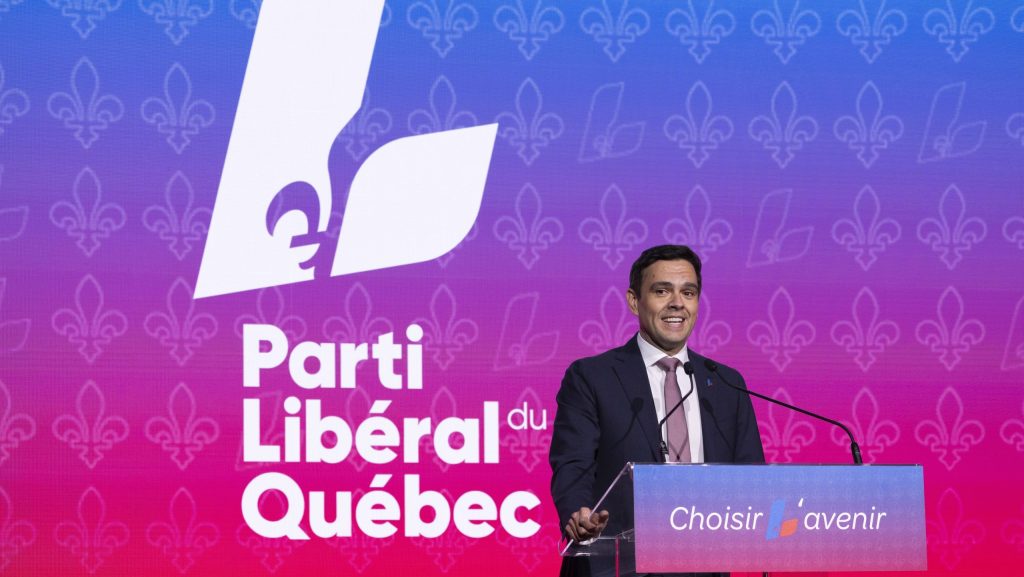
The race for the leadership of the Quebec Liberal Party (PLQ) begins Monday to find a successor to Pablo Rodriguez, who resigned amidst the turmoil that has engulfed the party. According to one expert, the PLQ will need a “savior.”
Charles Milliard, the former head of the Quebec Federation of Chambers of Commerce, has announced his candidacy after finishing second to Rodriguez in the previous race. Farmer Mario Roy has also indicated his intention to run for a second term.
“Well I think that’s the person they have. Mario Roy has no chance to win. During the first round of the vote in June, at the last liberal leadership race, he got less than 1% of the votes. So he has no chance against Charles Milliard,” said Daniel Béland, political science professor at McGill University.
“I think the possibility of a crowning or quasi-crowning is quite strong. We’ll see if we have any kind of surprise candidate emerging from out of nowhere,” said Béland.
The party’s executive council appointed Me Nicolas Plourde as the president of the vote and established an electoral committee to ensure the election runs smoothly and in compliance with party rules and the Electoral Act.
The race, divided into four phases. The first phase, the “consultation,” is intended to allow riding associations, regional councils and standing commissions to “meet with leadership candidates and share their concerns, ideas and needs with them.”
This phase, which began on Monday, will end on Feb. 13 at 5 p.m., the deadline for submitting a nomination.
Candidates must collect 750 signatures from members in good standing, representing at least 70 ridings across 12 regions, and make a deposit of $30,000. The spending limit is set at $120,000.
The new Liberal leader will be chosen at a party convention to be held on March 14.
All members in good standing as of Feb. 19 at 5 p.m. will be eligible to vote. The vote will use a preferential ballot and a weighted points system: each riding is allocated 3,000 points, with 2,000 points for members aged 26 and older, and 1,000 points for members 25 and younger.
A candidate must obtain more than 50 per cent of the points to be elected.
The PLQ announced last week that it had appointed a “compliance and ethics officer” to ensure, in particular, compliance with the Electoral Act regarding financing in the context of its new leadership race.
“The Liberal Party truly needs a savior, and there aren’t many of those saviors,” pointed out Alain-G. Gagnon, a tenured professor in the political science department at the University of Quebec at Montreal (UQAM).
Marc André Bodet, a tenured professor in the political science department at Laval University, stated that the race will be “very fast-paced” and run with more limited resources. It will therefore be different from the previous one.
The Quebec Liberal Party (PLQ) was battered by weeks of crisis during the fall parliamentary session. Rodriguez finally resigned on Dec. 18, shortly after the Journal de Montréal alleged that some 20 donors had been reimbursed for their $500 contributions at a fundraising event, a practice illegal under the Election Act.
In November, the media outlet also published text messages suggesting that sums of money, “brownies,” had been paid to encourage people to vote for Pablo Rodriguez in the Liberal leadership race.
Last Wednesday, “La Presse” reported that Milliard was gathering the support of 200 young Liberals.
Professor Gagnon pointed out that other names of potential candidates are circulating, such as that of the former president and CEO of Via Rail Canada, Yves Desjardins-Siciliano, and the former president and CEO of the Desjardins Group, Guy Cormier.
The former chairman of the employers’ council, Karl Blackburn, has already announced that he will not be in the running.
A difficult slope to climb back up
With the Permanent Anti-Corruption Unit (UPAC) having launched a “criminal investigation” into the PLQ, the party’s new leader will have to try to distance the political party from corruption scandals.
“The fact of recruiting either Milliard, or Cormier, or Desjardins-Siciliano, these are people who are still at a critical distance from what has been done in the Liberal Party and that would give them credibility, I think, to put forward measures to protect the party against such situations,” said Gagnon.
Professor Bodet also indicated that the PLQ’s brand image, in its recent history, has been tarnished by allusions or confirmations of irregular situations, which represents a difficulty for the party in view of the next provincial election campaign, next fall.
“But what we know from the most recent work in political science is that ideas, or at least people’s perceptions of political parties, are changing more and more rapidly because there is much less partisan attachment, there is much less ideology in the vote of Quebec voters. So, in that sense, the chances are perhaps better now than they were 20 years ago,” he nuanced.
“Let’s just say the climb back up is going to be very difficult, especially since Charles Millard was there in the previous race,” added Bodet.
According to him, the party will try to avoid this thorny issue in order to focus on the economy. “The Liberal Party is trying to become the party of the economy again, thus building on one of its former strengths with the electorate,” he stated.
Mobilize the members
Professor Gagnon also stressed that the PLQ will have to make its mark outside of the ridings it is guaranteed, particularly in the west of Montreal.
“The arrival of someone like Charles Millard would allow us to recruit within the Federation of Chambers of Commerce itself, perhaps regional leaders. I think that this could allow the Liberal Party to broaden its reach and its presence in each of Quebec’s regions,” said Gagnon.
“He’s not that well known from the general public, and he has no prior political experience in terms of running for office, except the last liberal leadership race, which was not that long ago. He’s Francophone. He was born in Lévis, in the greater Quebec city area. I think the liberals in Quebec need more support among Francophones,” said Béland.
Bodet also argued that another difficulty for the PLQ lies in the fact that the organizers and members of the PLQ and the Liberal Party of Canada are “somewhat the same.” With the federal election in 2025, Bodet said these people have already been “very busy.”
“It’s going to be difficult to mobilize all these people, both for a leadership race, but also for an election next fall, especially if, at the federal level, the government doesn’t manage to survive very long because it’s in a minority situation, then it would be complicated for the Quebec Liberal Party,” explained Bodet.
–This report by La Presse Canadienne was translated by CityNews